

Despite rebuttals from Pakistani authorities, social media has been exploding with unverified rumors that the country’s former Prime Minister, Imran Khan, has died in prison. Incarcerated since 2023, Khan has not been allowed to meet his family or lawyers for the past few weeks, triggering speculation about his well-being. The result: assurances from Pakistani authorities that he is in good health have done little to calm protests by his family and supporters, who have been demanding more concrete proof of life.
[time-brightcove not-tgx=”true”]
While rumors of his death appear to be greatly exaggerated, the Pakistani establishment’s desire to erase Khan from the public imagination is very real and can be fact-checked on a weekly basis. He has already been sentenced for 14 years and faces several lifetimes in prison in more than 150 cases charging him with offenses ranging from stealing state gifts to instigating a violent attack on military headquarters.
Khan’s ascent to power might have been miraculous but his path to a cramped prison cell was always foretold—at least to people with a glancing familiarity with Pakistani history. In the past five decades, every elected prime minister in Pakistan has had to do jail time at some point in their careers. It’s almost a job requirement. Zulfikar Ali Bhutto, who served as the Prime Minister of Pakistan from 1973 to 1977, was hanged after being charged for murder in 1979. Forty-five years later, in 2024, the Supreme Court of Pakistan declared that the noose around his neck may have been the result of a mistrial.
Since Bhutto’s execution, all Pakistani prime ministers have managed to walk out of prison alive, and some have even returned to power. There is a simple formula: at some point during their incarceration, they cut a deal with the military establishment, go into exile, and wait for better times. The Pakistan army has a playbook for dealing with the prime ministers who start taking their title seriously while the politicians have their own bag of tricks to escape the jail cell.
This is why observers of Pakistan’s politics expected Khan to end up in prison. The only question was how it would unfold. Would he beg for a deal after a few weeks in the isolation of his prison cell and end up in exile in London? Or would Khan, a world class athlete, fitness freak, and a very stubborn man, who believes in nothing but his destiny fight his way out?
After two years in prison, Khan is still defiant and the only vocal political opposition in Pakistan. He is also the biggest headache for the military and the government. Through his lawyers, party affiliates and a boisterous social media team, he gets his message out, calls out his captors, and rants about corruption in Pakistan’s governing coalition.
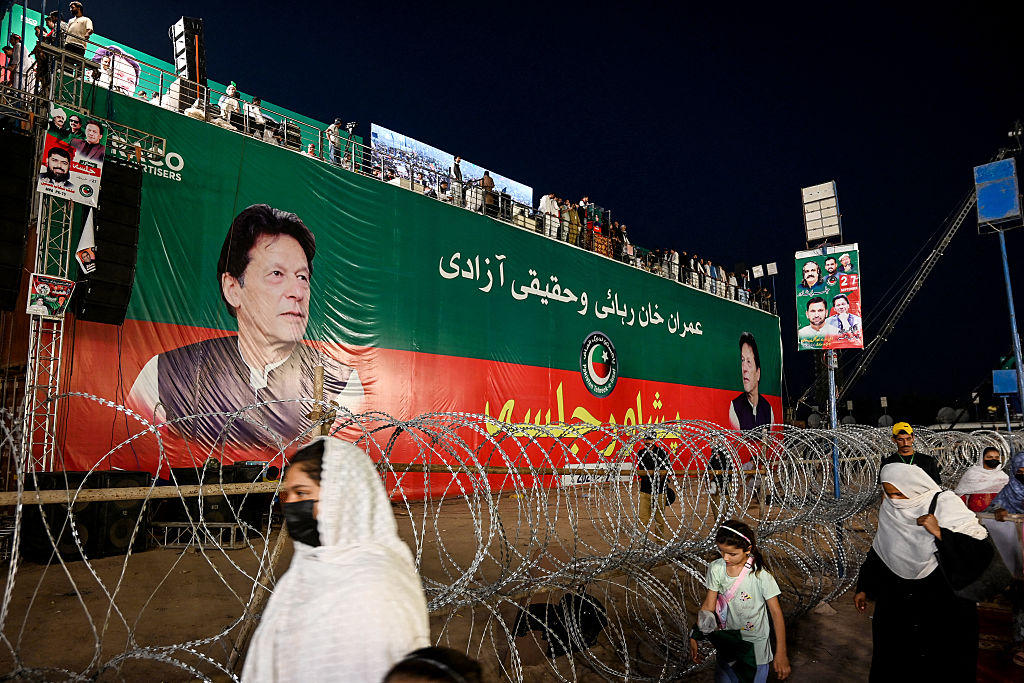
The military and the government have sought to erase Khan from television bulletins, from social media, from public memory. His pictures are not allowed on television in Pakistan. Even mentioning his name is forbidden. Some television news networks speak of him as, “Kasim’s dad,” a reference to Kasim Khan, one of his two sons in Britain. In June, when his sons announced that they wanted to come to Pakistan to campaign for his release, they were threatened with arrest. Now, the Pakistani authorities, despite court orders, have cut off Khan from contact with his family and his lawyers.
Imran Khan had a plan for a scenario like this. When he was starting out in politics in the mid 1990s, and his entire party could fit into a living room, he was seen lecturing his followers about how to deal with the army: all you need is 20,000 people coming out in each of Pakistan’s four largest cities, and these generals won’t know what to do. Later, he found out that the road to power in Pakistan always passed through the army headquarters. For a time, those same generals, bored with their revolving jail door inductions for prime ministers, looked at him with adoring eyes and, by all accounts, helped him rise to power by disqualifying or throwing his opponents into the same jail.
When he ultimately fell out with the generals, Khan did try to unleash those crowds of his imagination: his followers ransacked a general’s official residence and attacked military installations. The generals saw it as an attempted coup and decided to do what they do with failed coup makers. Khan was arrested. He seemed certain the crowds would arrive, batter down the jail doors, and he would be a free man. The crowds tried to gather and the generals unleashed their fury. Activists of Khan’s party were abducted, leaders hunted down, bought or bludgeoned into submission. Khan was left with a handful of family members and loyalists haggling for a weekly prison meeting. Now he has been denied even that luxury.
Meanwhile, in an unprecedented power grab, General Asim Munir, the Pakistan army chief, has consolidated power, recently orchestrating a constitutional amendment which gave him command over the navy and the air force as well, extended his term from three to five years, and granted him the privilege of staying in uniform for life, and immunity from prosecution for life. The generals reduced even their limited need for an obedient prime minister.
As this power grab unfolded beyond the walls of his prison cell, Khan must surely have realized the limits of his dream of a popular uprising. After all, he is 73, and the current military regime has snatched away the bargaining chips a former prime minister could use to get out of jail. In fact, even his opponents claim that he hasn’t cut a deal simply because there is no deal on offer.
Every lever of political power that Khan has pulled since his incarceration has come unstuck. His supporters have been appealing the courts where judges are too busy saving their jobs. They have been appealing to international human rights organizations and have set up vigils in Barcelona and London. His followers in America have been attempting to lobby the U.S. Congress and President Donald Trump for help with his release—a doomed effort, some might say, given Trump recently referred to Munir as, “my favorite field marshal.”
Back home, Khan’s political opponents, all of them escapees of the same jail where Khan resides, have cut their noses to spite his handsome face. After the recent constitutional amendment expanding Munir’s power, they have practically handed over the little political clout they retained to the military establishment. Keep him in and we’ll do everything you ask us to, they seem to be saying. Unsurprisingly, in a country with a long history of coups, the army is happy to have its pick of puppets to do its bidding without actually declaring military rule.
The legend of Imran Khan was born in 1992, when he led a rag-tag Pakistani cricket team on a losing streak to victory at the cricket World Cup. He motivated his team by urging them to fight like cornered tigers. He wore a T-shirt with the same slogan. Today, the military has that aging tiger in a cage and they believe they have already thrown away the key. The speculation about his health and well being may be misguided, but this much is clear: Now they want to drown out his weekly roars and rants from that cage.