

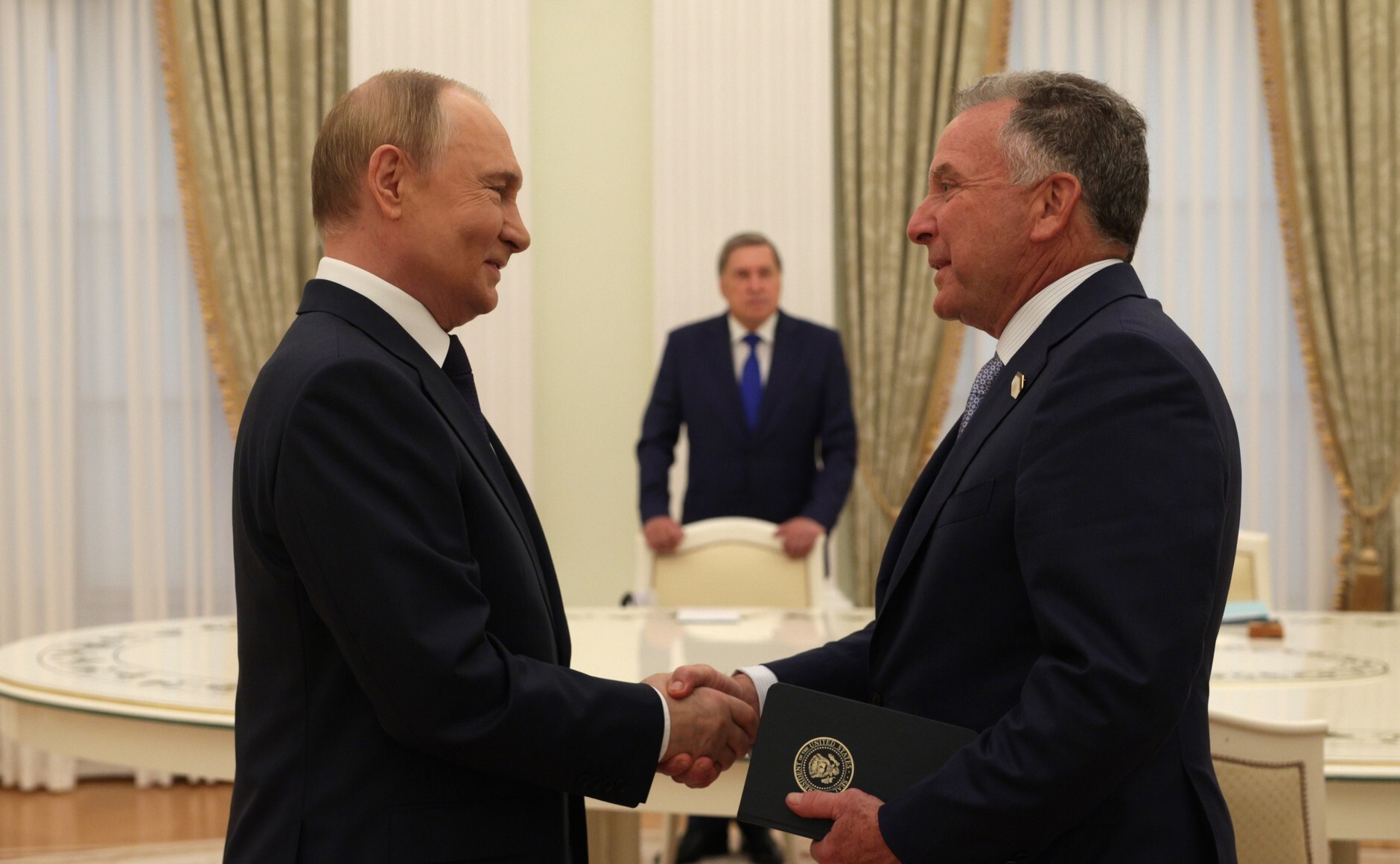
Russian President Vladimir Putin is set to meet with President Donald Trump’s special envoy Steve Witkoff in Moscow today to discuss the U.S.-led peace plan to end the Russia-Ukraine war. The pair will be joined for the high-stakes sit-down by Trump’s son-in-law, Jared Kushner.
The summit comes after Witkoff and Kushner, along with Secretary of State Marco Rubio, led a U.S. delegation in talks with Ukrainian officials in Florida over the weekend. Rubio said the meetings, which followed on from similar talks between U.S. and Ukrainian representatives in Geneva last week, were “productive,” but admitted there’s “more work to be done.”
[time-brightcove not-tgx=”true”]
“This is delicate, it’s complicated, and there’s a lot of moving parts,” Rubio told reporters after the sit-down. “Obviously, there’s another party involved [Russia] that will have to be a part of the equation, and that will continue later this week when Mr. Witkoff travels to Moscow.”
The Ukrainian delegation in Florida was led by a new negotiator, Rustem Umerov, who serves as the country’s National Security and Defense Council secretary. Umerov took over the helm from Andriy Yermak, who resigned as Ukrainian President Volodymyr Zelensky’s chief-of-staff last week after a raid on his home by two national anti-corruption agencies amid a widespread corruption scandal.
The Trump Administration’s 28-point proposal to end the Russia-Ukraine war leaked on Nov. 20, and has since been vigorously discussed by the two main parties, European officials, and the U.S.
Among the more controversial points of the proposal was the stipulation that Kyiv reduce its army and make significant land concessions—a request Ukraine has always adamantly ruled out as a possibility. The proposal also contained a pledge that Ukraine won’t join NATO, shutting down one of Zelensky’s long-time ambitions. Trump previously urged Zelensky to forgo Crimea and retire the idea of joining NATO. The U.S. President reiterated his stance during an interview with Fox News Radio on Nov. 21, arguing that Ukraine is already “losing land” and would likely lose that land “in a short period of time” anyway, should the conflict with Russia continue.
Given the land concessions suggested, there were concerns raised as to who authored the 28-point plan, with some lawmakers—both Republican and independent—suggesting that the proposal had been authored by Russia or its allies. Rubio staunchly rejected this claim, saying: “It is based on input from the Russian side. But it is also based on previous and ongoing input from Ukraine.”
After the proposal leaked, Zelensky lamented that his country had been faced with a difficult “choice” between losing its dignity or a key partner, the United States.
Zelensky has since worked on a “refined” peace proposal with U.S. officials including Army Secretary Daniel Driscoll, and has reiterated his rejection of significant land concessions, while also doubling down on his argument that frozen Russian assets be used to help rebuild Ukraine (an item that is suggested in the original U.S.-drafted proposal).
“Putin wants legal recognition for what he has stolen, to break the principle of territorial integrity and sovereignty. That is the main problem,” said Zelensky in a video address to the Swedish parliament last week.
Zelensky repeated those red lines again on Monday, during a press briefing alongside one of his most vocal allies, French President Emmanuel Macron. He also expressed his hope that he and Trump will share a phone call after the Putin-Witkoff summit.
The world leaders put on a united front, condemning Putin’s continued advance into Ukraine, with Macron urging: “Russia must stop the aggression. It has given no signal, no proof to that effect.”
Macron and Zelensky also spoke with Witkoff and Umerov during their time together on Monday, as well as various European supporters.
Meanwhile, some of Zelensky’s ardent European allies have expressed concern over the talks in Moscow, which Ukraine will not be involved in.
“We shouldn’t lose focus that it’s actually Russia who has started this war, and Russia that is continuing this war,” Kaja Kallas, the E.U. high representative for foreign affairs and security policy, told the media on Monday. “I am afraid that all the pressure will be put on the weaker side, because that is the easier way to stop this war when Ukraine surrenders, but this is not in anybody’s interest.”
Read More: Zelensky Says Ukraine Faces Losing Dignity as Trump Issues Deadline to Sign His New Peace Plan
The sit-down between Putin and Witkoff comes after a leaked audio recording appeared to show the U.S. special envoy advising a Russian official on how to best appeal to Trump. (Talking to reporters aboard Air Force One, Trump defended Witkoff, saying that although he had not heard the audio, it was merely a “standard form of negotiation” for a “dealmaker” to do.)
Now, with all eyes on Moscow as the high-stakes meeting comes to fruition, and with Ukraine and Europe anxiously awaiting updates, here’s a breakdown of the key issues at the center of the Russia-Ukraine peace talks—and where the Kremlin stands.
The proposed land concessions at the heart of the Russia-Ukraine stalemate
The original widely-leaked peace proposal sought a number of significant land concessions, prompting grave concern from Zelensky and his European allies.
A section labelled “territories” put forth that “Crimea, Luhansk, and Donetsk will be recognized as de-facto Russian, including by the United States” and emphasized that “Kherson and Zaporizhzhia will be frozen along the line of contact, which will mean de facto recognition along the line of contact.”
Among the most contentious of points was the notion that Ukraine would also hand over some of its own unoccupied territory.
According to the proposal, which has since been revised (although the amendments have not been made public) Russia would “relinquish other agreed territories it controls outside the five regions” and “Ukrainian forces will withdraw from the part of Donetsk Oblast that they currently control.”
In a statement shared with TIME on Nov. 21, White House press secretary Karoline Leavitt said the plan was formed “to find the best win-win scenario, where both parties gain more than they must give.” Rubio also stated publicly that “a durable peace [would] require both sides to agree to difficult but necessary concessions.”
Experts have warned that the proposed land concessions are of paramount concern.
The Donetsk Oblast is “Ukraine’s best fortified, best defended terrain at this time,” said George Barros, senior analyst of the Russia and Geospatial Intelligence Lead at The Institute for the Study of War (ISW), arguing the strategic nature of the possible concessions.
Russia is “adamant about having all of the Donetsk Oblast,” Barros told TIME.
“The Russians are therefore trying to have the Ukrainians diplomatically surrender terrain that the Russian military is very unlikely to actually seize through warfighting. And then once they have this terrain, they have the gate to the center of Ukraine,” predicted Barros. “If you give the Russians this terrain, it [increases] the likelihood of them being able to advance much deeper.”
Debates over territories are expected to be a core focus of the talks between Putin and Witkoff. But there’s little indication that the Russian President intends on compromising. (Putin’s August summit with Trump in Alaska notably ended earlier than expected, with no deal being reached.)
Putin said last week that pursuing a peace deal with Ukraine is “pointless,” so long as Zelensky is in office.
Mapping out his hardline conditions during a trip to the Central Asian republic of Kyrgyzstan, Putin celebrated Russia’s advancement on the battlefield and suggested that Russia will reach its goals by completing its military operations.
“If Ukrainian forces leave the territories they hold then we will stop combat operations,” he said. “If they don’t, then we will achieve it by military means.”
Putin’s comments underline the bitter stalemate between Moscow and Kyiv, as his demand that Ukraine surrender its own territory is met with Zelensky’s refusal to concede that land.
Read More: Zelensky Says Russia ‘Must Pay Fully’ for War in Ukraine as U.S. Agrees to Modify Peace Plan
Security guarantees—a shared focus of Zelensky and his European allies
“The war must be brought to a fair end. It is important to make progress on developing security guarantees and a long-term foundation for our resilience— for both Ukraine and Europe,” said Zelensky on Monday.
Zelensky has been bolstered by the support of his allied European counterparts, with security guarantees at the forefront of discussions.
While the leaked U.S.-drafted peace proposal included a pledge that “Ukraine will receive reliable security guarantees,” there was a vagueness surrounding such guarantees and how they would be enforced.
The Coalition of the Willing, a group of countries that support Ukraine, previously committed to deploying troops on the ground in Ukraine after a cease-fire. But Putin swiftly rejected the proposals for the so-called “reassurance force.”
Speaking at an economic forum in Vladivostok in September, he warned that any troops deployed to Ukraine would be “legitimate targets for destruction.”
The leaked peace plan—in its original form—also proposed that Kyiv reduce its army.
While this idea has, unsurprisingly, not encountered any backlash from the Kremlin, it has concerned European officials.
“If we want to prevent this war from continuing, then we should curb the army of Russia and also their military budget… the focus should be on the concessions that Russia will make,” argued E.U. high representative Kallas. “Ukraine has never attacked Russia. If aggression pays off, it will serve as an invitation to use aggression again and to use it elsewhere. That is a threat to everybody in the world.”