

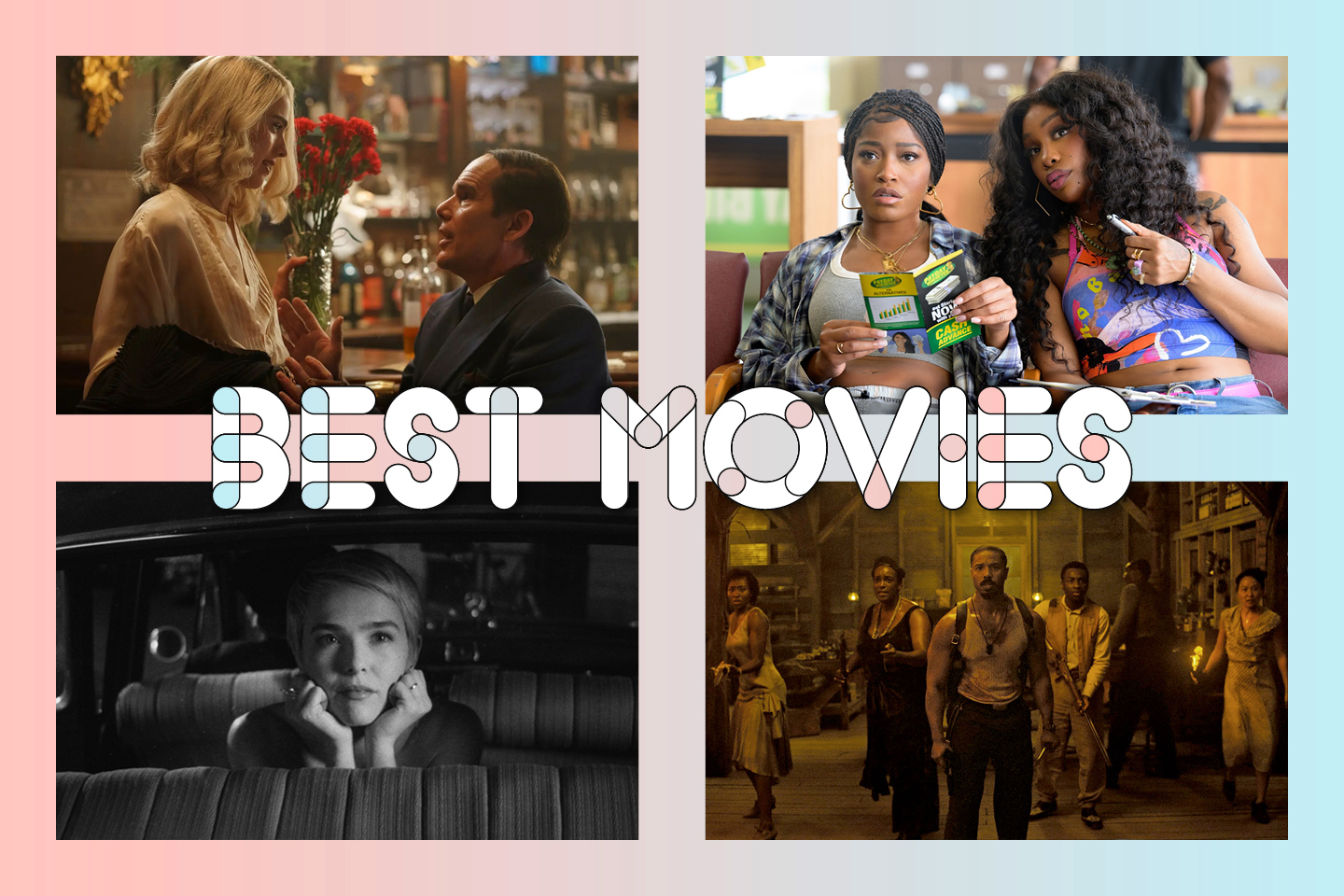
Movies can mean so many things to us, depending on the weather outside, the political climate, our mood on any given day. Sometimes, especially in an age where it’s often more convenient just to stay at home and stream, we take them for granted; we let them wash over us as we’re making dinner or tackling random household chores, treating them as entertainment afterthoughts rather than the main event. But every year, there are at least a handful of movies that demand we stop what we’re doing and pay attention, and 2025 was no exception. Here’s a selection of films that delighted me, that made me think—that stopped me. Perhaps they’ll bring some pleasure, and have some meaning, to you as well.
[time-brightcove not-tgx=”true”]
Read more: The 10 Best TV Shows of 2025
10. One of Them Days
Dead broke? You’re not alone. In one of the year’s most boisterous and breezy comedies, Keke Palmer and SZA play two scrappy denizens of Los Angeles who have just one day to scrape together the $1500 they need to pay rent on their cruddy apartment. They try to sell their blood, with disastrous results. When the clothes they’re wearing are ruined, they’re forced to dive into a charity bin—which means they spend the rest of their already-challenging day in godawful day-glo leisure wear. They find a pair of rare vintage Air Jordans they hope to resell, but that plan goes awry too. Still, they come out on top, making One of Them Days—directed by Lawrence Lamont and written by Syreeta Singleton—the kind of movie that miraculously makes you feel better about everything. We could all use more of those.
9. Kill the Jockey
You’ll find echoes of Buñuel and early Almodóvar in Argentine filmmaker Luis Ortega’s swingy, surrealist neo-noir about a perpetually sozzled jockey, Remo (Nahuel Pérez Biscayart), who’s forced into hiding when he suffers a serious accident involving the prized race horse of his mobster boss. After awakening with amnesia, he dons a fur coat, accented by a fetching head bandage, and adopts the guise of a woman he calls Dolores—perhaps the woman he’s always wanted to be. Kill the Jockey is playfully erotic, gorgeous to look at, and often confounding, the kind of inventive experiment we used to see all the time at the movies. Thank goodness someone out there is still making pictures like this.
8. The Mastermind
Kelly Reichardt’s almost-a-comedy about a hapless art thief in 1970s Massachusetts is a vivid portrait of a guy who’s had everything handed to him and still manages to be a lost soul. Josh O’Connor’s J.B. is an art-school dropout who decides, for nebulous reasons, to steal a quartet of valuable paintings. As he explains to his wife (Alana Haim), everything he’s done has been “mostly” for her and the kids—his lopsided reasoning is both gently funny and heartrending. Who wouldn’t buy anything O’Connor, with his darling secret smile, tells them? His slippery performance holds the movie steady. You never approve of J.B., but you feel something for him even so.
7. Sinners
Michael B. Jordan plays twin brothers, Smoke and Stack, returning to their Mississippi Delta hometown after surviving World War I and a stint in Chicago. They’ve got money to set up a juke joint. Opening night is a success, until—or perhaps because?—a trio of bloodsucking white folk musicians show up at the door. Writer-director Ryan Coogler has made a picture that’s alive to the mystery of music, with its power to both divide and unite. Sinners is gory, seductive, exhilarating—but it’s wistful, too, as if its characters had glimpsed a possibility of freedom, unity, and happiness that, some 100 years later, is still out of reach.
6. Roofman
In recent years, we’ve been talking a lot about a crisis of masculinity in American culture, though no one has been able to define exactly what that means. Derek Cianfrance’s bittersweet romantic comedy, based on real-life events, inches toward an answer. Channing Tatum is superb as Jeffrey Manchester, a onetime robber and prison escapee who builds a new identity for himself, finding a new love (played, with sunny gravitas, by Kirsten Dunst) and a new family in the process. Roofman is about all the things so many men yearn for, incuding the basic ability to support a family. That used to be a reasonable goal; Roofman shows us how elusive it has become.
5. Peter Hujar’s Day
One winter day in 1974, New York writer Linda Rosenkrantz—here played by the always-tuned-in actor Rebecca Hall—sat down with her friend, photographer Peter Hujar, to hear him recount every little thing he’d done the previous day. That interview is the foundation for Ira Sachs’ quietly radiant Peter Hujar’s Day. Ben Whishaw plays Hujar as a seductive jokester, keyed into both the banality and the cracked glamour of the artist’s life. Hujar died in 1987, of AIDS-related pneumonia; he found fame only after his death. Sachs’ film is both a great New York movie and a reminder that so much of the art we love emerges from the margins of everyday life.
4. Sentimental Value
Love, death, real estate: those three words sum up both the messiness and the glory of family life, and here, Danish-Norwegian filmmaker Joachim Trier surveys it all with tender regard. Renate Reinsve and Inga Ibsdotter Lilleaas play sisters, raised in a sprawling yet cozy house that has been in the family for years; when their mother dies, they’re forced to reckon with the selfishness and self-absorption of their long estranged filmmaker father (Stellan Skarsgård). Houses may hold families together for many years, but they’re never the real glue. What really sustains us is the person—whether it’s a parent, sibling, partner, or whomever—who always has your back.
3. Blue Moon
Few filmmakers can give us two fantastic pictures in one year, but Richard Linklater, one of our most unassuming movie craftsmen, has done it. Ethan Hawke gives one of the year’s great performances as Lorenz Hart, the onetime writing partner of composer Richard Rodgers (Andrew Scott). Blue Moon takes place on a single night: Rodgers’ Oklahoma!, written with his new collaborator Oscar Hammerstein, has just become a massive hit, and Hart is forced to acknowledge that his friend and colleague has moved on without him. Witty, imaginative, and brushed with a whisper of melancholy, Blue Moon is a perceptive portrait of one of the 20th century’s finest lyricists.
2. An Officer and a Spy
Roman Polanski is one of our most controversial, and reviled, living filmmakers. He’s also one of our greatest. In his exquisitely crafted account of the Dreyfus Affair—which premiered in Venice in 2019 but didn’t receive a U.S. release until this year—Jean Dujardin gives a sterling performance as Officer Marie-Georges Picquart, the counterintelligence official who fought to free Jewish army captain Alfred Dreyfus (Louis Garrel), wrongly accused of being a spy. At a time when our most cherished civic and moral ideals are threatened, an open mind is more valuable than ever.
1. Nouvelle Vague
Motivated by pure affection, veteran indie director Richard Linklater tells the story of how Jean-Luc Godard’s early masterpiece Breathless came to be: it’s 1960 Paris, and Godard (channeled here by magnetic newcomer Guillaume Marbeck) takes to the streets with an American star (the marvelous Zoey Deutch) and a raffish French boxer (a limber, sexy Aubry Dullin) to pull off a sublime act of guerilla filmmaking. Breathless changed movies forever, and Nouvelle Vague is the ultimate tribute, standing boldly on the side of beauty, of pleasure, of art’s power to keep us going.
Honorable Mentions: Kleber Mendonça Filho’s The Secret Agent, Paul Thomas Anderson’s One Battle After Another, Stephen Quay and Timothy Quay’s Sanatorium Under the Sign of the Hourglass, Lynne Ramsay’s Die My Love, Raoul Peck’s Orwell: 2+2=5, Boris Lojkine’s Souleymane’s Story, Clint Bentley’s Train Dreams, Harris Dickinson’s Urchin, Jim Jarmusch’s Father Mother Sister Brother, Spike Lee’s Highest 2 Lowest.