

Warning: This post contains spoilers for The Last Frontier
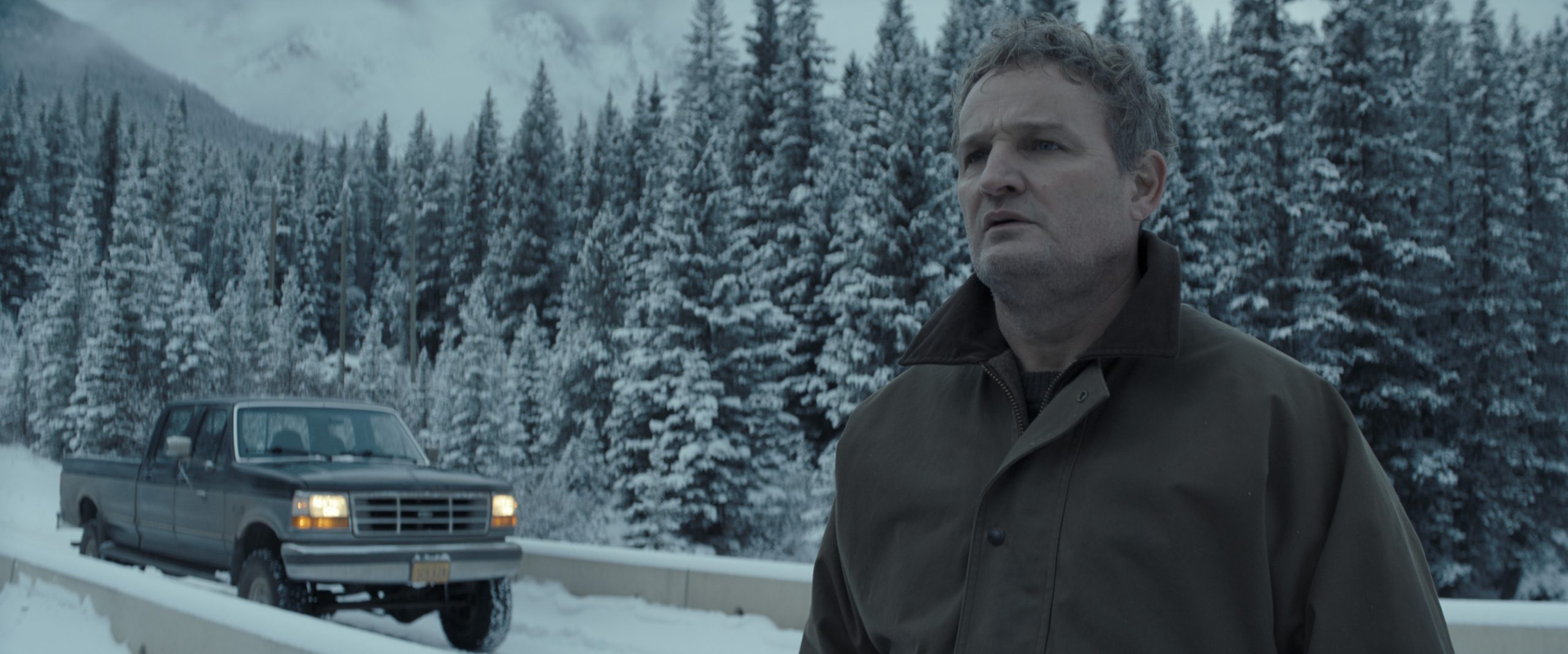
A snowmobile tears across concrete, metal on stone, sparks flying in the dark. U.S. Marshal Frank Remnick (Jason Clarke) hunts a ghost through the corridors of an Alaskan dam while above him, two women battle over what to do with the truth: one believes in accountability, the other seeks to contain it to preserve her power.
[time-brightcove not-tgx=”true”]
What began as a manhunt across Alaska’s tundra in The Last Frontier ends as something smaller and stranger. In the series premiere, a prison transport plane crashed in the wilderness, sending dozens of fugitives scattering into the snow and forcing Frank to hunt them while uncovering a deeper conspiracy involving rogue CIA agents and a covert assassination program known as the Atwater Protocol. The procedural chase becomes a reckoning with the limits of law, the weight of grief, and the realization that doing things “by the book” might be a way to avoid making any real decisions. Across 10 episodes, Frank’s pursuit moves from the hunt for killers and operatives to a search for something harder to capture: the daughter he couldn’t save, the rules he thought would protect him, and the moment he’ll have to decide what matters more: procedure or people.
For Clarke, the finale works because Frank’s journey feels “earned.” “He earns your respect. He earns your empathy,” Clarke says. “He’s flesh and blood, and he’s done the work to deserve your care.” It mattered that the man leading a massive manhunt is grounded in something recognizably human: grief over the loss of a child alongside a sense of duty. “We took this huge action-adventure and turned it into a heartfelt drama,” he adds.
Read more: The 10 Best TV Shows of 2025
When justice fractures
Chaos converges at the Nenana Dam. CIA Director Jacqueline Bradford (Alfre Woodard) corners operative Sidney Scofield (Haley Bennett) in the facility’s control room, desperate to stop the upload of Archive 6, a classified file containing evidence of the Atwater Protocol—an off-the-books government program that authorized targeted assassinations of U.S. citizens deemed national security threats. Bradford helped oversee it with Sidney’s late father, eventually twisting it to advance her own motives, erasing missions and silencing leaks.
Sidney’s father, an idealistic analyst, originally designed the Atwater Protocol as a last-resort defense system meant to save lives, not end them. When Bradford twisted it into a mechanism for political murders—and later killed him to protect that secret—Sidney made exposing the truth her life’s mission.
Their confrontation is brutal and intimate. Bradford swings an axe. Sidney fights back with the fury of someone who’s lost everything. When Bradford drives a blade into Sidney’s stomach, the ideological battle crosses a point of no return. They tumble over the dam’s edge together, suspended by a power cord hundreds of feet above icy water. Sidney finally kicks free. Bradford falls.
“It’s a betrayal,” co-creator Richard D’Ovidio explains. “Sidney’s father created this program, and the woman he trusted most used it to destroy him. That’s what drives everything—avenging her father and exposing what his legacy became.”
For co-creator Jon Bokenkamp, the sequence resolves the conspiracy but opens something deeper. “The bad guy’s story ends first,” he says. “All the emotional questions come after—the fate of Sidney, the choices Frank makes, the reckoning that follows. We put the action behind us so the people could take over.”
Sidney’s crusade was complicated by love: she’d fallen for her asset, Levi “Havlock” Hartman (Dominic Cooper), a fellow operative who once believed in the Protocol’s original ideals. Their marriage fractured when he defected, convinced that only chaos could reveal the government’s hypocrisy.
Meanwhile below, Frank chases Havlock through the dam’s tunnels on a snowmobile, the machine shrieking against concrete. When he finally corners him at gunpoint, Havlock offers a choice: arrest him or save Sidney, who’s bleeding out from Bradford’s blade. “You’ve got to let me go,” Havlock says. Frank curses and lets him run. The decision reframes everything, as duty gives way to mercy.
The book and its limits
When Frank reaches Sidney, her liver is torn, her oxygen levels dropping. The nearest hospital capable of a transfusion is hours away. A medevac can’t make it in time. Frank turns to the one thing that’s sustained him since returning to Alaska: his community. He’s spent weeks untangling a conspiracy that began with the Atwater Protocol and spilled blood from Washington to the tundra, and now the consequences of that secrecy have literally landed at his doorstep.
“That’s what we do, isn’t it?” he tells the villagers gathering around him. “We work together. We pool resources. We survive.”
A young boy suggests using sled dogs. Six huskies, strong enough to pull a tank, can cover ground no vehicle can manage. Frank bundles Sidney in blankets and takes the reins. The journey unfolds like a fever dream—snow and silence, trees towering on either side, the dogs moving like wind. At the trail’s end, a man named Shooter waits with a truck. But when he realizes the injured woman is Sidney—the one behind the plane crash that killed his friends—he refuses to help.
Frank cites violations to impound the vehicle: no license plate, open container, missing seat belt, and Shooter grudgingly relents. “He’s not a superhero,” Clarke says. “He can’t do it alone. He depends on everyone around him, and that’s what he’s always had. There’s a joy in that, in needing your family and your neighbors.”
Frank gets Sidney to the hospital before returning to the investigation base and hands the Archive 6 disc to a politician who can launch a full inquiry. Only after that does he drive back to see Sidney, who finally regains consciousness.
A choice made in stillness
In a hospital room, Frank sits beside Sidney, bruised and quiet. The tension between them—born from weeks of distrust and pursuit—softens into something closer to understanding. What emerges in the stillness is how differently they see themselves: Sidney sees her choices as a verdict. Frank sees his as a beginning. The gulf between them is the cost of everything they’ve endured.
“Hayley’s unpredictable in the best way,” Clarke says. “You lean in to see what she’ll do. She’s got that movie-star quality, and there’s an honesty to her that makes you find your way through the scene together.”
Sidney breaks the silence first. She’s thinking about what Bradford said before she fell: that Sidney didn’t become a monster—she always was one. “This whole time I wanted to believe I’d lost myself in this thing,” Sidney says. “I didn’t lose myself. This didn’t change me. It revealed who I’ve always been.”
When Frank asks if she truly believes that, she thinks about the air marshals who died in the crash, the townspeople caught in the crossfire, Frank’s friend Donnie. “They’re all gone because of what I did,” she says. “A deliberate decision that was made because of what I thought was right. My father would have despised that. He played by the rules. He lived by the book.”
Then Frank tells her the truth about his daughter Ruby. She didn’t die by accident but because of a choice he made, suppressing evidence to ensure a guilty man wouldn’t walk free—a decision that cost Ruby her life.
“When I put my little girl in the ground, I swore to myself that I would always do things from now on by the book,” Frank says.I have forced myself to do just that. Because when you do things by the book, you don’t actually have to decide anything, do you? There’s no subjective choice about what is right and what is wrong. You’re not responsible for any of the damage that your choices make. You’re just doing your job. You blame it on the book.”
He asks her: Is justice found in a book, or does it take people making tough decisions, sometimes impossible ones, in a moment? He doesn’t agree with everything Sidney has done, but he understands why she did it. And he thinks her father would agree she spent herself in a “worthy cause.” “They’re both two sides of the same coin,” D’Ovidio says of Frank’s stance. “They understand each other on a deeper level.”
The weight that sinks
Back at their cabin, the family gathers. His wife Sarah (Simone Kessell) and their son Luke (Tait Blum) have been talking. Neither could understand how to move forward after Frank’s confession about Ruby. “But in the end, that’s exactly what we need to do,” Sarah says. “Move forward.”
Frank says he’ll turn in the gun, the evidence connecting him to the case that got Ruby killed, and face the consequences. Luke asks if that will bring her back. If doing that will make them a family again.
“The only thing that will do is destroy this family,” Sarah says.
They tell him to get rid of the gun. Frank protests. These things come back, he says; they have consequences. But Sarah asks what about what she and Luke deserve? Frank has paid his debt. They all have. “If there is any more to be paid, then we pay it together.”
Later, Frank stands on a bridge and hurls the gun into the water below. The splash is small. The ripples fade. “It’s the right thing for the family, but it’s also covering up a crime,” Bokenkamp says. “The gun is a metaphor for the daughter and for the guilt he’s carried. Letting it go means forgiving himself.” He continues, “But it’s messy. These things have a way of coming back, and Frank knows that.” It recalls what happened at the dam, when doing the lawful thing and doing the human thing stopped being the same.”
That night, the family burns Ruby’s old post-its—messages like “I wish I was as brave as Dad”—in a fire outside the cabin. The gesture feels tranquil and final. The next morning, Frank paints the window sills white. He talks to Sarah about repairs. Luke jokes he can’t watch his parents dance. The world feels almost settled; then the phone rings.
Read more: The 48 Most Anticipated TV Shows of Fall 2025
What the cold preserves
It’s Havlock. After Frank let him go, authorities found a body in the wreckage of a charred car, incinerated beyond recognition. But the body wasn’t Havlock’s. He’d faked his death using a body he found in the woods. Frank knew; he just chose not to say anything. “I can live with the fact that you are alive out there somewhere in the world,” Frank says. “Just so long as you stay as far away as possible from my little corner of the world.”
“That’s going to be difficult, because you and your little corner of the world, Frank, are now the center of everything,” Havlock replies.
The camera closes in on Frank. Havlock watches through binoculars as FBI agents escort Sidney—bruised, handcuffed, smiling—into an armored truck. He and his men ready their weapons. “What can I say?” Havlock grins. “I love my wife.”
Inside the truck, Sidney smiles at the camera knowingly. The door closes. Funkadelic’s “Can You Get to That” plays as the credits roll.
Bokenkamp calls the ending “closure and a tease at once.” The story resolves, but its fallout keeps circling the characters who remain. D’Ovidio is more direct: “The past is never done with you.” The finale accepts that premise—history isn’t forgotten, and consequences refuse to stay buried. Truth always circles back.
What remains after the thaw
For all its scale—plane crashes, conspiracies, snowmobile chases—The Last Frontier closes as an intimate study in forgiveness. The story has always turned on what the Atwater Protocol stood for: a system of sanctioned violence, and the people who tried, too late, to undo it.
Frank is older now, slower, less sure. “His heart’s not as strong, but this time he’s not alone,” Clarke says. “He’s settled back into his community, because he can’t do it without them.”
The finale makes clear that redemption isn’t free—it demands truth, and it asks the people who seek it to live with the damage they’ve done rather than bury it in procedure or secrecy. Frank doesn’t erase his past. He stops pretending it didn’t shape him. The gun sinks in the river, Ruby’s post-its burn, and the family moves forward not because the pain is gone but because they’ve chosen each other over formal punishment.
Bokenkamp and D’Ovidio set out to make what they called the TV equivalent of comfort food. “There are a lot of really thoughtful questions that we’re raising—about justice, what’s right and wrong, and identity—but at the end of the day, we want this show to be a cheeseburger,” Bokenkamp says. “We want you to be able to step away from life for an hour and just disappear in this world.” Still, while The Last Frontier is entertainment that may not require homework, within its thriller framework, they carved out something deeper: a meditation on the gray space between law and love, duty and grace.
By the end, The Last Frontier delivers both. Beneath the frost and fire, it finds what survives after guilt, after loss, and beyond the law: the fragile need to begin again with everything you’ve learned and everything you can’t forget. The cold still bites, the past still calls, but Frank has finally stopped running. Within the hush of his family’s freshly painted cabin, there’s the feeling of acceptance and the promise of forgiveness.