

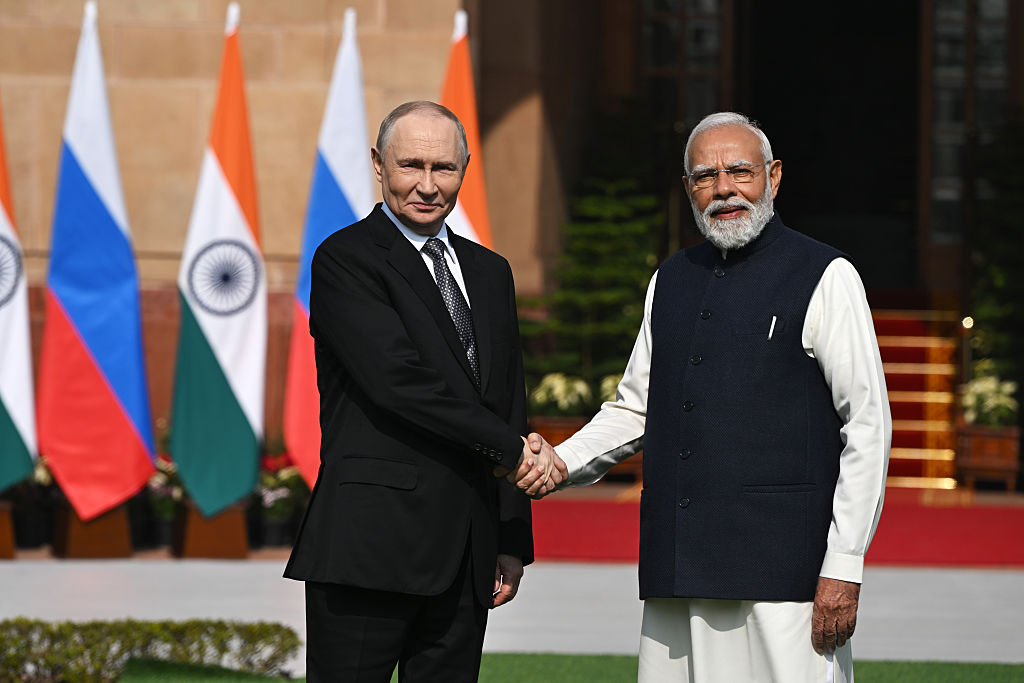
Even as Russia once again made clear this week that it had no intention of pursuing genuine peace negotiations on Ukraine, Vladimir Putin landed in New Delhi to a red carpet treatment. Indian Prime Minister Narendra Modi greeted the Russian leader on Thursday with a handshake and hug on the tarmac, breaking diplomatic protocol. The sight was a reminder that Russia is far from a geopolitical pariah in important parts of the world, and it was a chance for New Delhi to flex its strategic autonomy as relations with the U.S. sour.
[time-brightcove not-tgx=”true”]
President Donald Trump has slapped 50% tariffs on India ostensibly over its purchase of Russian oil, which is one of the highest rates in the world. U.S. Trade Adviser Peter Navarro has even gone as far as calling Russia’s ongoing war in Ukraine as “Modi’s war” because of how much India has ramped up its purchase of Russian oil—from 0.2% before the invasion to up to 40% today—and said that the “road to peace runs, in part, through New Delhi.”
As a consequence, even as India and the U.S. continue to pursue a trade deal, fault lines persist on trade, H1-B visas, Pakistan, and Trump’s push for a G-2 with China. That would undo decades of U.S. policy that saw New Delhi as crucial to containing Beijing’s rise in the Indo-Pacific.
Clearly, the Trump Administration’s approach to New Delhi has been myopic. This was on display not just in Putin’s current visit to India, but in Modi’s decision in September to attend the Shanghai Cooperation Summit in Tianjin, where he traded smiles and held hands with Putin and Xi Jinping. The way Trump and several senior advisers have publicly disparaged India in recent months has become a political liability for Modi at home, and prompted a debate over the way New Delhi has grown closer to Washington over the past two decades.
The agenda of Putin’s trip covers energy, defense, civil aviation, critical minerals, investment projects, and labor migration. India still wants Russia to expedite deliveries of critical military hardware—including two S-400 missile defense units from a 2018 deal that have faced delays due to the Ukraine war—and the two agreed to expand defense collaboration further. Yet the share of Russian arms imports to India has halved in recent years, even as Moscow remains New Delhi’s largest arms supplier. India’s consistent push to diversify its arms supplies alongside Russia being bogged down in Ukraine will constrain deeper bilateral defense ties going forward.
Read More: How Modi Misread Trump
This is the reason why trade and economics dominated the agenda of Putin’s visit. At a press conference on Friday, Putin and Modi outlined an economic cooperation program until 2030. But record trade levels are largely down to oil, and that seems to be coming to an end. The recent announcement of U.S. sanctions on Rosneft and Lukoil, Russia’s two largest oil firms, will significantly dampen that trade. Major Indian refiners have already paused new Russian oil orders. Moreover, bilateral trade is heavily skewed in favor of Russia, so New Delhi is now seeking greater market access in Russia, particularly in pharmaceuticals, machinery, and agricultural products. Putin promised “uninterrupted” fuel supply to charge the Indian economy.
In some ways, Putin’s trip is more symbolic than substantive. No major defense deals were inked between Russia and India. There were deals on critical minerals, civilian nuclear energy, and shipbuilding, but these are small fry compared to the current oil trade. And Modi was careful to say that India was not neutral on the Ukraine war and stood on “the side of peace.”
Both India and Russia face significant challenges as they navigate the evolving geopolitical and geoeconomic realities. Modi and Putin have made it clear that they intend to continue to invest in bilateral ties. They also seem to recognize that historical defense ties and a temporary surge in the oil trade cannot be the only pillars on which to engage. Washington may find solace in the many obstacles to deeper U.S.-India ties. But Putin’s trip should serve as a wakeup call to Trump that its approach toward India as of late is unlikely to work.