

In the 1980s, the U.S. negotiated the exile of world leaders like Haiti’s Jean-Claude “Baby Doc” Duvalier to France and Ferdinand Marcos from the Philippines to Hawaii.
Now, President Donald Trump wants Venezuelan President Nicolas Maduro out of power. Maduro’s “days are numbered,” Trump told Politico in an interview released on Dec. 9. His Administration considers Maduro the head of a government-sponsored cocaine smuggling syndicate. Since September, he’s blown up 22 alleged drug boats off Venezuela’s coastline, parked a carrier strike group in the Caribbean, and flown F/A-18 attack jets near Venezuela’s border. On Wednesday, the U.S. seized an oil tanker off Venezuela’s border.
[time-brightcove not-tgx=”true”]
The escalating military campaign has raised questions about the prospects of Maduro’s exit after 12 years in power, and what would happen to Venezuela’s 29 million people the day after. The gargantuan task of taking the reins of Venezuela’s government, shifting it away from a brutal dictatorship and keeping the peace is expected to largely fall to the opposition group led by Maria Corina Machado.
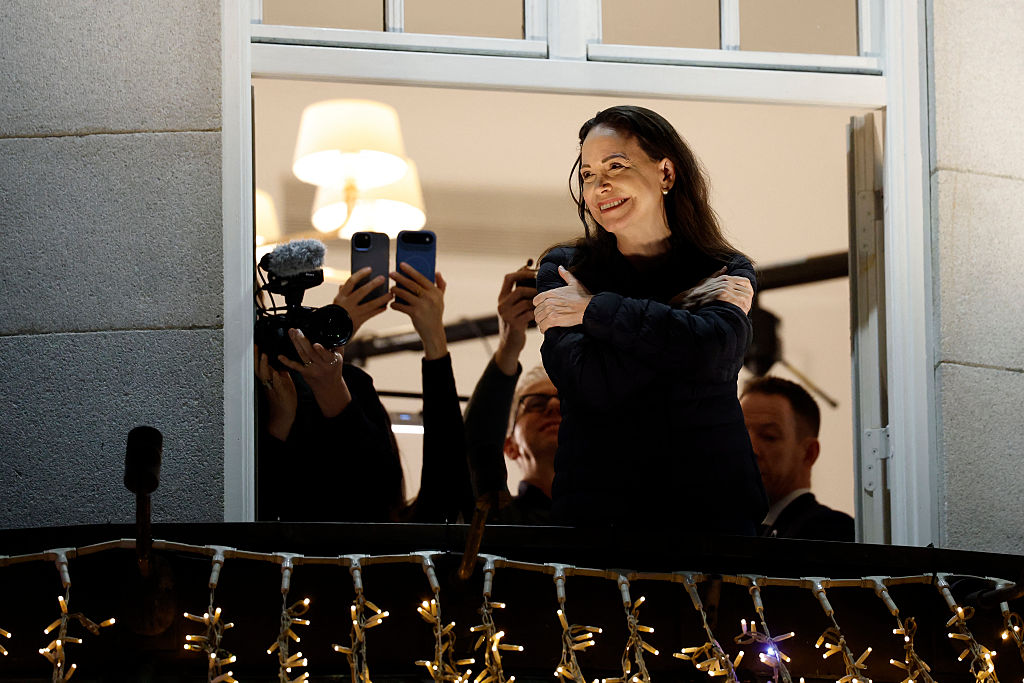
Machado has vocally supported Trump’s military campaign that’s targeting her country, even as Trump’s deadly strikes on alleged drug boats are seen as violating the laws of warfare. On Wednesday, after nearly a year in hiding, Machado appeared in public in Oslo, hours after her daughter accepted the Nobel Peace Prize on her behalf. In an interview with the BBC, Machado didn’t directly answer when asked if she would support a U.S. military strike on Venezuelan soil. “We didn’t want a war, we didn’t look for it,” she said. “It was Maduro who declared war on the Venezuelan people.”
Venezuela’s opposition has been planning for years to lead a transitional government in the event of Maduro’s ouster, a longtime Venezuelan democracy advocate who is close to Machado tells TIME. But their ability to follow through without significant investments from the U.S. is a source of debate, bringing to mind the kind of nation-building in Iraq and Afghanistan that Trump criticized on the campaign trail as not in the interests of the U.S.
Trump advisors have been preparing options for what to do if Maduro steps down or is ousted. Those include ways to support the opposition in setting up a transitional government and how to ensure Venezuela’s oil fields and infrastructure are kept safe. “It’s the responsibility of the US government to prepare for all scenarios around the world that may or may not unfold. To not do so would be a dereliction of duty, as we saw under the previous failed Biden Administration,” said a U.S. official.
In mid-November, Machado published a blueprint for what would happen in Venezuela if Maduro exits the stage. She envisioned a dramatic transformation for the country, including an end to the state-controlled economy under Maduro and a “free marketplace of ideas and enterprise” that includes a guaranteed right to property. She said that the country’s oil and gas sectors should no longer be controlled by state-owned enterprises but privately held. She called for protecting freedom of speech without fear of censorship or reprisal, and the ability of people to vote securely without manipulation. She called for the return home of the 9 million Venezuelans who have migrated away from the country in the previous two decades. “We will bring them home,” Machado wrote.
Part of Machado’s manifesto was ominous for Maduro. She asserted 18,000 people had been arrested as political prisoners under Maduro; many were tortured or murdered. His government “must be held accountable,” she wrote.
Altogether, it makes for a daunting to-do list, says Javier Corrales, a political science professor at Amherst College who has studied Venezuela extensively. “They are going to need a lot of help,” he says. “I worry that they may overestimating their capability to deliver on what they’re promising.”
Venezuela is a country with vast oil reserves and close military ties to Cuba and Russia. From Trump’s standpoint, an ideal post-Maduro Venezuela government would establish closer ties with the U.S., accept deportees, help cut off cocaine trafficking and provide access for American companies to its oil fields.
The Trump Administration’s position on Venezuela pivoted significantly over the course of 2025. Within days of Trump returning to office, he sent his envoy for special missions, Richard Grenell, to meet with Maduro. Maduro had just been sworn in for a third six-year term after an election late last year in which he lost but refused to accept the results. Machado ally Edmundo González was seen by international observers as the true winner.
After his meeting with Grenell, Maduro released six Americans who had been held in prison in Venezuela and agreed to accept the deportations of Venezuelans from the U.S. But negotiations stalled.
At that point, Venezuela’s opposition found itself desperate to shift momentum, according to the source close to Machado, who described the decision to support Trump’s military campaign as something of a last resort. The Venezuelan opposition is aware of the contradictions involved in cheering on Trump and boat strikes against its own people, but believe that possibly ousting Maduro outweighs those concerns.
Secretary of State Marco Rubio has signaled exile is Maduro’s only option, expressing skepticism that Maduro can be trusted to negotiate with the U.S. “Maduro has never kept a deal,” Rubio said during a Dec. 2 interview with Sean Hannity on Fox News. “If you wanted to make a deal with him, I don’t know how you’d do it. He’s broken every deal he’s ever made.”
In the event of Maduro’s ouster, U.S. officials have been vague on the extent of any resources it would provide Machado or others to stabilize the country or its new government. Corrales notes Machado’s ambitious vision will take significant resources.
“You need to rethink the Constitution and many of the laws in the country, in a way that produces power sharing and rather than granting the President full power,” Corrales says. “You have to make sure that the new folks do not become too punitive and that the displaced folks don’t become too threatened.”