

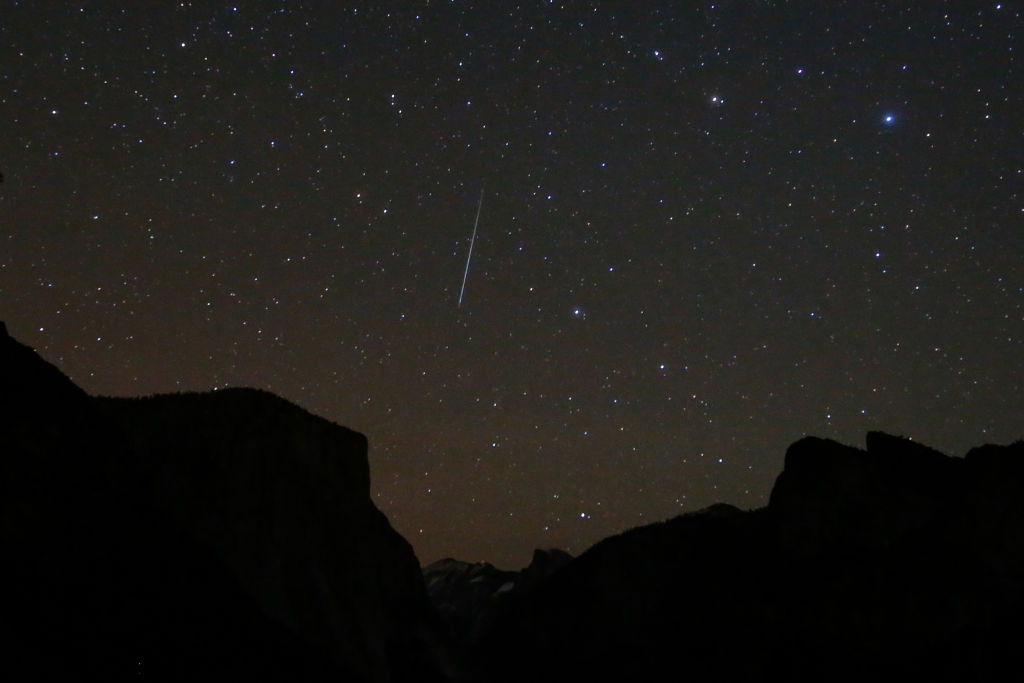
Every year around this time, bright, yellow fireballs streak across skies around the globe in the popular Geminids meteor shower.
The Geminids, considered one of the best and most reliable annual meteor showers, begins around mid-November each year and lasts for roughly a month, reaching its peak for a couple of nights in the middle of December.
[time-brightcove not-tgx=”true”]
This year, that peak is predicted to occur on Dec. 12th and 13th—meaning that if conditions are ideal, up to 120 meteors per hour could be visible in the night sky starting as early as 9 p.m. on Friday and Saturday.
Here’s what to know about this highly anticipated celestial event, and how you can see it best.
What is the Geminids Meteor Shower?
Meteors, the “shooting stars” that can sometimes be seen in the sky, are caused by pieces of comets and asteroids known as meteoroids coming into contact with Earth’s atmosphere when the planet passes through trails of cosmic debris orbiting around the Sun. The meteoroids enter the atmosphere at extreme speeds, causing them to disintegrate in fiery, colorful streaks.
Most meteor showers occur when the Earth travels through the dust trail of a comet. But the Geminids—bright, fast meteors that are usually yellow in color—come from an asteroid, called 3200 Phaethon.
The asteroid was discovered in 1983 and given the name 3200 Phaethon, a reference to the Greek mythological figure who drove the Sun-god Helios’ chariot, because its orbit brings it into close proximity to the Sun. It is considered a small asteroid: Its diameter measures just 3.17 miles—shorter than the distance separating New York City’s Empire State Building and the Statue of Liberty.
The Geminids themselves are named for the Gemini constellation, which lies in the part of the sky where the meteors appear to come from.
The Geminids meteor shower first began appearing in the mid-1800s. At that time it featured only 10 to 20 meteors per hour, though in the years since it has grown into a bigger and more noteworthy celestial event.
How can you best see it this week?
Unlike more localized celestial events, like the Northern Lights, the Geminids meteor shower is visible across the globe.
The shower can best be seen in clear skies, and without the interference of light pollution. To get a good view of it, you should seek to avoid cities and street lights. NASA recommends lying flat on your back with your feet facing south, taking in as much sky as possible.
Your eyes will adjust to the dark with time—NASA estimates around 30 minutes—and make it easier to see the meteors.
Activity usually to peak around 2 a.m. But the shower will last until dawn, and NASA advises viewers to “be patient.”