

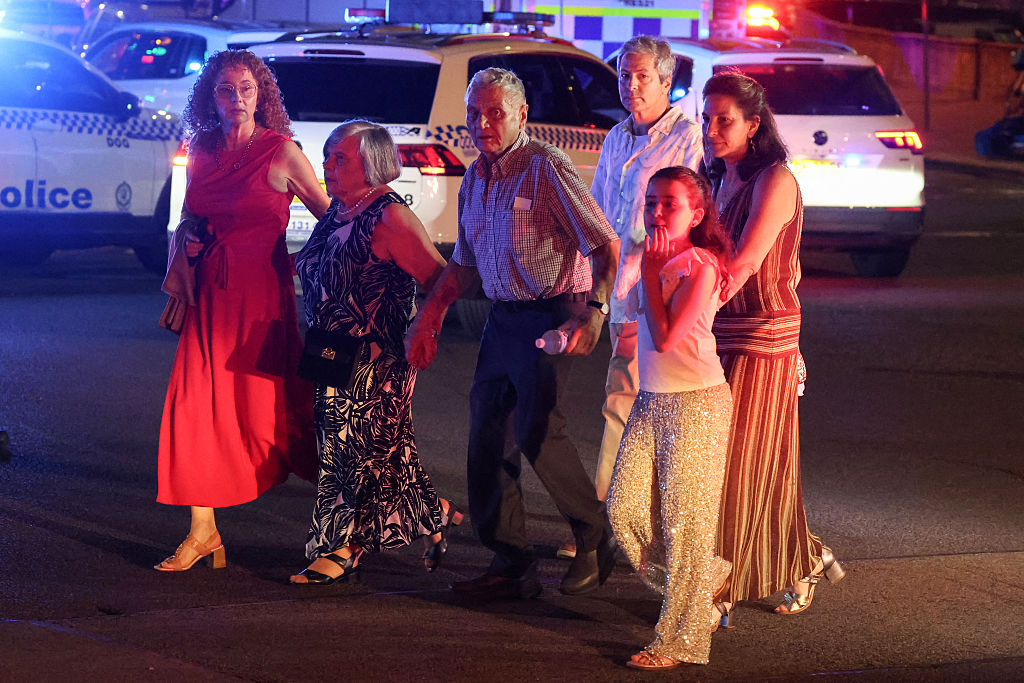
If Australia is famous for anything, it’s the beach, relaxed summer holidays, and its very strict gun laws. The shooting on Dec. 14 that targeted Jews celebrating the first day of Hanukkah at Bondi Beach—a long stretch of sand surf and outdoor cafes just four miles from the center of Sydney—strikes at the heart of all of it, all of the things that Australians take for granted.
Two men killed 12 people and shot at least 30 others at about 6:45 p.m. Witnesses say that the shooters were clearly aiming at Jews, reportedly from a local Chabad organization, who were having an event at the beach. A witness said one of the perpetrators was moving people out of the way before he shot, so he seemed to have clear victims in mind. One of the shooters was disarmed when a man tackled him from behind. He was taken into custody; the other shooter was killed.
Read more: A Timeline of Rising Antisemitism in Australia
This is the largest shooting to take place in Australia since a gunman opened fire at a popular tourist destination in Tasmania in 1996, killing 35 people. After that massacre, the conservative Prime Minister at the time, John Howard, instituted a set of gun-ownership reforms that have been credited with keeping the country largely free of gun massacres. Until Dec. 14, there had been just a single Australian mass shooting, defined as one in which more than four people, not including the shooter, were killed by a non-family member, in 29 years.
The reforms, which included a gun buyback as well as restrictions around licensing, storage, and the type of guns an individual could own, have been a point of pride for Australians, and have been refined and expanded in the intervening years. Even gun enthusiasts have expressed support for many of the protocols around gun ownership. The assumption of safety under which Australians operated, that their schools and malls and beaches were almost assuredly gun-free, has now been shattered.
That’s just one of the hard truths that Australians will wake up to on Monday morning. An even more complicated issue is that the Australian Jewish community is under attack. The local ethos of equality, often expressed as “Jack’s as good as his master”—meaning that the circumstances of birth or wealth should not dictate anybody’s treatment in society—is also now being deeply challenged.
Read more: What it’s Like to Own Guns in a Country with Strict Gun Control
The area east of Sydney in which the shooting took place has long been known for its vibrant Jewish community. The first Jewish kindergarten and Hebrew school was founded in North Bondi in 1942, and many of the city’s most highly regarded schools are in the surrounding suburbs. It was the first part of Sydney to have a lively cafe and art gallery scene. Central Synagogue, the largest in the Southern Hemisphere, is in nearby Bondi Junction. Police said the event, which marked the start of Hanukkah, had more than 1,000 in attendance.
While the Jewish community has flourished in Sydney, antisemitic graffiti and vandalism of cars, cemeteries, and places of worship have been on the rise, especially since the start of the Israel-Hamas war. Australian public sentiment has largely been condemnatory of the Israeli actions, and in September, Anthony Albanese, the moderate left Australian Prime Minister, formally announced that his government was recognizing the state of Palestine. After the shooting, he described the attack as “an act of evil antisemitism that has struck the heart of our nation.” But it is now glaringly apparent that the public anti-war sentiment has spilled over into local communities.
The fact that the shooters felt emboldened to carry out the massacre on what is probably Australia’s most famous and popular stretch of sand suggests that this was an act planned to cause nationwide, if not global attention. Bondi during the long Christmas vacation is like Rockefeller Center in New York City at the same time—thronged with people of all ages and nationalities, especially tourists, in a festive mood. A brazen shooting at such a high-traffic site is designed to cause maximum impact and fear. It’s worth noting this is not the first time an Australian has been involved in a religiously motivated massacre; the man who killed 51 Muslims at two mosques in Christchurch, New Zealand, in March 2019, grew up about 400 miles north of Bondi.
The only point of light for Australians is the man who crept up between the parked cars near one shooter’s location and wrested his gun away. Having taken possession of the weapon, he pointed it at the retreating shooter, but did not fire. Instead he leaned the gun against a tree, partly to alert the cops that he was not a risk, and partly in a manner that suggested that he wanted nothing to do with the armament. Australia’s gun laws have proved their worth. But they can’t do it all. Now the country must wrestle with its soul.