

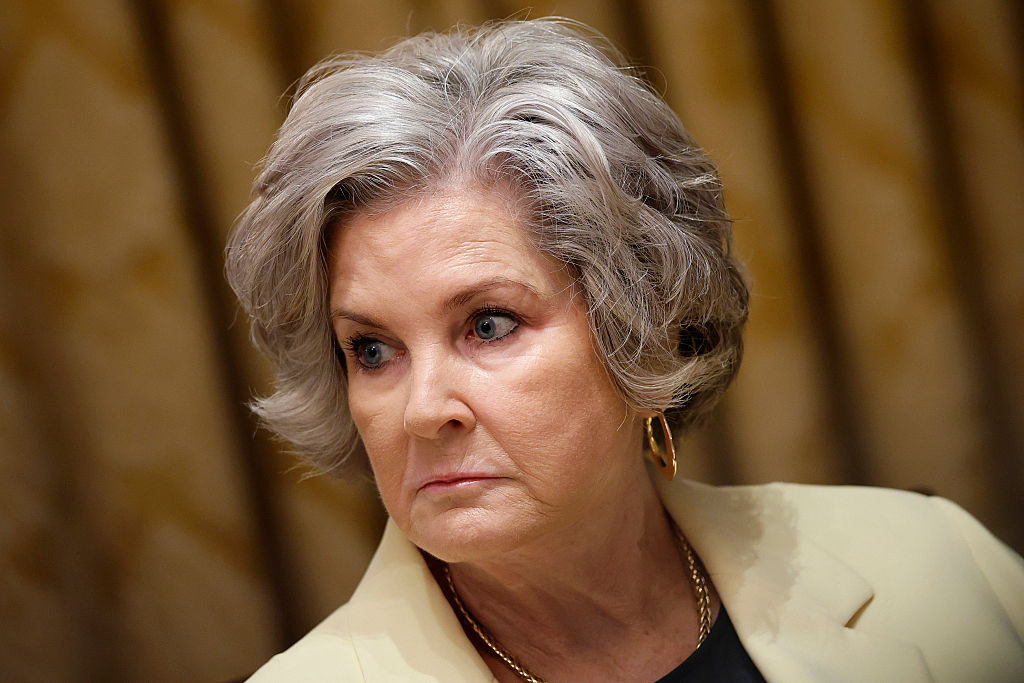
This article is part of The D.C. Brief, TIME’s politics newsletter. Sign up here to get stories like this sent to your inbox.
The night Donald Trump reclaimed the Presidency, he invited campaign manager Susie Wiles to the microphone to take her bow. She declined.
[time-brightcove not-tgx=”true”]
When his team decamped for a two-day public debrief about the campaign up at Harvard, Trump’s chief aide stayed back in Florida.
And when she was preparing to move into her corner office in the West Wing, Wiles repeatedly said she did not have patience for anyone looking to be a star. “My team and I will not tolerate backbiting, second-guessing inappropriately, or drama. These are counterproductive to the mission,” she told Axios before Inauguration Day.
All of which stand in sharp contrast to the image of Wiles that emerged unexpectedly on Tuesday after a series of 11 interviews with a student of White House chiefs of staff published by Vanity Fair. In them, Wiles dishes with remarkable candor and perhaps indifference to decorum about Trump and the team she leads on his behalf. While Trump has called her an “ice maiden,” she described him as having an “alcoholic’s personality” in that he “operates [with] a view that there’s nothing he can’t do.” (Trump famously is a teetotaler.) And while Trump has repeatedly touted her as “the most powerful woman in the world,” she returned the favor by acknowledging he is wrong about many, many things.
For someone who espouses a mantra that seems more fitting for the No-Drama Obama team, Wiles certainly flung some spice into the Washington stew with her chats, sometimes from her office and sometimes from her home laundry room. “I don’t ever seek attention,” she said in one interview.
Maybe. But the disclosures sent D.C. into its all-too-familiar guessing game of how much longer Wiles would stay in her job or what game she was playing. After all, Trump’s first four years cycled through four chiefs of staff and his three campaigns seemed to be constantly rebooting with rival personalities emerging as a first among equals. And Wiles, a shrewd lobbyist based in Florida, seldom makes unconsidered moves.
Still, Trump delights in this sort of drama. The former reality show host punishes folks not when they dispute his agenda but when they get credited for shaping it. On that last point, Wiles may have actually bought favor for comments that paint so many of the Administration’s decisions coming because Trump ordered them. Even as she shows sass, she is still primarily his enforcer, carrying out his wishes even when she disagrees with them.
On tariffs, Wiles said there was a mighty big disagreement on how to go forward. Trump announced them anyway.
On serving retribution to political foes, Wiles said she had a loose agreement that he would move on after about 90 days back in the White House. He has not.
On pardoning those 1,500 people convicted for their role in storming the Capitol on Jan. 6, 2021, she said she was outvoted.
On dismantling the U.S. Agency for International Development, she simply said she was aghast.
And on the ongoing saga of disgraced financier and convicted sex offender Jeffrey Epstein, Wiles said the boss was wrong when he continued to say former President Bill Clinton had a hand in the scandal. Meanwhile, Trump himself is mentioned in the files, Wiles acknowledges, adding it’s nothing nefarious.
For her part, Wiles said Tuesday that the author, Chris Whipple, took her comments out of context and omitted her praise for Trump and his team. It was, in her public estimation, a “hit piece.” The White House insisted Wiles continues to have the trust of Trump. Still, Wiles did not deny any of her quotes from the piece, including her calling Vice President J.D. Vance a “conspiracy theorist” who only joined Trump’s movement out of convenience, suggested that former Trump adviser Elon Musk was microdosing ketamine when he posted incendiary statements on X, and blamed Attorney General Pam Bondi for whiffing the Epstein story.
The seemingly unguarded moments were certainly giving juice to what a lot of Washington already suspected or even knew firsthand. Still, Trump hates to give his foes a win, and anything short of standing up for Wiles would break his M.O. After all, when his first national security adviser this term was called out for sending sensitive information about ongoing military operations by mistake to a reporter, he got sent to the United Nations.
Still, the moment of revelation from Wiles certainly was a break from the insider Trump beckoned to speak on election night down at his Florida club. “Susie likes to stay sort of in the back,” Trump said. “The ice maiden. We call her the ice maiden.”
She may now find herself iced out, at least for a brief bit while everyone calibrates the thaw.
Make sense of what matters in Washington. Sign up for the D.C. Brief newsletter.