

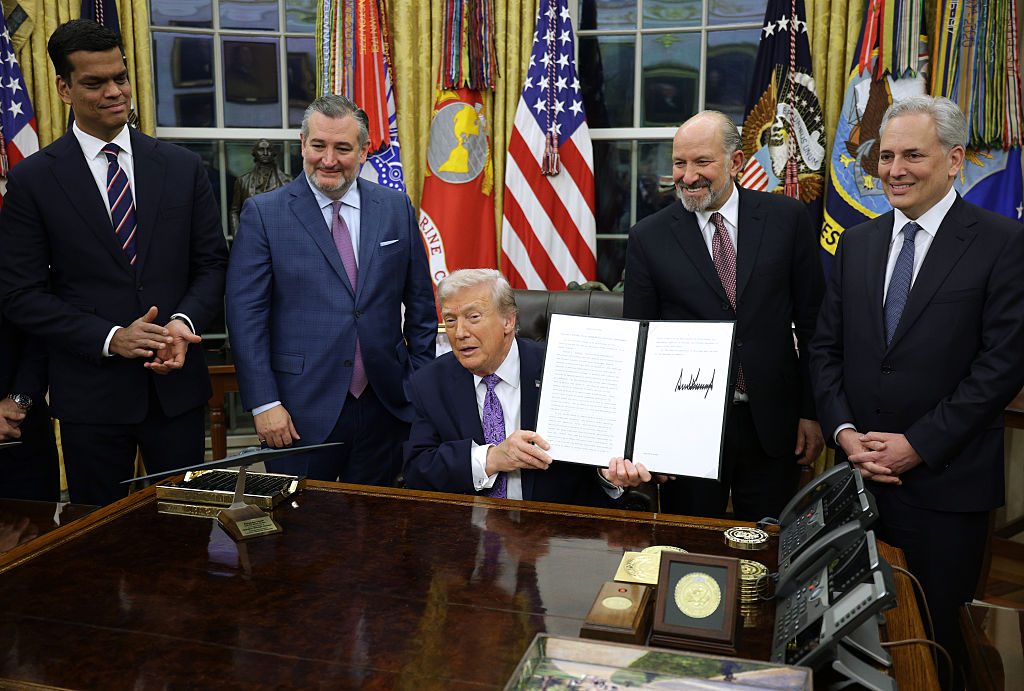
Last week, President Donald Trump signaled his allegiance to the AI industry yet again by signing an executive order that aims to block states from regulating AI.
The AI industry has long pushed for this sort of measure, as they worry that a patchwork of state laws would make it hard for them to do business. Many leaders on the left vehemently opposed the order, calling it an overreach of power and warning it would allow AI harms to spread.
[time-brightcove not-tgx=”true”]
But Trump is also receiving significant backlash from some conservative leaders, who believe in states’ rights and want to protect their constituents. Florida Governor Ron DeSantis, Utah Governor Spencer Cox, and Republican state lawmakers across the country have expressed concern with the executive order, and have signaled their intention to uphold state AI laws. Other conservative leaders worry that this battle will spill over into the midterms next year, forcing Republicans to take sides in an increasingly bitter internal policy fight.
“For red states, it seems like terrible optics going into the midterms to have the administration potentially sue you,” says Wesley Hodges, who directs tech policy at the Heritage Foundation, a prominent conservative think tank. “It widens the schism between populists and tech advocates in the conservative movement right now.”
‘Destroyed in its infancy’
Polling this year has shown that most Americans want guardrails around AI. But Congress has been slow to act, so dozens of states have forged ahead and passed over 100 AI-related laws related to safety, deepfakes, mental health, and more.
AI boosters hate this flood of laws, because they say it creates massive headaches to figure out how to comply with all of them at once. So several efforts have been made this year in Congress to preempt state AI laws. A moratorium on state AI laws was put into Trump’s “Big Beautiful Bill,” but failed 99-1 after some last-hour jockeying. AI proponents then tried to slip a clause preempting state AI laws into the annual defense spending bill, but the measure was extremely unpopular even among Trump voters according to a recent poll, and was dropped from the bill.
In July, TIME spoke to Arkansas Attorney General Tim Griffin, who vehemently opposed the moratorium proposal. “I am sensitive to those in the industry and government who say we need to make sure we don’t kill the goose that laid the golden egg,” he said. “But we also need to make sure the goose doesn’t attack us. And we need to make sure the golden egg is actually gold.”
On Thursday, Trump went ahead and signed an executive order that attempts to do what Congress could not. Writing on Truth Social, Trump said: “if we are going to have 50 States, many of them bad actors, involved in RULES and the APPROVAL PROCESS. THERE CAN BE NO DOUBT ABOUT THIS! AI WILL BE DESTROYED IN ITS INFANCY!” When he signed the order in the Oval Office, he was joined by AI and Crypto Czar David Sacks, who has pushed hard for preemption all year.
Read More: Persons of the Year 2025: The Architects of AI
The executive order directs the Justice Department to set up an “AI Litigation Task Force” to sue states over AI-related laws. It asks the Department of Commerce to look into whether it can withhold federal broadband funding for those states. Notably, the order excludes “child safety protections” from its scope, which many Republican lawmakers have forged in states across the country.
States to watch
It is yet unclear whether the actions proposed by the EO are constitutional. “The type of preemption that has been pursued is ahistorical: There’s not an example that we can point to that shows this kind of sweeping, broad ban on laws without a replacement standard,” says Hodges, who is the acting director of the Heritage Foundation’s Center for Technology and the Human Person.
On Dec. 8, Gov. DeSantis cast doubt upon the relevancy of the EO on X, arguing that such an order would not limit states’ powers to pass their own laws. (States’ powers are protected by the Tenth Amendment.) DeSantis issued a proposal containing consumer protections against AI harms last week.
So it is now up to the states to determine whether they want to pass and uphold AI laws, which could trigger a DOJ lawsuit—and then a battle in the courts over whether that lawsuit has standing. Many blue states will likely move forward with AI legislation despite the risk, perhaps partially to score political points.
But for red states, the calculus is trickier. Passing state AI laws, and enforcing them, could result in a head-on war with the president. The threat of this situation alone could lead to a chilling effect, in which state lawmakers refrain from writing AI legislation.
Brendan Steinhauser, a GOP strategist and the CEO of the Alliance for Secure AI, says he’s been talking to several leaders over the last week about the possibility of fighting back. “People are trying to figure out at the state level, ‘What if we called their bluff?’” he says. “I am encouraging all Attorneys General to defend the laws on the books and defend their states against potential Department of Justice lawsuits related to AI laws.”
One potential battleground may be Utah, which passed a law requiring companies to disclose AI use in industries like finance and mental health. Republican State Representative Doug Fiefia called Trump’s order an “overreaching act that fundamentally disregards the Tenth Amendment” to KSL.com.
Another state to watch is Texas, where several AI-related bills have been passed, including around AI-generated child pornography. One of the state’s most vocal lawmakers about AI has been State Senator Angela Paxton, who told TIME that she intends to continue working on state-level AI legislation. “I don’t think we should stop moving on our policies to protect our kids, consumers, privacy, and infrastructure the way we see fit in Texas before there is meaningful federal legislation,” she says. “We can’t be handcuffed by the federal government.”
Paxton is appreciative that the executive order exempts child safety laws from being targeted. And Sacks has flagged that the administration will only selectively pursue cases, and with a special eye to stamping out “ideological meddling” in AI systems from progressives. Still, Paxton is wary of the power that the order gives the executive branch to strike down statutes simply because they “don’t like your state law,’” she says.
The brewing political battle
The defiant messaging from Paxton and others could foreshadow a larger rift in the Republican Party over AI, which could spill over into the midterms. Steve Bannon, a MAGA leader, has devoted several segments of his podcast Bannon’s War Room to the topic, and described the order as “tech bros doing upmost [sic] to turn POTUS MAGA base away from him while they line their pockets.”
Brad Littlejohn, program director and policy advisor at American Compass, says that the executive order could backfire among Trump’s base, especially with traditional social conservatives concerned with tech’s impact on the family, as well as some working class populists. “I think the administration is taking a major political risk by positioning itself as it has,” he says.
Littlejohn points to the dot-com boom, in which the bubble burst before the internet could become a major productivity driver. “Even if the gamble pays off economically in the long term, the average American will see the downsides long before they see the upsides,” he says.
Matt Pankus, a small business owner in Austin, Texas who voted for Trump in the last three elections, says that he does not support any measure that tries to limit states’ abilities to self-regulate. “This country was set up so that states could do different things to see what works and what doesn’t,” he says. “I don’t like the idea of the federal government saying ‘you can’t protect your state.’ That’s insane.”