

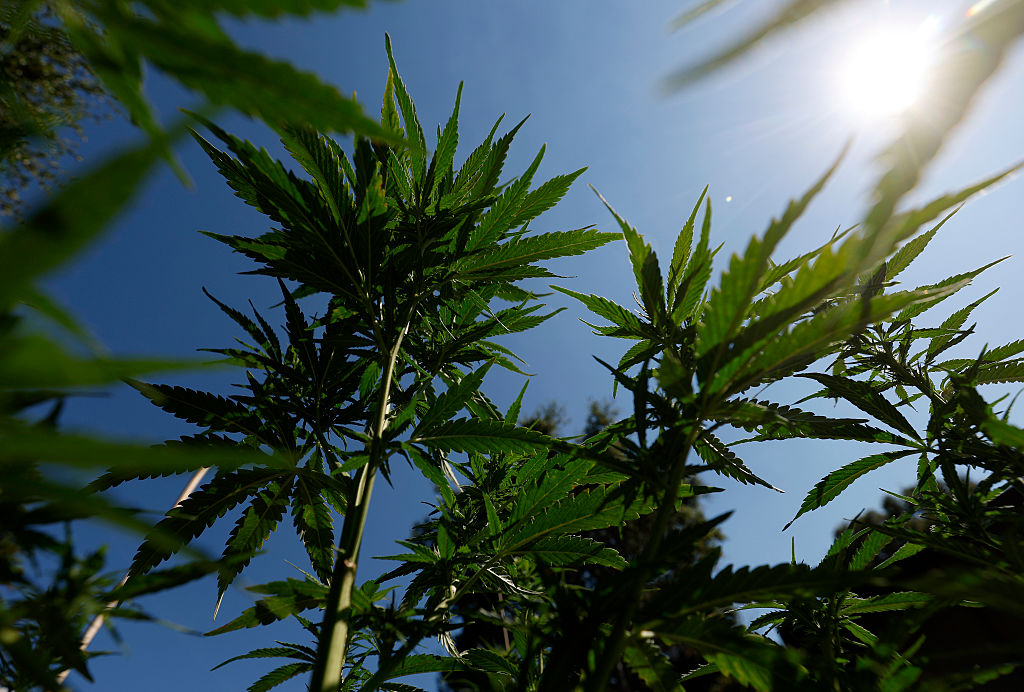
President Donald Trump has ordered federal restrictions on marijuana to be loosened.
The executive order, signed Thursday, would reschedule marijuana to a lower drug classification equal to that applied to some common prescription drugs. The change would not legalize the drug on the federal level, but would ease barriers for research using cannabis and could bolster the cannabis industry.
[time-brightcove not-tgx=”true”]
Trump had signaled on Monday that he was weighing the reclassification after months of his Administration reportedly looking into the move.
“This reclassification order will make it far easier to conduct marijuana-related medical research, allowing us to study benefits, potential dangers and future treatments,” Trump said in the Oval Office on Thursday. “It’s going to have a tremendously positive impact.”
Here’s what the order means for the drug, its uses, and the cannabis industry.
What does the order do?
The order directs Attorney General Pam Bondi to hasten the process of reclassifying marijuana from a Schedule I drug—the same classification as heroin and LSD—to a Schedule III drug.
Schedule I drugs are defined by the Drug Enforcement Administration (DEA) as having “no currently accepted medical use and a high potential for abuse.”
Schedule III drugs, meanwhile, are defined as having “a moderate to low potential for physical and psychological dependence.” Tylenol with codeine, for example, is considered a Schedule III drug, as are certain other prescription drugs like Valium, painkillers, appetite suppressants, and some steroid and hormone medications.
Does the order legalize marijuana?
The order would not legalize or decriminalize cannabis, which is illegal in any form under federal law.
Forty states and Washington, D.C., have legalized medical marijuana, while 24 states have legalized recreational marijuana. But while those uses are approved by a number of states, they are still considered federally illegal under the Controlled Substances Act, which requires that manufacturers seek approval from the U.S. Food and Drug Administration for their products to be lawful.
The order would not change this—companies would still need to get authorization in order to legally manufacture and distribute the drug.
Recreational use of marijuana and penalties for crimes related to the drug would not be impacted by the order.
How will the order affect cannabis research and businesses?
The order would ease regulatory hurdles for cannabis’s use for research purposes, which would likely boost efforts to study the drug and develop medical marijuana products.
Reclassification could also be beneficial for legal cannabis businesses, as they may be able to claim tax deductions for some business expenses. Cannabis companies would no longer be subject to Section 280E of the U.S. federal tax code, which bars businesses that deal in Schedule I and II controlled substances from deducting business expenses from taxes or claiming tax credits. Viridian Capital Advisors, a cannabis investment firm, reportedly estimates that the move could mean around $800 million in annual savings for the top 12 U.S. cannabis companies.
The change could also make it easier to advance other measures toward legalizing and regulating the industry with Trump signaling his support. Because of cannabis’ classification as a Schedule I controlled substance under federal law, many major banks and financial institutions have refused to provide full financial services to the industry out of fear of federal penalties. While rescheduling alone would not resolve these banking challenges, Trump’s support could tip the scales in favor of legislation like the Secure and Fair Enforcement Regulation (SAFER) Banking Act, a bill introduced in 2023 that proposes providing a “safe harbor” for financial institutions to lend to cannabis firms that are legal in their states.
“Rescheduling is not the whole enchilada but it would be a big deal,” Beacon Policy Advisors analysts wrote in a research note this week. “The momentum these changes would bring would itself be an ‘important domino’ in advancing other reforms.”
Why does Trump want to reclassify marijuana?
Trump became vocally supportive of easing federal marijuana restrictions during his 2024 presidential campaign as he pushed to court younger voters. He said in September last year that he planned to vote for a Florida ballot measure to legalize recreational marijuana that November.
Trump said on Truth Social at the time that as President, he would “continue to focus on research to unlock the medical uses of marijuana to a Schedule III drug.” He has also said that he supported letting state-legal cannabis firms hold bank accounts, empowering states to pass marijuana laws, and allowing universities to research marijuana.
“I believe it is time to end needless arrests and incarcerations of adults for small amounts of marijuana for personal use. We must also implement smart regulations, while providing access for adults, to safe, tested product,” Trump wrote.
Trump may again be seeking to increase his favor with young adults with the 2026 midterm elections in mind. The President’s support among 18 to 29 year olds is at just 29%, according to a poll by the Harvard Institute of Politics published this month, down slightly from 31% in a previous survey the institute conducted this spring.
What other efforts have been made to ease marijuana restrictions?
In October 2022, former President Joe Biden directed the Department of Health and Human Services and the DEA to review marijuana’s classification. In 2023, HHS recommended that marijuana be reclassified as a Schedule III drug, and the DEA began administrative reviews of the drug with a pending administrative hearing on the proposal. The hearing stalled in the transition to the Trump Administration, as cannabis companies claimed that the DEA was deliberately obstructing the measure.
The effort to reclassify marijuana has faced opposition from some Republicans, including nine GOP lawmakers who sent a letter to Bondi earlier this year saying that rescheduling the drug would “enable criminal activity and harm our kids.”