

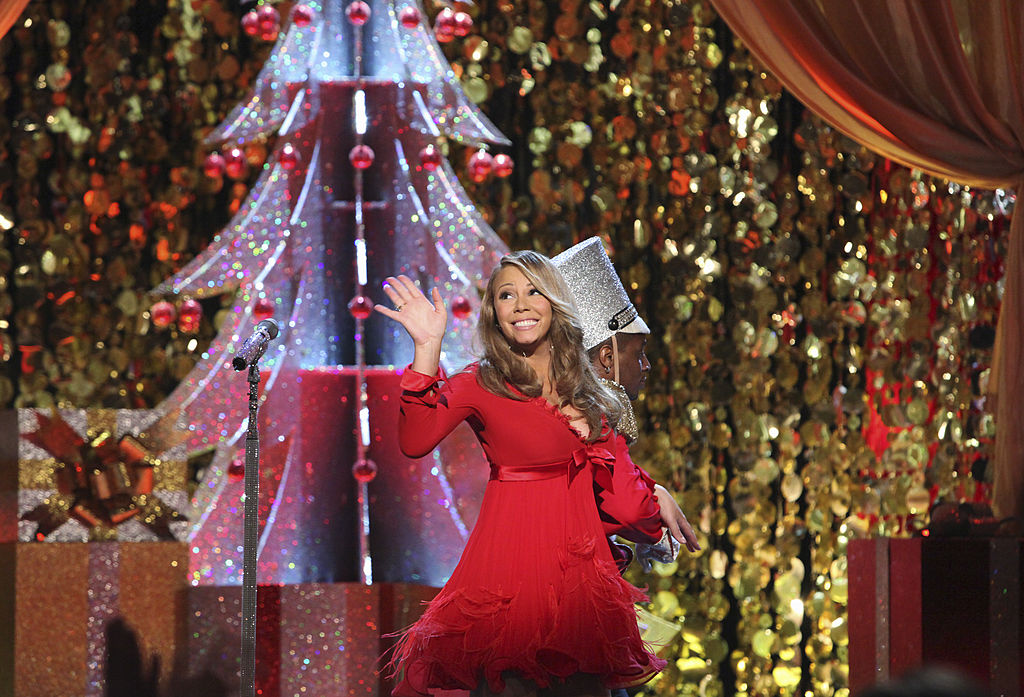
For the past 30 years, Mariah Carey has dominated the Christmas season with “All I Want for Christmas Is You.” Her reign, which appears to be never-ending, does not allow for a new song to take over the coveted top spot. With the exception of Michael Bublé, the majority of Christmas songs on the Holiday 100 are from artists of the 20th century, like Wham!, Brenda Lee, Bobby Helms, Nat ‘King’ Cole, and more. Which begs the question, is there even room for a new Christmas song, or are we doomed to listen to Mariah Carey year after year?
[time-brightcove not-tgx=”true”]
The answer to that question is tricky.
Even though Billboard changed its criteria to prevent chart stagnation, the annual revival of holiday classics on music streaming services leads to an ongoing monopolization of old Christmas songs at the top on the Billboard Holiday 100 chart. In the past, popular songs could maintain top positions on the Billboard charts because of repeat listening by users on streaming services, as well as continuous airplay on radio stations. Now, hit songs will leave the chart after an allotted number of weeks. For example, if a song drops below No. 5 after 78 weeks, it will be removed from the Hot 100. The same goes for if a song falls short of No. 10 after 52 weeks, it will leave the chart. If a song descends beneath No. 25 after 26 weeks, it will depart the chart.
Artists, whether independent or signed to a record label, heavily profit off of a music placement on a prominent Christmas playlist, which receives millions of streams from listeners in the mood for the holiday season. Christmas Hits, a playlist created by Spotify, has over 7 million saves on the streaming platform. Another playlist, Christmas Classics, has over 3 million saves. Both playlists are made by the editorial team at Spotify with the use of algorithmic data, compiled by user data. Unlike summer, when new songs are in, the winter season is hallmarked by nostalgia. Many listeners prefer to celebrate the holidays by listening to songs they grew up with instead of something new.
“When we first hear a new piece of music we tend to not like it very much,” Alexandra Lamont, a senior lecturer in music psychology at Keele University wrote in The Conversation. “But repetition breeds liking—and repetition both within a song and through repeated listening over days, weeks and months will usually increase our liking in a fairly rapid linear way.”
This repetition is why, for many artists, participating in the Christmas music business is worth it. According to Billboard, Christmas music brings in over $170 million dollars in annual revenue for music labels. The holiday themed subset of the music industry starts the day after Halloween and ends on Christmas.
Nov. 1 is the kick-off date for radio stations across the United States to play Christmas music on air. The tradition of Christmas radio began in the 1930s where households congregated in their living rooms to hear the New York Metropolitan Opera, and continued to grow as Christmas radio programming became a part of the war effort in the 1940s. The practice continued into the 21st century, where Internet radio stations, such as SiriusXM, have channels dedicated to Christmas music.
Among those who have attempted to craft a new Christmas classic—like Sia, Lizzo, and Gwen Stefani—Ariana Grande and Kelly Clarkson are the only artists with staying power in the Holiday 100. “Santa Tell Me,” Grande’s 2014 Christmas single, takes a contemporary hip-hop approach, while “Underneath the Tree”, Clarkson’s 2013 song, feels adjacent to the 1960s pop tunes created by Phil Spector. Both songs are over 10 years old. Another modern entry into the Christmas music lexicon is Pentatonix, who surpassed Bublé, Carey, Cole, and Crosby as the top holiday artist of 2022. And who can forget “Mistletoe,” Justin Bieber’s holiday single that was released at the height of his popularity as a teen idol?
One thing that these artists have in common is an intense fandom. Arianators, Beliebers, Pentaholics, and Kellebrities have followed the rise of their respective favorite artists from their first introduction to them on popular television shows, such as “Victorious”, “The Sing-Off”, “American Idol,” and the early days of YouTube. Their chart placement would not be possible without the intense efforts of their passionate fandoms, because new holiday classics are inherently not as impactful as the ones created during the Great American Songbook. New holiday music appears to be the capitalization of a hyper active fanbase by an artist and record label to bring in substantial end of the year revenue.
This year, Sabrina Carpenter, Mickey Guyton, the Jonas Brothers, and some notable names in pop have released holiday albums. Xavier “X” Jernigan, Spotify’s head of cultural partnerships, described it best in a 2018 interview with Rolling Stone: “If you create a Christmas classic and people love it, you will always be relevant,” he said. Another key to maintaining relevancy is pop culture appeal.
To date, there hasn’t been another Christmas song that has been able to tap into pop culture like Carey’s “All I Want For Christmas Is You.” It’s not for lack of effort. But the advent of streaming and the highly fractured media landscape does not allow for new Christmas songs to capture a new generation of listeners like it did in decades past.
If repetition is what our brains need to develop a desire for something over time, the onus is on us to introduce new Christmas songs into repertoire until they become commonplace. The reality is that no one will be able to achieve the levels of fame and notoriety that “All I Want For Christmas Is You” has, but it is possible for new Christmas songs to rise up alongside it.
Maybe when the first generation of Arianators and Beliebers become parents, and their holiday songs are nostalgic, there will be a changing of the guard. But, for now, the holiday season belongs to the Christmas classics.