

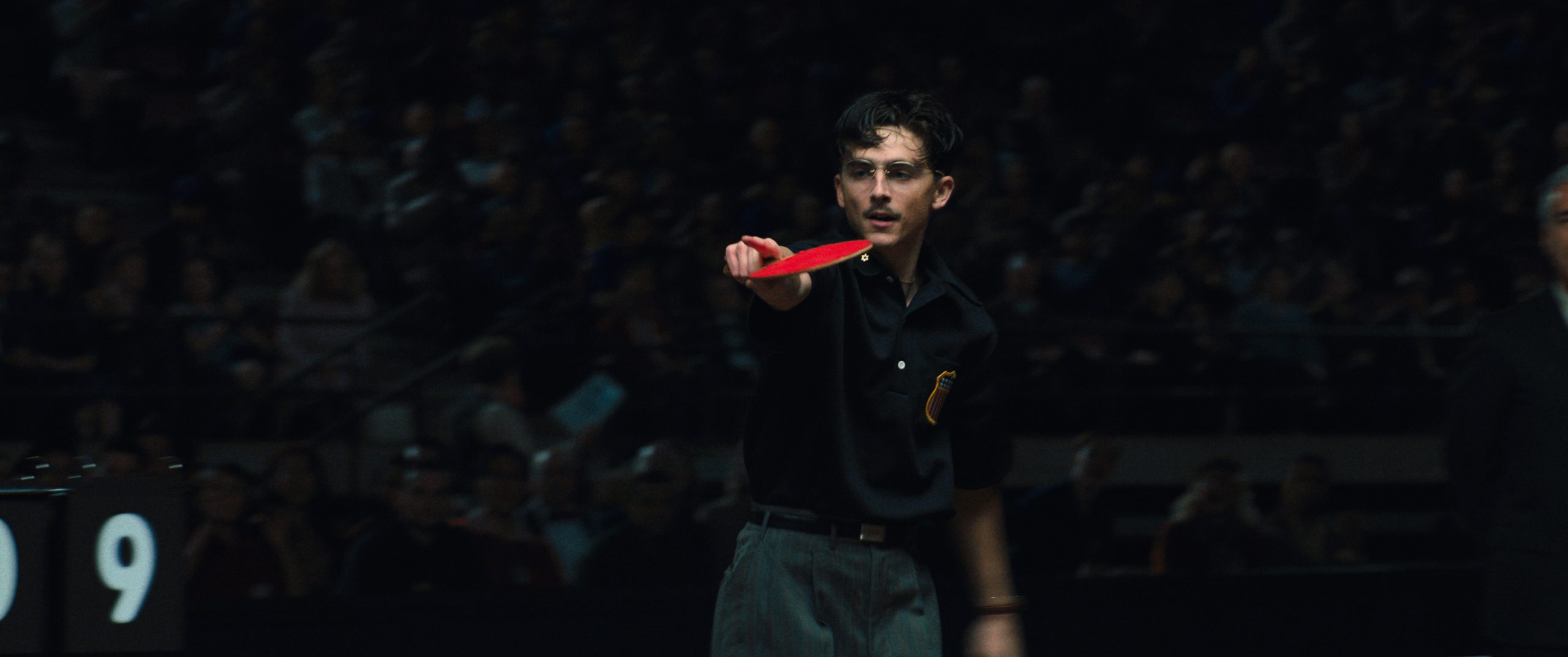
Warning: This post containers spoilers for Marty Supreme
In Marty Supreme, out Dec. 25, Timothée Chalamet stars as a table tennis player who ping pongs between playing in tournaments and hustling for money in the seedy underworld of New York City so he can travel to more matches.
[time-brightcove not-tgx=”true”]
His character Marty Mauser is loosely inspired by Marty Reisman, a New Yorker who was one of the world’s best table tennis players, boasting 22 major titles from 1946 to 2002, including two United States Opens and a British Open.
While plot details in the movie are fictional, Reisman was known for his constant hustling. Here’s what to know about the real athlete who inspired the film.
The Marty in Marty Supreme
The movie starts out with Mauser as a young salesman in his uncle’s Lower East Side shoe store, playing competitive table tennis as an escape. While Marty Reisman did work as a shoe salesman at one point—though not as a young man or for a family member—the job is supposed to represent one of the many short-term gigs he did over the years “largely as a way of avoiding roots or stability,” as screenwriter Ronald Bronstein puts it.
Director Josh Safdie first learned about Marty Reisman when his wife Sara bought him a copy of his memoir The Money Player. He pored over it, and with Bronstein, began to write a story about “a Lower East Side provincial dreamer who managed to thrust himself onto the postwar world stage through sheer force of will,” according to Bronstein. While the movie’s plot does not come from the book, Reisman’s memoir “opened a huge door into a forgotten and extremely colorful subculture of New York misfits, obsessives, hustlers, and dreamers.” Coincidentally, Safdie’s uncle played table tennis with some of these characters and even had Shabbat dinners with them.
Mauser was always trying to “put his stamp” on ping pong, according to Bronstein. He was skilled at putting on a show at every match so that people would bet on him. In the film, he even tries to launch a business selling orange ping pong balls so players can see them better than the white ones.
The film takes place in 1952, which was a significant year for Marty Reisman. He was defeated by a Japanese player at a world championship, though in real life, the tournament was in Mumbai, not London as the movie shows. Mauser wants a rematch, so he’s hustling to raise money to go to the world table tennis championships in Japan. At a time when America and Japan had recently been enemies in World War II, an ink-pen mogul (Kevin O’Leary) offers Mauser a free ride on his private jet if he agrees to play an exhibition game in Japan to help sell his pens in the country. Mauser doesn’t want to play that match, so he spends the movie trying to find a way to get to Japan on his own.
Frankly, Mauser is more interested in the ink-pen mogul’s movie star wife (Gwyneth Paltrow) than the exhibition game. As Bronstein describes the nature of this torrid affair, “In Kay, Marty sees a version of his future self: someone who has crossed the threshold into wealth, fame, and legitimacy in his chosen field. In Marty, Kay sees an opportunity to reclaim something she’s lost—a younger version of herself, before she traded risk and ambition for security.” Ultimately, Mauser sees her as a means to an end, stealing one of her expensive-looking jewelry pieces to pawn for his plane ticket to Japan, but in a moment of karma, he finds out it’s just a piece of costume jewelry. He ends up caving and doing the exhibition game, but he doesn’t get to play in the world championships because of an outstanding fine from a previous tournament.
The real Marty Supreme
Reisman was known as both “the Needle” for his quick strokes and also as “the Bad Boy of Table Tennis.” A 1974 TIME magazine profile described him as a “lifelong con man” regularly involved in “grand and petty larceny,” reporting that “in the gamblers’ world he remains a legend—the equal of Minnesota Fats and Bobby Riggs.” As TIME described his modus-operandi in 1974:
“To supplement his income, he played exhibition matches between halves of the Globetrotters’ basketball games and conned wealthy amateurs into believing that they could beat him if he gave away 19 points and sat in a chair. If the money was right, Reisman would even play with a garbage-can lid. After being approached by a Chinese smuggler during a Far Eastern tour, the kid padded himself with contraband gold, then ferried it across international borders.”
Needless to say, this is not the kind of table tennis played in parents’ basements. As Reisman described the stakes in The Money Player: “Table tennis players have to survive on their own wiles. A player who depended on exhibition fees could starve. The top players were either gamblers, smugglers, or both. I had already won more than 175 trophies, but I could not eat them.”
Before table tennis games, he liked to measure the net using a $100 bill, the New York Times reported in his obituary. He played at the famous table tennis club Lawrence’s in Midtown Manhattan, as the movie depicts, and he also ran his own parlor on the Upper West Side from the late 1950s to the late 1970s, patronized by actor Dustin Hoffman, author Kurt Vonnegut, playwright David Mamet, and chess player Bobby Fischer.
He had a colorful style, sporting vintage fedoras and Panama hats. He performed a comedy routine at Harlem Globetrotter games, in which he and his partner Doug Cartland would hit balls across the net with frying pans and the soles of their sneakers while “Mary Had a Little Lamb” played in the background.
Reisman played table tennis up until his death in 2012 at the age of 82. At the time of his death, he was president of an organization he founded Table Tennis Nation to promote the sport. Nine months before his death, he stood by his hustling, telling the New York Times for a profile, “I took on people in the gladiatorial spirit. Never backed down from a bet.”