

This article discusses plot points from Stranger Things Season 5, Part 2.
Try to remember what it was like to be alive in the summer of 2016. As the West struggled to absorb the shock of Britain’s vote to leave the European Union, a humanitarian crisis was unfolding in Aleppo. Barack Obama was still President of the United States, and Donald Trump was still months away from being elected as his successor. Just about every trusted pollster favored a Hillary Clinton victory that would—after a stressful election cycle fueled by inflammatory rhetoric, and despite a media frenzy surrounding Clinton’s emails—presumably preserve democratic norms. X was still Twitter, and most people would’ve laughed off the idea of radicalization via Facebook and YouTube. On July 14, an Islamic State terrorist drove a truck into a crowd of revelers at a Bastille Day celebration in Nice, killing 86 people.
[time-brightcove not-tgx=”true”]
The next day, as a military coup failed in Turkey, Netflix debuted Stranger Things. Created by relatively unknown identical twins Matt and Ross Duffer, and featuring just one marquee star in Winona Ryder—whose mere presence tied the show to Gen X cult classics like Beetlejuice, Heathers, and Mermaids—it landed as a family-friendly gift from Planet ’80s, wrapped in blinking Christmas lights and soundtracked by the Clash. Amid what seemed to many, at the time, to be a chaotic blip rather than an extreme new normal for the American experience, people sought distraction to survive the next few months. Also, at that early stage in the transition from linear to streaming, summer was still a dead zone on the TV calendar and the ability to binge a full new season of programming had yet to lose its novelty. Add in adorable kids, a nostalgic setting, scary monsters, references that lit up the pleasure centers of Stephen King, John Carpenter, and Steven Spielberg fans, and of course Stranger Things became Netflix’s first homegrown mega-franchise. But nearly a decade later, in the prolonged lead-up to the series finale, it’s hard to appreciate it as anything but the bloated franchise it’s become.
Impossible though it might be to return to a naive summer 2016 headspace, revisiting the Stranger Things premiere did help me appreciate what I once saw in it. Running just over 45 minutes without the end credits, it’s a remarkably tight, vivid introduction. The episode famously opens with sensitive middle schooler Will Byers (Noah Schnapp) getting abducted by a shadowy creature on his way home from a 10-hour Dungeons & Dragons session with his three sweet, nerdy friends and ends on that trio encountering a superpowered girl their own age, known only as Eleven (Millie Bobby Brown), who has escaped from a local research lab. But what’s really impressive, all these years later, is everything that happens in between. Tracing roughly 24 eventful hours in November 1983, the Duffers convincingly build out the world of Hawkins, Ind.—a fictional everytown that houses a gateway to a nightmare alternate dimension.
As gold-tinged cinematography situates us in an analog past and the eerie buzz and flicker of malfunctioning lights becomes a motif, viewers don’t just meet the sizable cast of characters. We also discover who they are in the context of Hawkins: their relationships, how the community sees them. The boys are bullied, Dustin Henderson (Gaten Matarazzo) for his speech impediment and Lucas (Caleb McLaughlin ) because he’s Black. Will’s mom, Joyce (Ryder), and sullen big brother, Jonathan (Charlie Heaton), feel the stigma of being a working-class, single-parent household in a town where intact, financially comfortable families like Will’s friend Mike Wheeler’s (Finn Wolfhard) are the norm. Mike’s older sister, Nancy (Natalia Dyer), is our entry point to Hawkins High; a pretty striver, she’s recently been distracted from academics by a fling with popular jerk Steve Harrington (Joe Keery). As Joyce reports Will’s disappearance to the police, we meet the chief, Jim Hopper (David Harbour), a divorced alcoholic drowning in grief over his daughter’s death. These two adults have a prickly chemistry. We see enough of Hawkins National Laboratory, presided over by Matthew Modine’s icy Dr. Martin Brenner, to know something sinister and supernatural is afoot. When an escaped Eleven finds her way to a diner (the image of a bald Brown in a hospital gown shoving fries into her mouth is indelible), Brenner’s team impersonates social services, kills the kind proprietor, but fails to apprehend her.
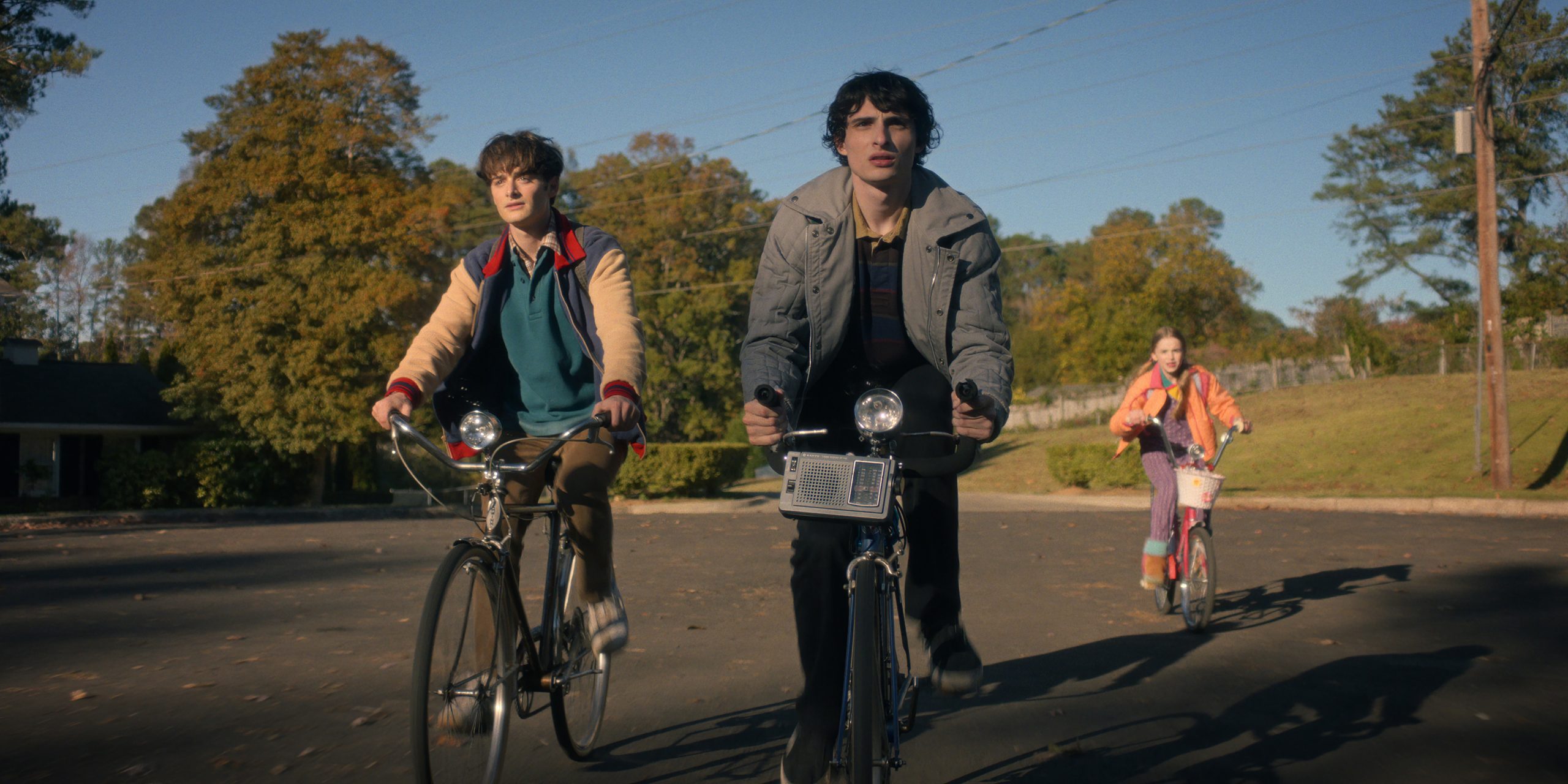
No one, except maybe kids too young to remember the 20th century, mistook Stranger Things for being original. But it did feel fresh. Its appeal was in the affection and exuberance with which the Duffers wove together their obvious influences: E.T.’s courageous kids on bikes, Ryder’s connection to the goth coming-of-age fantasias of Tim Burton, the monster-heavy pop horror of Carpenter and King, adolescent sociology that called back to John Hughes and Freaks and Geeks. The show’s characters fit old archetypes, but there was enough emotional specificity—in Will’s softness, in the pleasure El took in discovering mundane things, in the way Joyce’s love for her son won out over her exhaustion—to make us care about them. The plot was simple yet enticing: Will’s abduction and El’s arrival draw the characters into a supernatural, hellscape doppelgänger of Hawkins, the Upside Down, from which Will is rescued with a psychokinetic assist from El. Eight episodes, none of them much longer than the standard broadcast hour minus commercials, turned out to be the perfect length for a bingeable story that fleshed out the creature features of decades past by making Hawkins an enjoyable, if spooky, place to be.
Stranger Things was never such a fun hang again. It immediately became a franchise—exactly what Netflix needed to compete amid the launch of platforms like Disney+ and HBO Max, whose vast studio-based libraries encompassed Marvel, DC, and Star Wars titles, and more. The series gave rise to official aftershows, podcasts, video games, a Broadway prequel, and enough product tie-ins to fill a wood-paneled Hawkins basement. (An animated spin-off, Stranger Things: Tales From ’85, is due out next year.) More disappointingly, it took the narrative shape of a franchise, abandoning the first season’s economical storytelling as it milked every character beat and plot twist and new setting and budget increase for maximum monetizable content. When the Duffers pitched a second season of what they’d once envisioned as a limited series, Netflix encouraged them to stretch those ideas over four more installments. You can tell.
Season 2, which arrived just in time for Halloween weekend 2017, mostly felt like a more expensive, scaled-up version of Season 1, with an ill-conceived extra episode that sent El to Chicago and introduced so many new characters that viewers immediately clocked it as a backdoor pilot. The third season distinguished itself by adopting an era-appropriate mall as its main setting—a novelty only partially eclipsed by the heaps of product placement a retail environment enabled. Not every change that came with this expansion was for the worse; as the cast grew up and some of the original kids could no longer use cuteness to conceal middling talent, Stranger Things added more skilled performers, like Sadie Sink and Maya Hawke.
Released nearly three years after the demise of Starcourt Mall, in 2022, Season 4 marked another steep decline in quality. Streaming wars that had accelerated during pandemic lockdown had even the industry leader thinking more strategically; Netflix released the first seven episodes of its tentpole in May but saved the last two for July. Runtimes that had been creeping up since Season 1 clocked in at under seven hours exploded to roughly twice as long, culminating in a 142-minute finale so sluggish, it was impossible to watch in a single sitting. The cast fragmented, with the Byers family and El trying to start over in California while Hopper languished in a tonally dissonant Soviet gulag, as though the Duffers didn’t realize that what people loved most about Stranger Things was its grounding in Hawkins. Combined with dialogue that rehashed exposition more than it developed characters and lazy editing that stretched out scenes for far too long, it made the season feel excessive and self-indulgent but also weirdly nebulous. The best thing you could say about these episodes was that they introduced a new generation to Kate Bush’s masterpiece “Running Up That Hill (A Deal With God)”—though by the end of 13 hours the song had become as played out as the storylines.
If Season 2 was a costlier but inferior version of Season 1, then Season 5 is what Season 4 might have been if Netflix hadn’t felt the need to draw out a plot that was already thrice redundant. Another three-year hiatus, during which some actors who’d been tweens when they started making the show got married, had babies, and directed feature films, gave way to a tortured release schedule: four episodes the day before Thanksgiving, three on Christmas, and a two-hour finale still to come on New Year’s Eve. This time, everyone is back in Hawkins—now physically torn asunder, occupied by the military, and permeable to hostile leakage from the Upside Down—preparing for a final showdown with Vecna (Jamie Campbell Bower), the evil teen turned otherworldly ur-villain who was bruised but not vanquished in the Season 4 finale. Naturally, nothing less than the fate of the world depends upon this scrappy crew’s success.
The problems that have piled up over the years are more conspicuous than ever in the first seven episodes of the final season. Episodes are long, rambling, and shapeless. Monster battles get repetitive. There are too many characters to keep checking in with, all of whom have long since come untethered from the school or home or workplace setting where we first got to know them. Everyone who hasn’t been kidnapped by Vecna and imprisoned in a Matrix-esque dreamland in his mind spends all their time hatching incremental plans to save the world, explaining those plans to other people, enacting the plans, then recapping how the plans worked out for the benefit of those who weren’t present (also viewers, who are presumed to need constant hand-holding). There is a video-game quality to this format, if the game’s ratio of action to onscreen explanatory text were, say, one to five. Like every billion-dollar multimedia franchise, Stranger Things’ story is increasingly weighed down by fan service and reams of lore.
Maybe it seems inevitable that a show about fighting monsters would get old after a season or two. But as I endured Stranger Things 5, I kept thinking about another beloved show where teens fought monsters, one that managed to stay mostly vital for 144 episodes: Buffy the Vampire Slayer. Both series use supernatural elements as metaphors for growing up. But only Buffy created distinctive characters and kept developing them into people we felt we were getting to know better and better through the struggles that shaped them. Franchises keep their characters broad and bland, to make actors replaceable and avoid alienating huge, diverse audiences. When Will comes out as gay in the second part of Season 5, in a foregone conclusion Stranger Things delayed acknowledging for five seasons and even tiptoes around when finally forced to explicitly address it, his announcement isn’t “I like boys” but “I don’t like girls.” What do we know about him or Mike or Lucas or Dustin that wasn’t implicit in Season 1?
Buffy and Stranger Things both structure seasons as escalations to a finale where the characters face down, and enjoy some degree of victory over, what Buffy christened a “big bad.” But only Buffy took breaks from those ramp-ups to have fun with its magically elastic world, in haunting silent episodes and delightful musicals, or cut the high-body-count fantasy with jarringly realistic depictions of grief. By comparison—and in contrast to its buoyant first season—Stranger Things has devolved into a joyless, uninspired, unidirectional slog. Once a story achieves the breakthrough velocity to become a franchise, it’s no longer rewarded for taking risks or striving for excellence. It just has to serve up more of the things fans have come to expect from it on a regular-enough schedule to keep them from losing interest.
When Jonathan and Nancy, a couple I’ve never heard anyone profess any attachment to, break up while trapped in a room full of corrosive sludge that resembles Marshmallow Fluff, they agree that all they really have in common is “our shared trauma.” (Never mind that this is anachronistic terminology for Middle American young adults in the 1980s.) I suspect shared trauma has been a factor in Stranger Things’ longevity, too. Yes, the fourth season currently sits at No. 3 on Netflix’s ranking of its all-time most popular shows (note that the metric is hours viewed) and the first half of Season 5 reportedly broke viewership records. How many people have you heard praising it, though, or even mentioning it except to complain about episodes as long as movies?
Even if adults who no longer feel much urgency around each new Hawkins update wait until they’re hungover on New Year’s Day, there’s no question that millions will eventually watch the finale. When we do, I think it will be less because we’re really invested in a resolution unlikely to shock or delight and more as a way of sinking back into the comfort it gave us during a cataclysmic moment from which our culture has never recovered. A decade later, we’re still stuck in acid sludge, trauma-bonding over what Stranger Things used to be.