

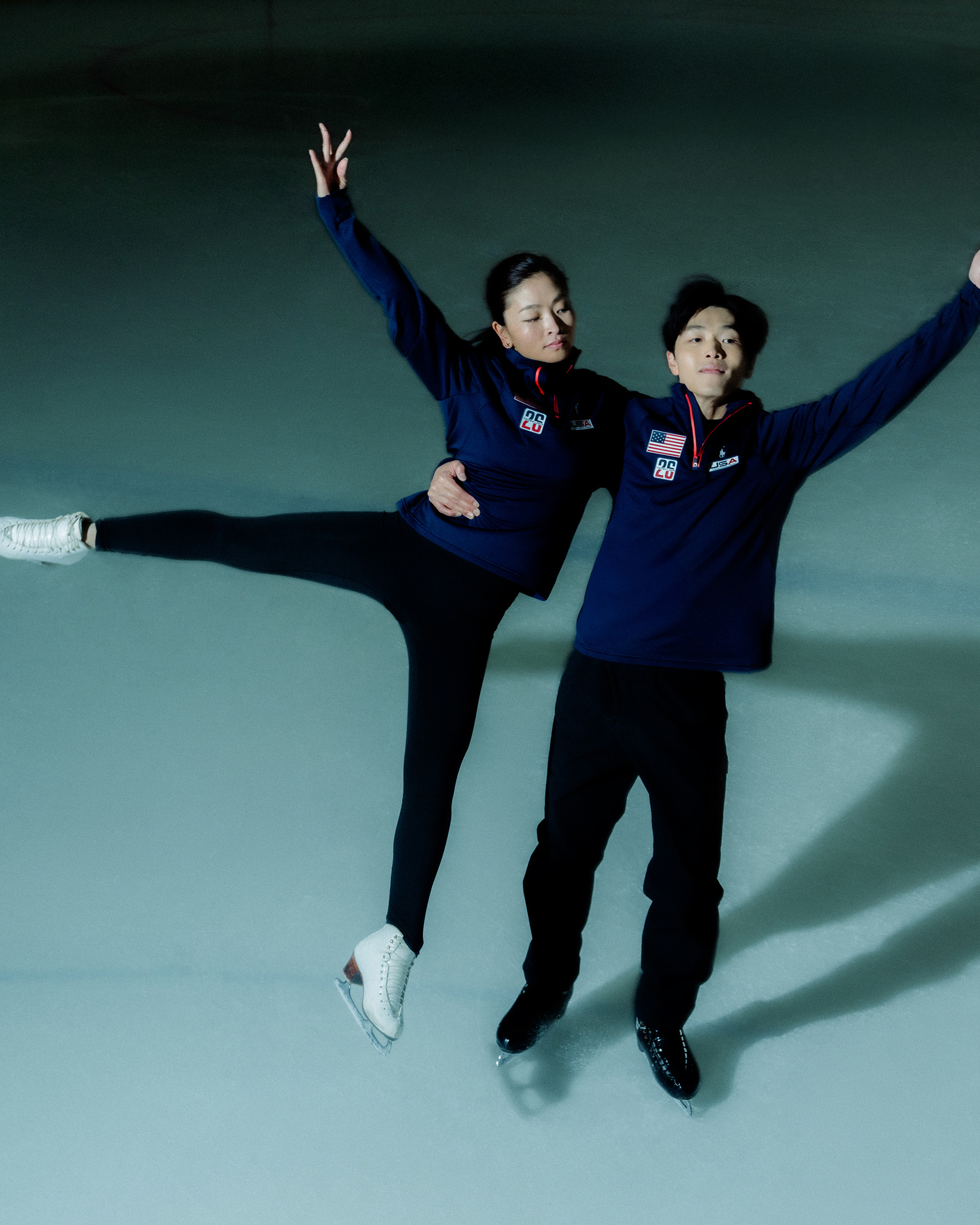
On a typically bright September afternoon in Southern California, the sun is baking the sidewalks and parking lots outside the Los Angeles-area rink where for the day the ice belongs to siblings Alex and Maia Shibutani. The ice-dancing duo is fortunate to have the space to themselves—no tinny arena music to block out, no playing tag team with other skaters for the chance to run through their programs. Of course the “ShibSibs,” as they are known, are not just any Olympic hopefuls.
[time-brightcove not-tgx=”true”]
The Shibutanis, who have won two national titles and eight senior-level medals at the U.S. championships, have been making history since they began skating together as kids. In 2011, when Maia was 16 and Alex was 20, they became the youngest U.S. team to win a world-championships medal, their first of three, in ice dance. And with that achievement they also became the first team of color to stand on the world-championship podium, a feat they would repeat in 2018, on the Olympic podium, when they earned bronze in PyeongChang.
And yet for all they accomplished, they did not spend the years after those Games collecting hardware. Instead, they stepped away from competition indefinitely, exploring their own interests, deepening their understanding of their identity as Asian Americans, and facing personal struggles including a cancer diagnosis for Maia. So when they announced in May that they intended to return, after seven years away from competitive skating, with an eye on the 2026 Winter Olympics in Milan-Cortina, the skating community responded with much enthusiasm.
“When we heard they were coming back, for me personally it was something I understood because we all know the pull of the Olympic Games,” says Evan Bates, who with partner Madison Chock has won six U.S. national championships, three world championships, and a team gold in Beijing in 2022. “It’s exciting, and it’s good for the sport.”
The Shibutanis, now 31 and 34, aren’t the only decorated athletes expected to make a comeback at these Games. Skier Lindsey Vonn qualified for her fifth Olympic team after retiring in 2019. Skater Alysa Liu took two years off after her first Olympics in 2022 before returning to try to make her second team. Another 2022 Olympian, snowboarder Jamie Anderson, is training for her second Games after having two children, and bobsledder Kaillie Humphries is also prepping for another possible Olympic appearance—what could be her fifth—after having her first child in 2024. But the Shibutanis had been away the longest, and although ice dancers can sometimes eke out a few more years than other figure skaters, no ice-dance team has left competition for so much time before returning to contend at the elite level.
Since they revealed their plans, the Shibutanis have also enjoyed support from an Asian American fan base who celebrated their athletic achievements and advocacy for people of color. Coming back for another Olympics, they say, is about bringing their lived experience and a more mature outlook to their skating. Their programs this season intentionally build on the Maia and Alex of before but weave in a deeper appreciation of their Asian American heritage and their roles as ambassadors of the sport and their culture.
Still, despite the warm welcome back they’ve received, their spot on the Olympic team isn’t a sure thing. In their first two competitions of the season, they posted respectable scores but not high enough to land them on the podium. But that wasn’t the point of this comeback, says Maia. “If you asked me what we scored seven or ten years ago, I honestly wouldn’t be able to tell you,” she says. “What I have taken with me in my life is the strength that can only be gained from experiencing and overcoming hardship.”
Their journey also hasn’t followed a completely feel-good narrative. Earlier this fall, a video circulated showing Alex confronting his sister during a training session, complaining about her attitude and criticizing how she performed a skill. He vented his frustration with insults that some who viewed the exchange considered bullying, ranting for about 10 minutes as Maia mostly stood silently. “I let my emotions get the best of me,” Alex tells TIME in an email. “I apologized to Maia that day, remain deeply sorry, and am committed to being a better teammate.”
Now the two are trying to put that behind them and focus on the future. Their next big test will come at the U.S. Figure Skating Championships in St. Louis, Mo., where on Jan. 11 the U.S. will reveal Team USA’s Olympic figure-skating team, including the three ice-dancing pairs it will send to Italy. Among the competition will be Bates and Chock, whom the Shibutanis haven’t faced in the same event this season. “It’s going to be exciting,” says Bates. “Our U.S. fleet of ice dancers is really strong.”
The Shibutanis betray no apprehension about their ability to perform at or above the level they once did. Instead, they are happy to have come this far. “After everything we have experienced individually,” says Alex, “we can feel that our love for being on the ice together is actually even stronger than it was in 2018.”
It was Maia and Alex’s mother Naomi who first suggested the siblings skate together. Maia was enamored with skating from an early age after discovering it at birthday parties. Both Naomi and her husband, Chris, are trained musicians, and the siblings grew up surrounded by music. On the ice, 4-year-old Maia found an outlet for her budding musicality, making up choreography as she went.
Alex was a more reluctant participant, dutifully tagging along during Maia’s lessons, but more interested in mirroring Michael Jordan’s career on the basketball court. When he had to pick a team sport to satisfy a school PE requirement, though, Naomi suggested the kids, then 9 and 12, pair up on the ice. After all, two makes a team.
Mother, it turns out, knew best. Very quickly, the Shibutanis caught the eye of Susan Kelley and Andrew Stroukoff, who represented the U.S. at ice dance’s first appearance as an Olympic event, in 1976. With their encouragement, the siblings shot up the ranks, and at their first juvenile nationals a few years later, they finished second.
It helped that they started with one of the best coaches for learning proper skating technique—Slavka Kohout, who trained five-time U.S. national champion Janet Lynn. Kohout’s students were known for their deep edges and precision bladework, which provided a perfect foundation for high-level ice-dance skills.
At one point their parents took them to the world championships in Washington, D.C., where they got their first in-person taste of elite-level competition. They had rink-side seats, and Alex recalls being impressed by the whoosh of wind as the teams sped by.
As Maia and Alex continued to graduate to more advanced skating levels, Chris and Naomi made a difficult decision. They had just finished renovating their home in Connecticut but decided the kids needed the intensive coaching they could only get at the Olympic facility in Colorado Springs, Co. Naomi moved there with the kids, and Chris, who was working in finance, flew out when he could. The 2014 Games were their target, to the point where Naomi recalls most of the family’s computer passwords at the time involved those numbers. (Note to hackers: The siblings no longer take this approach to security.)
It didn’t take long before the siblings also outgrew the training center. They reached out to Igor Shpilband and Marina Zoueva, who had coached Tanith Belbin and Ben Agosto, the silver medalists at the 2006 Olympics, as well as Canadians Tessa Virtue and Scott Moir, who won gold in 2010 and 2018 and silver in 2014. Their rink in Detroit was becoming a hub for ice dance in the U.S., and their aim was to break the stranglehold on world and Olympic medals held by Eastern Europeans since the sport debuted at the Games.
“I always believed they had loads of potential,” Zoueva says of the Shibutanis. “They are brilliant skaters because they have a precise edge and strong flow. Even when they were young, the International Skating Union would use them as role models to show coaches and judges what precise edges and clean skating was like.”
But at their first practice sessions with such elite teams, the siblings were intimidated by being on the same ice as the champion couples and instinctively stuck by the boards. Alex remembers Moir skating over to tell them that the ice belonged to them as much as it did the other teams who were there. “I’m surprised they remember that,” says Moir. “I certainly didn’t! But we all understood the importance of the training environment and wanted people to feel welcome, take their space, and bring their own energy.”
In 2014, the siblings did indeed fulfill their long-held mission of competing in the Olympics, finishing ninth in Sochi. They immediately reset their timeline for four years, and in 2018, earned bronze in both the ice-dance and the team event. “Definitely a dream come true for us,” says Maia. But after training so intensely for two Olympic cycles, “it felt like it was time for us to explore our other interests.”
“It felt like the end of a chapter for us,” says Alex. “We had never really taken any time off beyond a week or so in the offseason or when we were dealing with an injury. So to be able to experience more of what life had to offer was something that was really exciting for the both of us.”
Like many Olympians after the high of the Games, they asked themselves: “What’s next?”
Though their sport had taken them around the world, the Shibutanis now had the chance to travel on their own terms. They took frequent trips to Japan to learn more about their heritage and gained a more profound understanding of what it meant to be not only Asian American, but Asian American in a sport that wasn’t that diverse.
Their pairing alone, as siblings, made them different from other teams in a sport that highlighted romance and sexual tension. “Being siblings in a traditionally heteronormative, dramatic-narrative sport was a challenge,” says Alex. But they also didn’t look like most of their competitors. “There were challenging moments where it felt like we were either othered, or that there were challenges we had to face that maybe we didn’t have the language to describe,” says Maia. Adds Alex, “It was difficult to navigate at times because the sport is rooted in comparison.” And being the rare non-white team was its own catalyst for comparison.
Alex says he’s faced racism, both on and off the ice, throughout his life. “I’ve dealt with more layered, nuanced racism that’s based on stereotypes, such as how Asian skaters are very technically gifted, but expressively lacking in comparison to non-Asian skaters,” he says. “Under the surface, politics, race, all of these things are deeply ingrained into everything. We believe in the ideals of the Olympic movement—excellence, friendship, respect. At the same time, though, it’s not always an equal playing field. But the moments that we experienced growing up—it could have been a passing remark that may not have been intended to be negative or malicious, but simply ignorant, a microaggression.”
Both siblings decline to cite specific examples of slights. “Fortunately, we had each other,” says Maia, “and between the two of us, we were able to talk about how we felt.”
Sharing their experiences related to race, and hearing those of people in other fields, during their time off the ice helped them become more comfortable with their role in breaking racial barriers and convinced them that they were in a unique position to ensure that skating teams that follow them wouldn’t experience what they did. “Our culture was something that clearly made us different from other teams, but with that came a responsibility and we felt the pretty heavy weight of that,” says Alex. “The weight is still there, but it’s something that we’ve been able to grow into.”
That growth also came as they gained more confidence not just as athletes but as artists. Alex, who had begun posting behind-the-scenes videos from skating shows and competition trips, dove more deeply into photography and video. (He had his first photo exhibit in Los Angeles in 2023.) Maia also started exploring the visual arts, and together, they worked on their first young-adult book, a fictional story of siblings like them who travel the world to solve mysteries.
Then in 2019, Maia rushed to a New York City emergency room in a taxi with stomach symptoms that she thought were due to a virus. Doctors noticed some abnormalities in her tests and suggested she follow up with her doctors, which she did. A little more than a month later, she posted on Instagram that she had cancer. Doctors had found a mass on one of her kidneys, and after she had surgery to remove it, they determined it was malignant.
“It was a life-changing moment for me when it came to my health, my sense of well-being and security, and how I thought about the future,” says Maia. “It was a huge physical recovery for me, but it was also emotional and mental.”
The news was compounded by the spread of COVID the next year. As much of the world shut down, the apertures that life generally opens up for young people like the Shibutanis began shrinking. Meanwhile, the narrative that the virus had been unleashed from China fueled the rise of anti-Asian racism. Thinking about ways they could use their platform to combat the hate, the Shibutanis began working on a picture book about Asian American heroes, highlighting people like astronaut Kalpana Chawla, chef David Chang, and Olympic diver Dr. Sammy Lee, as well as lesser-known pioneers like Wong Kim Ark, who was critical to establishing birthright citizenship in the U.S. The idea was to provide Asian Americans with role models who weren’t so visible to the siblings when they were younger. Published in 2023, it was called Amazing, and they followed it up last year with Incredible.
“Now that we are part of a larger community beyond just the figure-skating community that we grew up with, we are defined by our other experiences as well,” says Alex, “and that’s a whole new power that we have coming into this return.”
Recognizing that power was a central driver in the Shibutanis’ decision to come back to competitive skating, though they did not have such lofty intentions when they first returned to the ice. Initially, Alex just wanted to bring Maia some joy during her recovery. “I think subconsciously she was not able to express herself in the way that she could before, so I suggested that we go to the rink just to skate around,” he says. “We wouldn’t even skate together. Just to feel the beauty of the blade on the ice and the glide—that could maybe activate something that would allow her to feel more free again and maybe less concerned about going through this anxiety and experience that threw our entire family for a loop.”
But once they were skating again, opportunities arose. One of their friends, Japanese Olympic medalist Mao Asada, asked them to choreograph a program for one of her shows. “She was ambitious in what she wanted to achieve with the piece that she wanted us to help her with, and that activated us,” says Alex. “We got ourselves back in shape on that project.”
In 2024, the Shibutanis returned to Korea as ambassadors for the PyeongChang Legacy Foundation. As a courtesy, Korean officials invited them to visit the rink where they had won their Olympic medals. “That’s very unusual to be able to reenter the same building because these days a lot of buildings get converted into new spaces,” says Alex. “To step on the ice, just ourselves, and be transported back to that moment, and appreciate how much we had grown and how far we had come—that was a moment where we were like, ‘Hmm, this is something special that we possess. When it’s the two of us together, we can do anything.’”
But was another Olympic quest really possible? One of their first calls was to Zoueva, their former coach. “I asked, ‘Please tell me the reason why you want to come back,’” she says. Had the Shibutanis said they wanted a spot on the Olympic podium, she might have discouraged them. “Their answer was exactly what I wanted to hear,” Zoueva says. “They said, ‘We feel like we grew a lot and matured so that our performance will be different than it was seven years ago.’ They wanted to share that spirit. How can I say no?”
The Olympics are, no doubt, a pressure cooker. Most athletes train for four long years in the hopes of hitting their peak performance on the right day, at just the right time, for a few momentous seconds or minutes. For members of team sports there’s another element of stress—not just managing your own emotions, but ensuring you’re aware of and in sync with one or more people. Those who step away from competition and return after a long hiatus face even more scrutiny given the inevitable comparisons to their past performances. Add family to the mix and the intensity amplifies.
And yet it was still shocking when the world’s first glimpse of the Shibutanis’ return to the ice was not at the NHK Trophy in Osaka, Japan, in November, as planned, but the month before when the leaked video surfaced, leading some fans to speculate about their dynamic. Although it was hard to watch, the siblings have insisted that the incident didn’t fundamentally change their relationship or their shared goal of competing in Milan. “Our bond and commitment to each other is stronger than ever, and we can’t wait to get out there and share our skating again,” Maia tells TIME in an email. “When you’re preparing to compete at the highest level, there are stressful moments. Alex apologized to me, and we worked it out as siblings do.”
Moir recalls trying to navigate the heightened emotions that come with elite-level competition with Virtue, even as people made assumptions about their relationship. “They said, ‘You are in love, you’re dating.’ We never had a relationship off the ice, but our strength was our relationship,” he says. “It’s the most beautiful part of ice dancing—having to be in perfect unison with someone, having to deal with the human aspect but still perform, and how to be there for someone when they need you the most. How did we get there? It was ugly. It was hard work.” For Virtue and Moir, it took marriage counseling–the closest type of support they could find for an ice-dance team at the time–as well as mental coaching. Moir says that 10 months before their first Olympic appearance, in 2010 in Vancouver, they had an argument that created such a breach of trust that they didn’t speak to each other or skate together for a week. “I know it sounds cliche,” says Moir, “but we didn’t communicate our feelings and that ended up leading to a lot of resentment.”
The Shibutanis entered the competition in Osaka determined to show the world that their time off the ice had not taken away from their skills and expressiveness but added to them. Splitting their time between L.A. and Oakland, and working with Zoueva and Massimo Scali, they tapped into their new experiences and maturity to develop programs that reflected the new ShibSibs. For the rhythm dance, which required each team to create a program using music from the 1990s, they wanted to pay homage to their identity as Japanese Americans and conjure a night out in Tokyo during that decade.
Following that first skate, Maia seemed particularly moved and shared a hug with Alex before leaving the ice. “Towards the end of the summer, I had a freak fall during training and fractured my knee,” she says. “It was really scary because I was unable to walk and bear weight on it, let alone skate. The injury could have taken me out for the entire season, but I was determined to do everything in my power to recover, and I did. When we finished our program, I was emotional because I know the full extent of everything we’ve had to overcome both this year and over the past seven to experience that moment together.”
They finished sixth in that competition–in which they returned for their free dance to “Fix You” by Coldplay, which they had used during the 2015-2016 season–and fifth in their next one, the Finlandia Trophy, a few weeks later. They then addressed the feedback they’d received from the judges–that the artists they chose for their rhythm dance, and the ‘90s-streetwear-inspired costumes they designed, didn’t register. “We knew we had two choices,” the siblings explained in an email. “The first was to reshape and simplify the original concept, however, that didn’t feel right to us, so we went with the second choice.” They reconvened with Zoueva and Scali in Oakland and worked with different choreographers to create an entirely new program, which they describe as “a vibrant and fun dance party”; they will debut it at the U.S. championships in January.
Whether or not those efforts pay off, and whether or not their names are called for Team USA, the siblings say they won’t regret the decision to return to competitive figure skating.
“The time between Feb. 20, 2018, and Nov. 7, 2025, our first competition back, is 2,817 days, and we were present, connected, and happy. It took an immense amount of work to create our programs and reach a level of skating quality and fitness that we are proud of,” says Maia. “When I reflect on this season, the word that comes to mind is ‘triumphant.’’’