

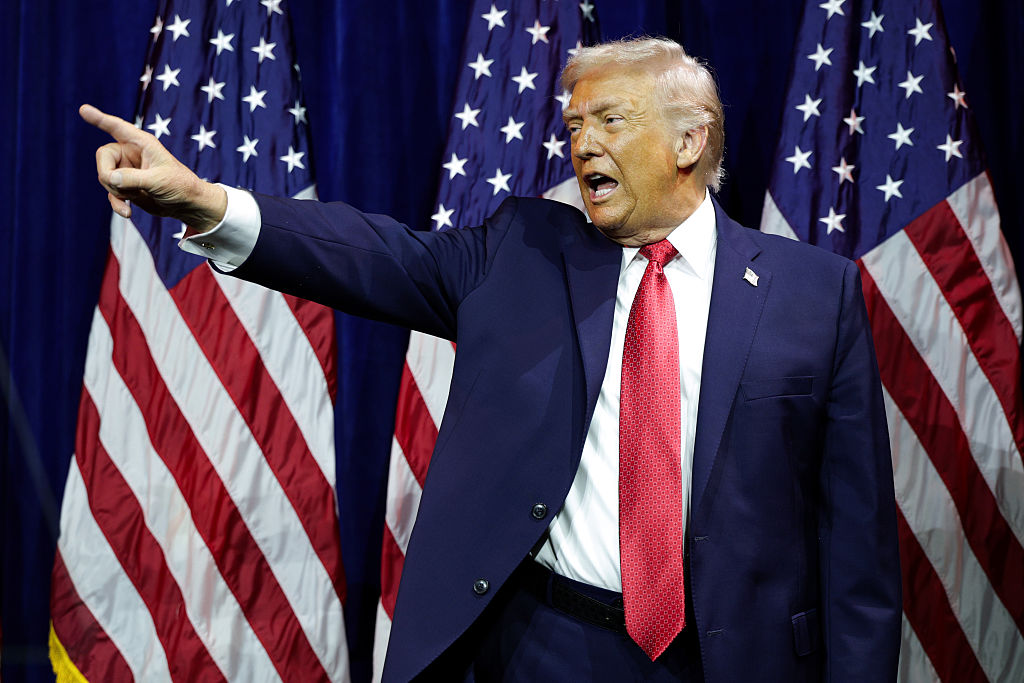
In the wake of the U.S.’s stunning operation to depose Venezuelan President Nicolás Maduro, President Donald Trump has coined a new term to describe his approach to foreign policy: the “Donroe Doctrine.”
Speaking to reporters at Mar-a-Lago on Saturday, Trump cast the operation as part of a revival of the Monroe Doctrine, a policy vision first articulated in 1823 by then-President James Monroe to oppose European interference in the Western Hemisphere.
[time-brightcove not-tgx=”true”]
The president claimed that under Maduro, Venezuela had hosted “foreign adversaries in our region” and acquired “menacing offensive weapons that could threaten U.S. interests and lives.”
“All of these actions were in gross violation of the core principles of American foreign policy, dating back more than two centuries,” Trump said. “All the way back, it dated to the Monroe Doctrine. And the Monroe Doctrine is a big deal, but we’ve superseded it by a lot, by a real lot. They now call it the ‘Donroe Doctrine.”
The State Department doubled down on the President’s message on Monday in a post on X, writing, “This is OUR Hemisphere, and President Trump will not allow our security to be threatened.”
Read more: How Trump’s Venezuela Takeover Could Change the World
This isn’t the first time the Trump Administration has harkened back to the doctrine laid out two centuries ago by Monroe, whose portrait hangs near Trump’s desk in the Oval Office, to define its own foreign policy agenda. In a Dec. 2 message, the President marked the anniversary of Monroe introducing the “bold policy” and stated that his Administration “proudly reaffirms this promise under a new ‘Trump Corollary’ to the Monroe Doctrine.” Days later, the Administration released a controversial national security strategy that laid out that Trump Corollary in a section detailing its planned approach to the Western Hemisphere.
Here’s what you should know about the history of the 1823 doctrine, and Trump’s moves to revive it.
The history of the Monroe Doctrine
Monroe introduced what would become known as the Monroe Doctrine in his otherwise routine annual message to Congress on Dec. 2, 1823. In it, Monroe warned European powers against further colonization or interference in the Western Hemisphere, asserting that the region was no longer open to Old World ambitions and would be regarded as a sphere of U.S. interest.
The policy has since been invoked by a number of Administrations as justification for intervention in Latin America.
It was first significantly put to the test in 1865, when the U.S. government helped then-Mexican President Benito Juárez overthrow Emperor Maximilian, who had been installed by the French government. Later in the 19th century, the U.S. stepped into Cuba’s fight for independence against Spain and went to war with the European power in 1898, a conflict that effectively ended Spain’s colonial presence in the region. The U.S., meanwhile, formally took control of Puerto Rico, Guam, and the Philippines, and gained significant influence in Cuba—which U.S. leaders had long sought to purchase from Spain—via the Platt Agreement in the name of protecting the country’s independence.
President Theodore Roosevelt, not long thereafter, introduced what would later be known as the Roosevelt Corollary to the Monroe Doctrine after European creditors of a number of Latin American countries threatened to use armed intervention to collect debts. Roosevelt responded by asserting the U.S.’s right to exercise “international police power” to curb what he deemed “chronic wrongdoing” in his 1904 message to Congress.
Read more: Trump’s Goals in Venezuela Don’t Add Up
While the Monroe Doctrine’s initial intent was to keep European powers out of the Western Hemisphere, Roosevelt, who himself fought against Spain in Cuba in 1898, in this way expanded it to encompass a claimed right to send troops into other Western Hemisphere countries.
This updated version of the doctrine helped set the stage for repeated U.S. military intervention in Latin America. Within just over a decade of Roosevelt articulating it, U.S. forces were sent to the Dominican Republic in 1903 and 1904, Nicaragua in 1911, and Haiti in 1915.
In the wake of the World Wars, other presidents asserted their own doctrines that staked out a more interventionist U.S. position globally with the goal of, in President Harry Truman’s words, supporting “free peoples who are resisting attempted subjugation” as the Cold War set in.
That guiding foreign policy vision at times converged with the longstanding justification for action in the Western Hemisphere under the Monroe Doctrine, such as in the case of the U.S.’s efforts to oust Fidel Castro’s communist government in Cuba and its role in the coups that overthrew Guatemalan President Jacobo Árbenz in 1954 and Chilean President Salvador Allende in 1973, both of which U.S. leaders framed as communist threats in the region.
Eduardo Gamarra, a professor of politics and international relations at Florida International University, told NPR that U.S. strategy in Latin America was one of strategic denial, aimed at deterring the involvement of non-American powers in affairs in the region. “In the 1800s, that meant Europeans; in the 20th century, especially after World War II, it meant the Soviet Union,” Gamarra said.
Read more: Donald Trump Is Risking His MAGA Base on Venezuela
The spirit of the Monroe Doctrine was also reflected in the U.S.’s actions during 1962’s Cuban Missile Crisis, when President John F. Kennedy ordered a naval and air quarantine of Cuba to prevent the Soviet Union from bringing further missiles to the island. Kennedy framed the crisis, prompted by the U.S. discovering the Soviet Union was secretly installing missile launch sites in Cuba, as a violation of long-standing hemispheric boundaries.
By the time Trump launched his 2016 campaign, however, Obama Administration Secretary of State John Kerry had declared that “the era of the Monroe Doctrine is over.”
“The relationship that we seek and that we have worked hard to foster is not about a United States declaration about how and when it will intervene in the affairs of other American states,” Kerry said in 2013. “It’s about all of our countries viewing one another as equals, sharing responsibilities, cooperating on security issues, and adhering not to doctrine, but to the decisions that we make as partners to advance the values and the interests that we share.”
Trump’s reassertion of the doctrine
On the campaign trail and during his first Administration, Trump revived the “America First” slogan—previously used to promote nativist and isolationist policies by several groups and politicians in the 19th and 20th centuries—to frame his agenda, arguing that the United States should prioritize domestic priorities over overseas conflicts.
That posture has shifted significantly in Trump’s second term, however, as his Administration has taken a more interventionist approach to foreign policy.
Even before returning to office, Trump began floating the idea of expanding U.S. territory by acquiring Greenland and the Panama Canal, and declined to rule out using force to do so. In June, he directed U.S. strikes against three Iranian nuclear facilities. And for months before Maduro’s capture, his Administration exerted escalating pressure on the Venezuelan government, carrying out a series of deadly strikes against boats in the Caribbean Sea and eastern Pacific Ocean that it alleged were carrying drugs, amassing a substantial military presence in the region, imposing a blockade on certain oil tankers going in and out of the country, and threatening further military action.
Read more: Trump’s Potential Next Targets After Venezuela
These moves culminated in the high-profile operation in Caracas in which Maduro was seized. Following the Venezuelan leader’s capture, Trump told reporters, “We’re going to run the country until such time as we can do a safe, proper, and judicious transition”—though Secretary of State Marco Rubio later said the U.S. would use economic leverage to influence the country’s policy direction rather than governing.
Trump has also threatened further intervention against a number of countries in recent days, reiterating his desire to annex Greenland, suggesting he might pursue military action in Colombia and Mexico, and warning that if Iran kills demonstrators amid the widespread protests in the country, “America will come to their rescue.”
The Trump Administration has positioned this foreign policy agenda explicitly within the Monroe Doctrine framework.
In Trump’s message marking the doctrine’s anniversary in December, he declared: “The United States will never waver in defense of our homeland, our interests, or the well-being of our citizens. Today, my Administration proudly reaffirms this promise under a new ‘Trump Corollary’ to the Monroe Doctrine: That the American people—not foreign nations nor globalist institutions—will always control their own destiny in our hemisphere.”
The national security strategy released by the Administration late last year elaborates on this corollary, outlining plans to “deny non-Hemispheric competitors the ability to position forces or other threatening capabilities, or to own or control strategically vital assets, in our Hemisphere.” The strategy also signals a more interventionist and contentious approach to relations with the U.S.’s European allies, levying sharp criticism against the continent’s leaders and policies and calling for “cultivating resistance to Europe’s current trajectory within European nations.”
The Administration has cast Trump’s threats and military actions as means of both protecting the U.S. and serving its economic interests. In regard to Venezuela, for instance, it has justified its strikes on alleged drug boats and moves against the country as part of an effort to combat cartels trafficking drugs into the U.S. Following Maduro’s capture, Trump has also referenced Venezuela’s oil and reserves and suggested that his Administration could subsidize U.S. oil companies moving into the country.
In his push to reference Greenland, he has also said the territory is essential for both the U.S.’s “national security” and “economic security.”John Bolton, Trump’s former security adviser, cautioned that there is no consistent framework guiding the approach, however.
“There is no Trump Doctrine: No matter what he does, there is no grand conceptual framework; it’s whatever suits him at the moment,” Bolton told The Atlantic.