

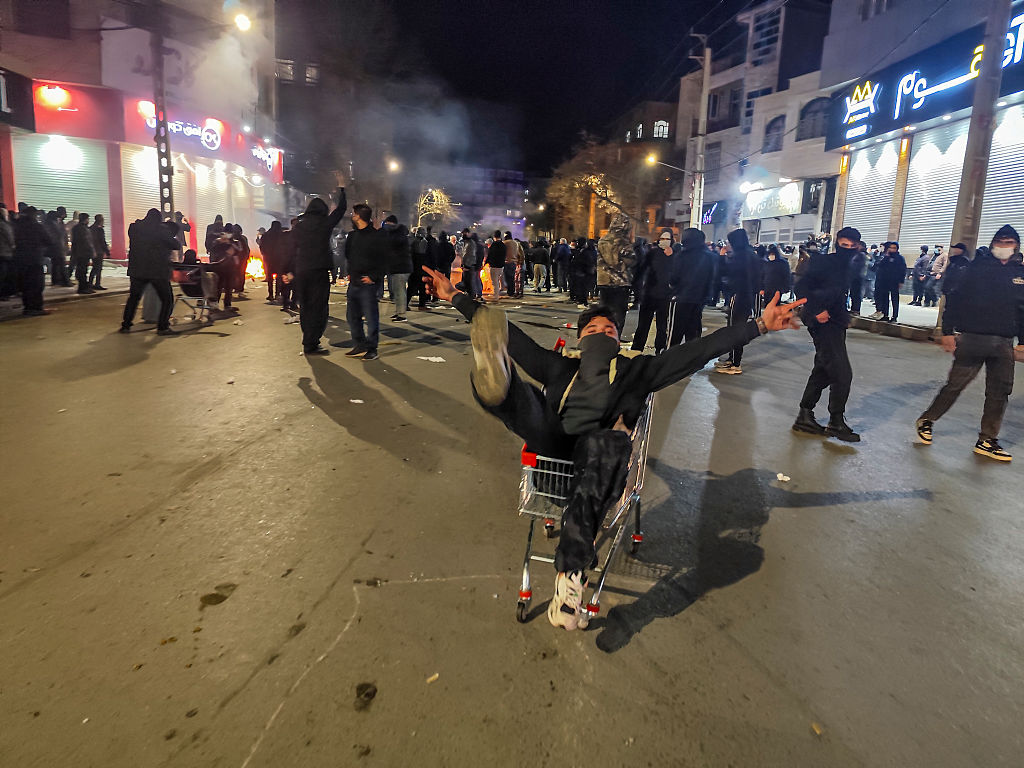
For 12 days now, protests fueled by a deepening economic crises have convulsed Iran. Demonstrators have filled the streets in Tehran, the capital, but also in smaller cities and towns far from the political and economic centers. The sites of protest include small cities such as Abadan and the Kurdish-majority Malekshahi in the southwestern Ilam province, where economic grievances, unemployment, and state neglect are stark.
[time-brightcove not-tgx=”true”]
In eight provinces, at least 28 protesters have been killed by Iranian forces, according to estimates by Amnesty International. Iranian government has blocked access to internet and doubled down on repressive measures against protesters.
Far from the desperate, ignored towns and cities of Iran, a familiar delusion has gripped Western observers: Perhaps Reza Pahlavi, son of the deposed shah of Iran, who presents himself as the crown prince in exile, can lead Iran’s democratic transition if the Islamic Republic falls.
The Pahlavi pretender himself certainly thinks so. After waiting for the protests to achieve international headlines, he has begun issuing statements and giving interviews. He has called for coordinated demonstrations, promised a smooth transition, and assured Iranians that he is ready to lead. His message is clear: I am your man.
We have been here before. And it didn’t end well.
The Chalabi template
Twenty-three years ago, another exiled pretender was being groomed by Western powers to lead a Middle Eastern nation into democracy: Ahmed Chalabi, the Iraqi banker-turned-opposition-leader, had everything the Pahlavi pretender lacks—and still failed spectacularly. The comparison isn’t just instructive; it’s essential for anyone tempted to pin their hopes on the shah’s son.
Chalabi arrived at regime change with sterling credentials—at least on paper. The Iraqi National Congress (INC) he led united Kurds, Sunnis, and Shias under one umbrella. He commanded serious financial resources, receiving over $100 million from the Central Intelligence Agency in the 1990s alone and another $97 million after Congress passed the Iraq Liberation Act in 1998. His Rolodex was the envy of any exile politician: Richard Perle, Paul Wolfowitz, Dick Cheney. He had the ear of The New York Times. He had boots on the ground in northern Iraq’s Kurdish regions, where INC forces operated for years.
Most importantly, Chalabi had what Pahlavi can only dream of: the full backing of an American invasion force prepared to topple the regime and install him in power. And yet, when Iraqis finally got to vote in 2005, Chalabi’s party won less than 0.5% of votes, and failed to win a single seat in parliament. The man once dubbed “the George Washington of Iraq” by neoconservative admirers ended his political career widely regarded as the least trustworthy figure in Iraqi politics—a remarkable achievement in a crowded field.
The Pahlavi deficit
Now consider what Reza Pahlavi brings to Iran’s moment of upheaval. He has no meaningful organization inside Iran. A Brookings Institution report in 2009 put it bluntly that Pahlavi lacked an “organized following” because there was no serious “monarchist movement” in the country. That assessment remains valid. His Phoenix Project and Munich Convergence Summit amount to theater of exiles—impressive press conferences that command no street-level organization where it matters.
Pahlavi has no substantial funding and operates on donations from diaspora Iranians. There’s no equivalent of the Iraq Liberation Act shoveling money his way. He and his supporters claim he has established a secure platform, where 50,000 Iranian officials have registered to defect and coordinate the toppling of the Islamic Republic. The claims, unverifiable and frankly implausible, echo Chalabi’s fantastical assertions about Iraqi army units ready to desert Saddam.
He has no ground game. Chalabi at least had Kurdish peshmerga willing to work with his forces. Pahlavi has been outside Iran for 48 years—longer than the Islamic Republic has existed. He has lived in the United States since he was 17. He is a stranger in his own country. And crucially, he has no invasion force ready to install him. Whatever President Trump’s threats, American boots aren’t coming to Iran’s rescue. If anything, the U.S. involvement would be the kiss of death for any opposition figure.
The most damning similarity between Chalabi and Pahlavi is the legitimacy deficit. Chalabi failed not because he lacked American support but because Iraqis didn’t want him. He was seen, correctly, as an American creation—a man who had spent decades outside Iraq, spoke Arabic with an American accent, and embodied foreign interference rather than indigenous resistance.
Pahlavi faces the same problem squared. The Pahlavi dynasty left Iranians with bitter memories: the 1953 CIA-backed coup that overthrew Mohammad Mosaddegh and restored the shah to power; the brutal SAVAK secret police; the Rastakhiz Party that antagonized formerly apolitical Iranians with compulsory membership and heavy-handed interference in daily life; the corruption and inequality that sparked the 1979 revolution.
While most Iranians are too young to remember these horrors firsthand, a substantial proportion—those over 50—lived through them. They remember the torture chambers, the disappeared dissidents, the rampant corruption, the grotesque inequality. They participated in, or supported, the revolution that overthrew the monarchy. Their children have grown up on the stories.
When protesters chant “Death to the dictator,” they are not pining for the return of a monarchy that many of them, or their parents, helped overthrow. The appearance of pro-Pahlavi slogans at some protests doesn’t indicate widespread monarchist sentiment; it reflects nostalgia for pre-revolutionary stability, artificially amplified by what researchers describe as social media campaigns using fake accounts and AI-generated content. Indeed, the emergence of “Neither Shah nor clergy” chants suggests that many Iranians reject both the Islamic Republic and Pahlavi restoration.
The Islamic Republic couldn’t ask for a better foil than Pahlavi. His visibility allows the regime to portray protesters as tools of foreign powers and the discredited monarchy—precisely what Pahlavi’s meeting with Benjamin Netanyahu accomplished in 2023. Every photo-op in Washington, every meeting with Israeli officials, every call for international intervention reinforces the regime’s narrative and undermines the legitimacy of the protests. Iran’s leading opposition figures understand that, and Nobel Peace Prize laureate Narges Mohammadi has described Pahlavi’s movement as, “the opposition against the opposition.”
And Pahlavi’s inability—or unwillingness—to control supporters who attack non-monarchist dissidents has fractured what should be a united front.
A vulnerable and formidable regime
The Islamic Republic is more vulnerable today than at any point since the Green Movement protests in 2009. The currency collapse, the insane inflation, water bankruptcy, and energy crisis have created conditions for sustained unrest. The regime’s regional proxies have been devastated. Its nuclear program has been set back by Israeli strikes. Supreme Leader Khamenei is 86 and ailing.
But vulnerability isn’t the same as defeat. The regime still controls a formidable repressive apparatus. It has weathered protests before by deploying overwhelming force—killing more than 500 people during the “Woman, Life, Freedom” uprising in 2022 and 2023. In the past two weeks, it has already killed scores, arrested more than 2,000 people, and has reportedly imported Iraqi Shia militias to supplement its security forces.
Those who have spent time in Iran know that for all the regime’s unpopularity, most Iranians fear chaos more than they crave freedom. Iranians have watched Syria, Iraq, Libya, and Yemen descend into chaos and terrible violence. They know regime collapse doesn’t guarantee democracy—it can just as easily produce prolonged violence and disintegration.
If the Islamic Republic falls, it will be because Iranians inside the country organize, mobilize, and ultimately compel elements of the security apparatus to switch sides—not because an politician in exile promises a smooth transition. The 1979 revolution in Iran succeeded because Ayatollah Khomeini co-opted sections of the armed forces. No comparable split is yet evident.
Iran doesn’t a pretender in exile making promises he can’t keep. It needs international solidarity with protesters, targeted sanctions against regime officials, support for independent media, and diplomatic pressure for human rights. Iran needs the world to stop pretending that one man—any man—can deliver 85 million Iranians from dictatorship.
The Chalabi disaster taught us that regime change might be easy but the human costs it exacts are terrifying and building democracy is hard. Installing exiles with no domestic base is a recipe for failure. Banking on pretenders instead of people is a mistake the U.S. can’t afford to repeat.
Iranians deserve better than the Pahlavi pretender. They deserve the chance to determine their own future—without the burden of other people’s delusions.