

Not far from where I live, an ICE agent shot and killed a woman. At first, I didn’t know her name, just the location. That morning, I received the news via text from an old friend of mine, a Latino activist and a fellow poet. The block where she was killed—34th and Portland—is the Minneapolis neighborhood right next to mine, a little over half a mile away from where George Floyd was murdered in broad daylight by Officer Derek Chauvin in 2020.
[time-brightcove not-tgx=”true”]
Later, I learned her name: Renee Good. She was a poet and a mom. Her wife bore witness to her murder. Even as I watch the video, I cannot imagine it. There are colorful bits of stuffed animals jutting from the glove compartment, splashed with her blood.
My child attended daycare and summer programs at Pillsbury United Communities center just four blocks away, where a multiracial cohort of kids happily play through the winter, swishing around in bulky jackets and snow pants, bouncing towards their parents. Two blocks from that, community activists have painted names of Minnesotans and others who have lost their lives to state-sanctioned violence, among them Jamar Clark, Philando Castile, and Fong Lee.
Minnesota was already reeling from other recent tragedies. A few months ago, about three and a half miles from where Good was murdered, a shooter opened fire during mass at Annunciation Catholic School, injuring 17 and killing two children. And a few months prior to that, State Rep. Melissa Hortman and her husband Mark were murdered in their homes in Brooklyn Park, a suburb about 15 miles away.
I think of the distance my family and I traveled to come to this country, to Minneapolis. Fifty years ago, my father was a Vietnamese soldier who fought as an ally to the United States Armed Forces in Vietnam. When the Communist military rolled into Saigon in 1975, I was three months old. My family had to flee everything that they knew and loved to avoid my father’s possible imprisonment, torture, and execution. We arrived in the United States, a country where the majority of the population did not want us, even though we were their allies.
Even though I was sworn in as an American citizen when I was in grade school, I carry three forms of I.D. when I leave the house. I fear—not for the first time—that the color of my skin and the shape of my eyes puts me at risk. I worry about my mother and father, elderly now, both legal residents for five decades, who have done nothing against the law, and yet could be scooped up at any time by ICE.
All around me, my fellow Minnesotans are being violently dragged away by masked and armed men empowered by the federal government. The majority being accosted and disappeared are Black, Muslim, Latinx, and Asian. There are stories of Native American citizens getting detained by ICE agents who do not recognize tribal IDs. Others are afraid to leave their homes to do mundane things like getting groceries or shoveling snow and clearing ice from their sidewalks.
Now, we have witnessed ICE shoot and kill a white queer woman in the face on a residential street, in broad daylight, caught on multiple cameras. Hours later, ICE agents detained a teacher outside of Roosevelt High school shortly after the end of classes, allegedly using tear gas. For the safety of students, public schools shifted to remote learning.
And it’s not just Minnesotans who have been dealing with tragedy: On New Year’s Eve, almost 2000 miles away, an off-duty ICE agent shot and killed Anthony Porter, a father of two, in Los Angeles. As I write this, over 30 people have died in ICE custody at sites across our 2,800-mile-long country.
All of this calculation of distance and I can’t reconcile the most important space of all: the distance between myself and some of my fellow American citizens, who believe that the actions of ICE—from the racial profiling, imprisonment, and detainment of people on American soil, to the killing of Good and Porter—are acceptable. I have felt sick all week. This vast gulf between us, not just as Americans but as human beings, has drained me of hope.
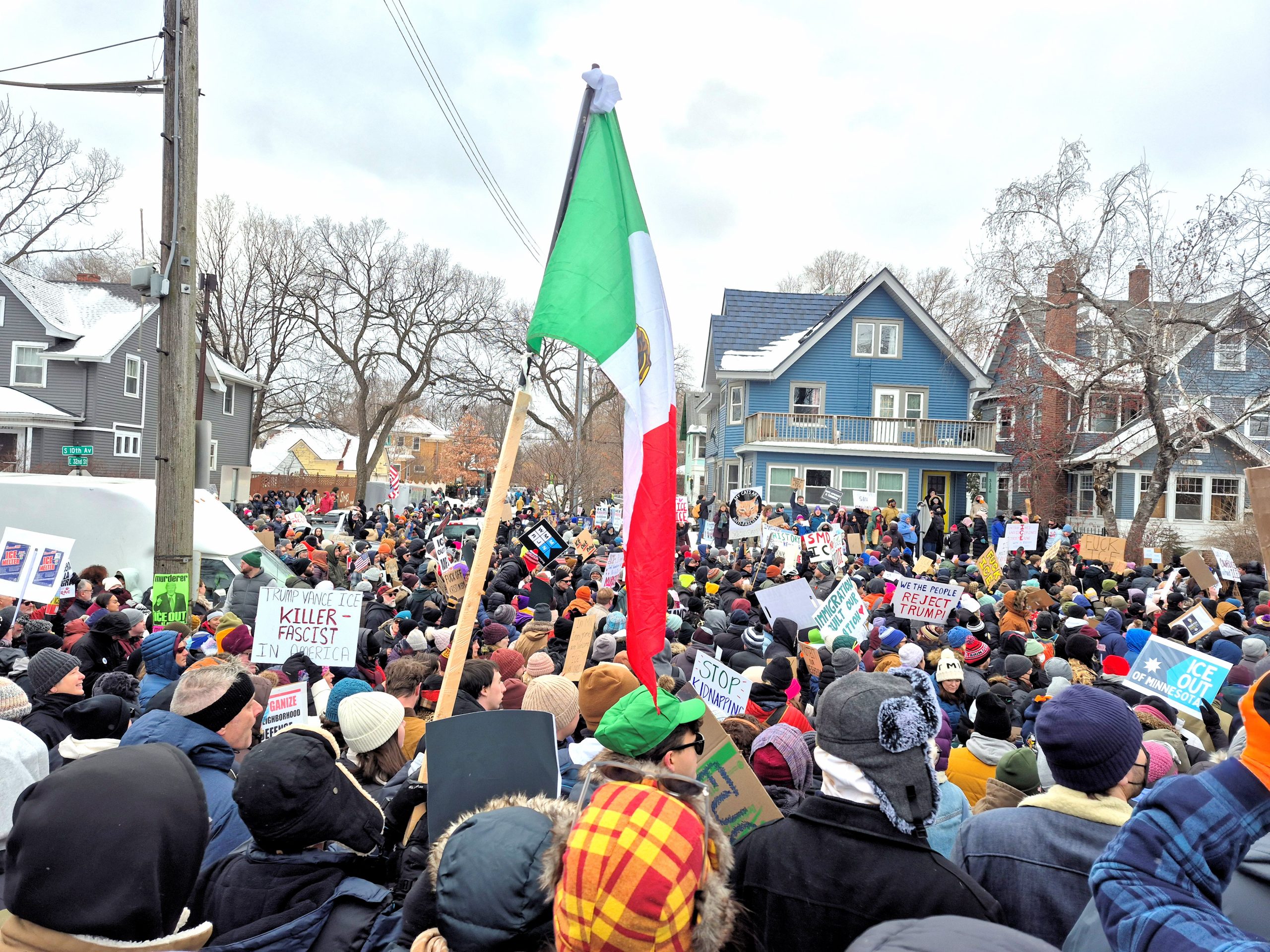
Still: I step out my front door and walk a few short blocks on Minneapolis sidewalks pockmarked with ice in 20 degree weather, which the 17 mph winds make it feel like 7 degrees. This is a place where the cold physically hurts. And yet there they are, thousands of my fellow Minnesotans. We march. We shout. We hold space with one another.
My grandfather was outspoken against the brutal French colonial regime back in Vietnam. One day, he vanished, and my mother never saw him again. Many times, she’s told me she worries something like this will happen to me in America, for standing up and speaking up for what I believe in, but she understands why I choose to do it.
In the days since Good was killed, people from all walks of life have stood together: people of different races, faiths, genders, sexualities, and economic backgrounds.
We march together no matter the temperature, no matter the fear inflicted, no matter the hatred weaponized, because of our love for humanity. We love our friends and our family and our neighbors, even the ones we don’t know so well, even the ones we may on occasion disagree with. And this love makes violence and injustice unacceptable.
I hope that the rest of the country and the world will stand with us in outrage and sadness that ultimately comes from a place of deep and unwavering love.
When we stand together, the distance between us closes.