

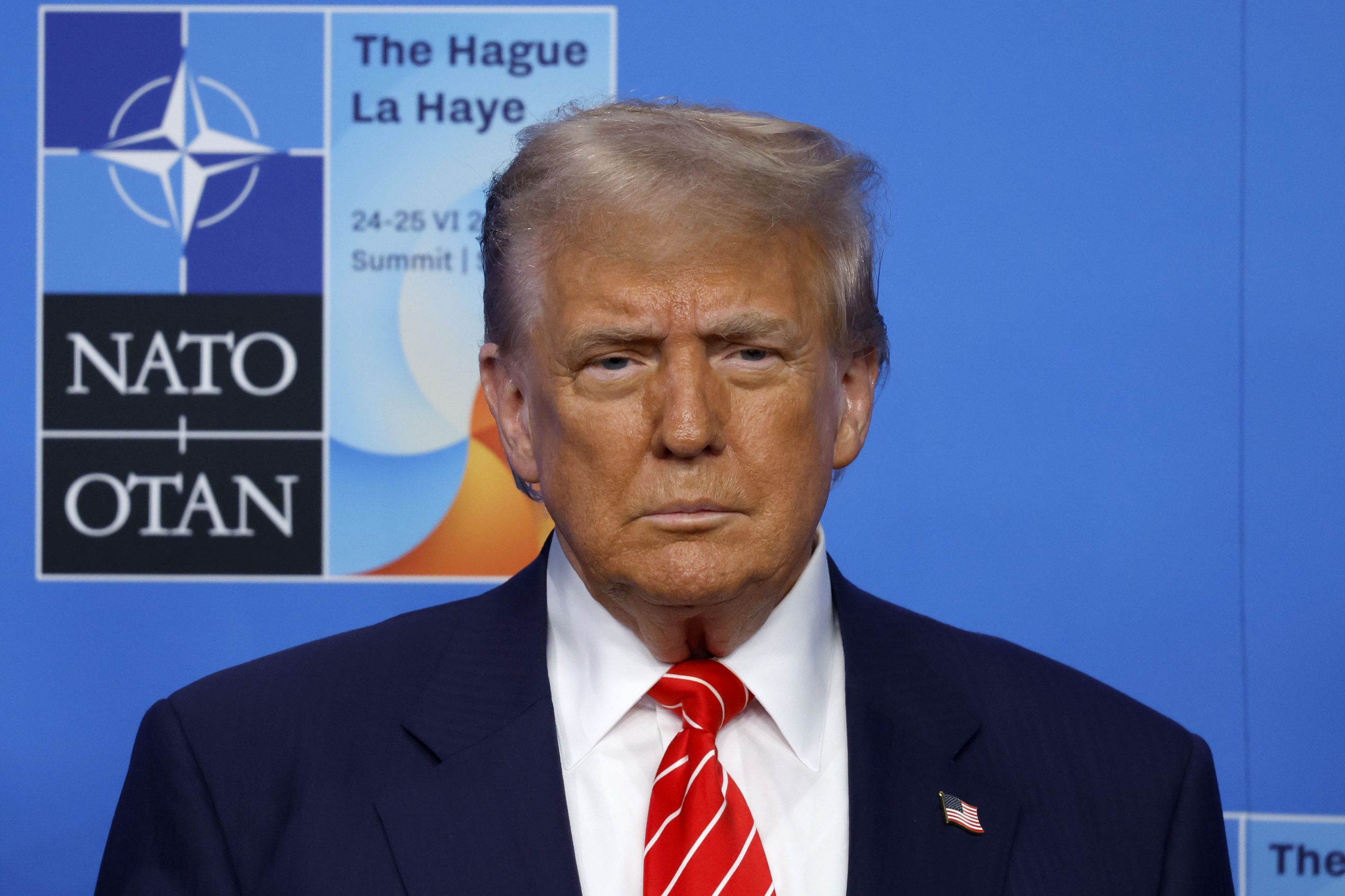
After talks between the Greenmark and Denmark foreign ministers and U.S. officials on Wednesday yielded no results, President Donald Trump was met with questions as to what his next steps might be. Talking to reporters in the Oval Office, Trump—who continues to ramp up pressure on Greenland in his desire to annex the territory—refused to rule out the option of leaving NATO.
[time-brightcove not-tgx=”true”]
“Greenland is very important for the national security,” said Trump, doubling down on his argument about the Kingdom of Denmark territory. He went on to say the U.S. “cannot rely on Denmark” to protect Greenland from Russian and Chinese interests and warned that he has many options to explore. “You found that out last week with Venezuela,” said Trump, referencing the operation that resulted in the capture and detainment of the fallen Venezuelan President Nicolás Maduro and his wife, Cilia Flores.
Danish Foreign Minister Lars Løkke Rasmussen said there remains a “fundamental disagreement” between Denmark and the U.S. as to what lies ahead for Greenland. In a display of strength, Denmark announced an expansion of its military presence on and around the island on Wednesday. Several European NATO allies followed suit, with Sweden and Germany among the countries committing to send military personnel to the territory.
Denmark’s Prime Minister Mette Frederiksen on Thursday said Greenland’s defence was a “common concern” for all of NATO. Echoing that sentiment, Danish Defence Minister, Troels Lund Poulsen, told reporters in Copenhagen that Denmark is planning to have a “larger and more permanent” NATO presence to ensure the island’s security. It’s “crucial to show that security in the Arctic is not only for the Kingdom of Denmark, it is for all of NATO,” said Poulsen.
NATO chief Mark Rutte earlier this week expressed the importance of “the Arctic and Arctic security, because we know that with sea lanes opening up there is a risk that the Russians and the Chinese will be more active.” Noting the geopolitical significance of the island’s location, he said discussions are ongoing as to how to keep it secure.
But Trump, who has repeatedly aired his grievances with the alliance, argued that anything less than U.S. control of Greenland is “unacceptable” and has insisted that NATO “should be leading the way for [the U.S.] to get it.”
Trump previously floated the idea of leaving NATO over other disputes, and as he refuses to rule out that possibility this time, concerns are mounting over the U.S’ relationship with the alliance.
TIME spoke to legal experts about whether Trump could legally pull the U.S. out of NATO, should he pursue that avenue, and the wider implications at play.
What is NATO?
The North Atlantic Treaty Organization has grown over the years since its formation in 1949, with 32 countries now part of the Western alliance.
According to NATO, the organization was founded based on three principles: “Deterring Soviet expansionism, forbidding the revival of nationalist militarism in Europe through a strong North American presence on the continent, and encouraging European political integration.”
In the aftermath of World War II, a race ensued between allies in western Europe and the Soviet Union to assert influence over other countries on the continent amid elections and coups in central Europe.
Increased American interest in foreign intervention, especially in Europe, saw the U.S., Belgium, Canada, Denmark, France, Iceland, Italy, Luxembourg, the Netherlands, Norway, Portugal, and the United Kingdom sign the Washington Treaty, or the North Atlantic Treaty, in April 1949. The treaty, which still forms the basis of NATO today, consists of 14 Articles.
“The parties agree that an armed attack against one or more of them in Europe or North America shall be considered an attack against them all,” reads Article 5.
When did the U.S. join NATO?
The U.S. has remained a core NATO member since its foundation. In an address following the Treaty’s formation in April 1949, President Harry Truman said: “In this pact, we hope to create a shield against aggression and the fear of aggression.”
“The nations represented here are bound together by ties of long standing. We are joined by a common heritage of democracy, individual liberty, and rule of law. These are the ties of a peaceful way of life. In this pact we are merely giving them formal recognition,” he continued.
NATO expanded throughout the 20th and 21st centuries, with countries including Turkey and Greece joining in the early 1950s.
“We do not keep security establishments merely to defend property or territory or rights abroad or at sea. We keep the security forces to defend a way of life,” said President Dwight Eisenhower of the treaty in 1954.
What has Trump said about potentially leaving NATO?
During his first term in the White House (and the early months of his second term), Trump aired his grievances with NATO, largely over defense spending and how much each member country contributes. He argued that the U.S. shouldn’t have to pay the most towards defense.
In August 2018, Trump referenced conversations he had with NATO officials from the previous year. “Someone said ‘would you leave us if we don’t pay our bills?’ They hated my answer. I said, ‘Yeah, I would consider it,” recalled Trump. (In 2018, European countries spent on average 1.5% of GDP on defense, compared to the U.S. rate of 3.39%.)
In December 2024, before returning to the White House for his second term, Trump said NATO had been “taking advantage” of the U.S., and said the U.S. would only remain a member if the others “pay their bills.”
Last year, Trump succeeded in getting NATO leaders to agree to raise defence spending to 5% of each countries’ economic output by 2035.
Can Trump legally leave NATO?
The National Defense Authorization Act of 2024 “sought to place a firm legal brake on any future attempt to pull the United States out of NATO by prohibiting a President from doing so without either a two-thirds Senate super-majority or an act of Congress,” says Ilaria Di Gioia, senior lecturer in American law at Birmingham City University. “Yet those legal constraints remain far from solid.”
Gioia says there’s a number of ways in which Trump could look for a work-around, should he seriously wish to pull the U.S. out of the alliance.
“Trump could seek to circumvent Congress’ statutory constraint by invoking presidential authority over foreign policy, an approach he has floated before to bypass congressional limits on treaty withdrawal,” Gioia explains in an email to TIME. “It is unclear whether any party would have legal standing to challenge such a move in court. The most plausible plaintiff would be Congress itself, but with the Republicans in control of the Senate, political support for such a lawsuit is far from assured. The result would be a constitutional confrontation between the Executive [branch] and Congress, with the courts as the likely referee.”
Trump has repeatedly stated that the U.S. needs to acquire Greenland as a matter of “national security.” According to Gioia, the President could seek to use this argument legitimately. Trump “could frame NATO withdrawal as necessary for national defense, citing broad Commander-in-Chief authority (Article II, Section 2),” she says.
Curtis Bradley, Allen M. Singer distinguished service professor of law at the University of Chicago, highlights that there is, at least, some precedent, citing President Jimmy Carter’s withdrawal from a mutual defense treaty with Taiwan in 1978, which was formalized in 1980. But still, given the National Defense Authorization Act of 2024, if Trump were to pull the U.S. out of NATO, it would be far from easy and there could well be legal fallout.
Bradley notes that due to the Supreme Court often ruling in favor of the Trump Administration, Congress may find it difficult to win against him in the courts, but legal backlash could stem from elsewhere
“If there are contractors with NATO that could lose money from the U.S. withdrawal, that would be an economic injury that would potentially give them a standing to sue,” he states.
Despite Trump having options, the legalities involved are, at best, murky, the experts agree.
“The very idea of a U.S. exit erodes trust, cohesion, and the credibility of collective defense,” says Gioia, highlighting that the mere suggestion of the U.S. leaving NATO has, in itself, caused a lot of damage. “Trump’s repeated questioning of the alliance weakens deterrence, shakes European security planning, and emboldens adversaries.”
Referring to the alliance as the “most important mutual defense treaty of the post-WWII era,” Bradley says a U.S. exit would be surprising, and that it’s far more likely we’ll see continued “tensions with NATO” rather than a formal withdrawal. “But Trump has surprised me on other things,” he notes.