

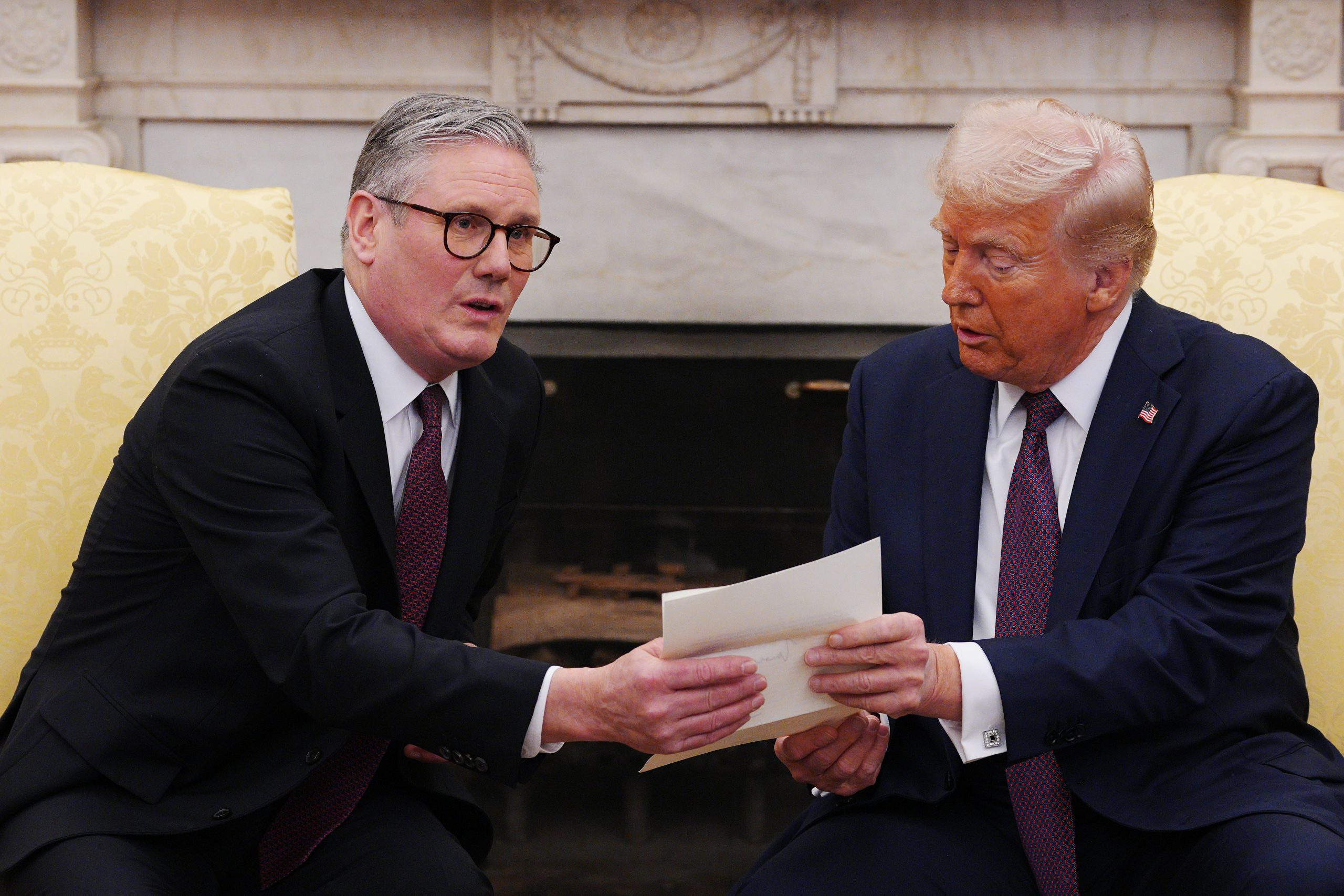
British Prime Minister Keir Starmer has publicly broken ranks with U.S. President Donald Trump over his renewed pressure campaign for the annexation of Greenland. Trump threatened to impose a 25% tariff on the U.K. and other European allies until Denmark relents and sells the territory of Greenland—a move Starmer has labeled “completely wrong.”
[time-brightcove not-tgx=”true”]
During a press conference at Downing Street on Monday morning, Starmer argued the use of tariffs against allies “is not the right way to resolve differences within an alliance, nor is it helpful to frame efforts to strengthen Greenland’s security as a justification for economic pressure.”
Referring to the matter as a “very serious situation,” Starmer—who rejected the idea of retaliatory tariffs against the U.S., for now at least—said a “trade war is in no one’s interest” and emphasized that his priority is to act in the national interest of the United Kingdom.
“On Greenland, the right way to approach an issue of this seriousness is through calm discussion between allies. Let’s be clear, the security of Greenland matters and it will matter more as climate change reshapes the Arctic,” said Starmer. “As sea routes open and strategic competition intensifies, the High North will require greater attention, greater investment, and stronger collective defence.”
The U.K. is ready to assist NATO allies on that front, Starmer vowed, before stating that no plan can be made without the involvement of Greenland and Denmark.
“Any decision about the future status of Greenland belongs to the people of Greenland and the Kingdom of Denmark alone. That right is fundamental, and we will support it,” Starmer said, taking a clear stance against Trump’s rhetoric, which includes the White House refusing to rule out taking Greenland by military force.
Read More: Trump Refuses to Rule Out Leaving NATO Over Greenland Tussle—Can He Legally Do That?
Starmer’s public rebuke of Trump’s tariffs threat stands in stark contrast to the strong working relationship he has cultivated with the U.S. President over the past year. The two previously put on a united front for a “groundbreaking” billion-dollar U.K.-U.S. Tech Prosperity Deal and were the first leaders to agree on a reciprocal trade agreement amid Trump’s initial “Liberation Day” tariffs push.
Highlighting his wish for the strong alliance to continue, Starmer told reporters at Downing Street that the relationship between the U.K. and the U.S. “matters profoundly, not just to our security, but to the prosperity and stability that people here depend upon.” He said he’s determined to keep that relationship “strong, constructive, and focused on results.”
However, although a calm approach to the matter is preferred, in a show of strength at home, Starmer, who shared his disapproval personally with Trump during a phone call on Sunday, emphasized that “being pragmatic does not mean being passive.”
Trump on Saturday said he would impose a 10% tariff on Denmark, Norway, Sweden, France, Germany, the Netherlands, Finland, and the United Kingdom beginning Feb. 1“on any and all goods sent to the United States of America.” He said the tariff would be increased to 25% on June 1.
NATO chief Mark Rutte last week expressed the importance of “the Arctic and Arctic security,” and several European NATO allies committed to sending military personnel to Greenland amid heightened concerns over the territory. Trump appeared to reference this in his tariffs threat, citing that European nations “have journeyed to Greenland, for purposes unknown.”
Read More: The Republicans Breaking Ranks With Trump Over Greenland Threats: ‘This Is Appalling’
The eight countries threatened with the charges put on a united front over the weekend via a joint statement issued in response to Trump.
“Tariff threats undermine transatlantic relations and risk a dangerous downward spiral. We will continue to stand united and coordinated in our response. We are committed to upholding our sovereignty,” the statement read.
However, Starmer’s approach to Trump’s threat—and his disinterest in retaliatory tariffs—may well differ from that of the E.U. leaders who are set to discuss ways forward during an emergency summit in Brussels on Thursday, as arranged by president of the European Council António Costa.
On Monday, German Finance Minister Lars Klingbeil and his French counterpart, Roland Lescure, weighed up various countermeasures at the disposal of the E.U., with Klingbeil asserting: “We will not allow ourselves to be blackmailed.”
Read More Trump Declares Anything Less Than U.S. Control of Greenland Is ‘Unacceptable’
European tariffs on imports from the United States, a package of 93 billion euros ($107.7 billion) which is currently suspended until early February, could be enforced. Another option comes in the form of the Anti-Coercion Instrument (ACI), which could restrict access to the single market in which the U.S. has a surplus with the bloc and block applications for E.U. contracts. Lescure noted that this avenue should serve as more of a deterrent, with deescalation seemingly remaining the ultimate shared goal among E.U. leadership.
Trump, meanwhile, has refused to rule out leaving NATO over the Greenland tussle, and maintains that anything less than U.S. control of Greenland is “unacceptable.” According to Trump, NATO “should be leading the way for [the U.S.] to get it.”