

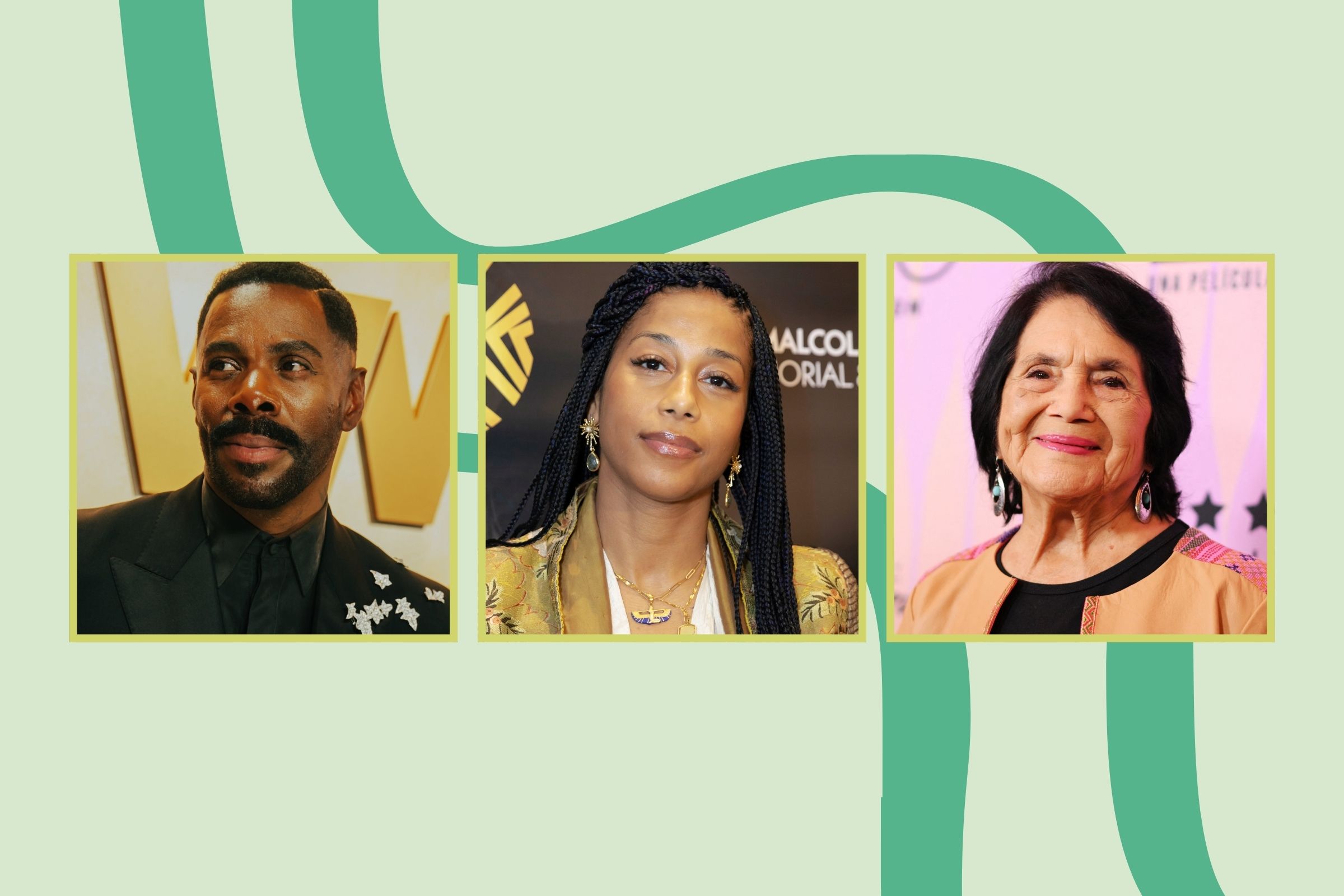
Four decades since Martin Luther King Jr. Day was first observed, members from across industries acknowledged that work remains to be done in civil rights, racial equity, and shared humanity at a TIME Impact Dinner on Monday night in Los Angeles.
TIME brought together industry leaders, advocates, and artists, as well as the architects of the national holiday, for the dinner, themed “Advancing the Dream — From Healing to Action.”
[time-brightcove not-tgx=”true”]
“Our hope is that tonight sparks ideas, deepens understanding, and strengthens connection,” said Loren Hammonds, the head of documentary at TIME Studios, in his opening remarks. “But most importantly, that it fuels the kind of collective action that Dr. King called us toward: action rooted in courage, compassion, and a belief in our shared humanity; and the power that comes from civic responsibility, community healing, and the vital role the arts play in moving these efforts forward.”
Throughout the dinner, six special guests gave toasts about continuing commitments to champion justice and community and how storytelling can help support these efforts and honor the late Dr. King’s legacy.
La June Montgomery Tabron
La June Montgomery Tabron, president & CEO of the philanthropic organization W.K. Kellogg Foundation, which sponsored the TIME Impact Dinner, raised her glass “not just to the dreamers, but to the artists and storytellers who show us what’s possible and the leaders who make it real.”
Kellogg said that she was introduced to King through his famed 1963 “I Have a Dream” speech—not the version at the Lincoln Memorial in Washington D.C., but the one in Cobo Hall in Detroit, Mich. months earlier.
“In so many ways, my life has been a realization of Dr. King’s dream—and only over time have I come to understand how deeply his words have shaped my career and the responsibility I have felt to help extend that dream to others,” she said.
In Tabron’s toast, she recognized that 40 years since the first celebration of MLK Day, “everything we’ve fought for, all the progress we’ve made, hangs in the balance. But the inverse is also true. In this moment of struggle and uncertainty, everything is possible.”
Colman Domingo
Award-winning American actor, playwright, producer, and director Colman Domingo says that as a storyteller, he feels deeply connected to the dream Dr. King spoke of, “a dream shaped by language, by clarity, by conviction, and by the courage to name injustice plainly.” He added the holiday and the TIME Impact Dinner “is not only about challenging systems that fail us, but about telling fuller truths and strengthening the human connections that those systems too often erode.”
In his toast, Domingo acknowledged Aml Ameen, whom he acted alongside in the 2023 biopic Rustin about civil rights activist Bayard Rustin. In the film, Ameen portrayed King, while Domingo portrayed King’s close advisor Rustin. “As a storyteller, I stand shoulder to shoulder with this man,” Domingo said of Ameen, “and I want to stand shoulder to shoulder in this room with all of you tonight as we continue to march forth and do the work, the good work.”
Appearing to allude to the political climate in the U.S., Domingo encouraged everyone not to be downhearted. “These are dark times; well, we’ve always lived in dark times,” he said. “And what do we do? We get up again and again and again, and we do the work, and we love, and we dance, and we write, and we play, and we make this world bend a little further towards justice.”
aja monet
Los Angeles-based surrealist blues poet aja monet also paid tribute to King and his legacy through poetic remarks. She began with a reference to King’s famous sermon, “The Drum Major Instinct,” which King delivered at Ebenezer Baptist Church in Atlanta on Feb. 4, 1968, just two months before his assassination, and she emphasized how that sermon speaks to the human desire to stand out.
monet, in her speech, lauded King at times—“Like many prophetic messages, Dr. King offers a view into now, the very age of the attention economy, a generation raised on the proclamation of me or I, without context of we or us”—as well as decried his demise. “There is no telling what Dr. King would say of this current moment, because this moment was stolen from him, an assassination turned into a holiday.”
In her performance, monet imagined an interaction between King and renowned American jazz drummer Max Roach, offering musicmaking as an analogy for changemaking. “The question we all must confront is, who are we on the bandstand, and what kind of musician do we choose to be?” she said, before adding: “Pick up your instrument. It’s not time for you to sit down. Play like you know how to listen.”
Dolores Huerta
Labor leader and civil rights leader Dolores Huerta, an inaugural TIME Latino Leader in 2023 whose work with migrant farmworkers birthed the United Farm Workers of America, said in her toast that crucial to King’s legacy was his work with working people and the poor.
Huerta also honored Rustin and actor-singer Harry Belafonte, who were pivotal figures in the American civil rights movement in the 50s and 60s, as well as King’s widow Coretta Scott King, who worked with Stevie Wonder to establish Martin Luther King Jr. Day as a national holiday.
“We’ve got to remember not only Dr. King, but we’ve got to remember everybody else that worked with him and that made the holiday possible, that made his legacy possible, the legacy that all of us have got to continue to commit, that we are not going to stop and we’re going to keep on working and we can realize his dream,” Huerta said, before ending her toast with chants to King and repeating the UFW slogan she famously coined: “¡Sí se puede!”
Ryan Alexander Holmes
In his toast, content creator and actor Ryan Alexander Holmes—born to a Chinese immigrant mother and an African American father—talked about the racial tensions he experienced growing up. Holmes pointed to how he saw, in 2020, the Black Lives Matter movement and the Stop Asian Hate movement being pitted against each other. “Because I am both Black and Asian, I am not armed with the illusion of choosing a side, because both are in my DNA,” he said. “In my blood is the unification of both—the very dream Dr. Martin Luther King Jr. spoke into existence.”
He ended his toast with how his grandfather’s life ended in gun-related violence, similar to King’s, and how his late grandfather had passed down a dream of continuous improvement. “It is now my dream, and it is the dream of everyone in this room—to make the next generation better than the next—and it was also Dr. Martin Luther King Jr.’s dream.”
Stevie Wonder
R&B legend Stevie Wonder opened his toast with a question: “What will it take for us to say enough is enough? Armed, masked men marching down the streets, snatching American citizens off the streets?” The question appeared to be in reference to ongoing immigration enforcement across multiple states, which has led to deaths and widespread protests against President Donald Trump’s immigration crackdown.
Wonder called on the dinner attendees to “remember your responsibility” in upholding justice, and he challenged them “to find our own personal resistance to the evil forces at work.”
Wonder capped off the evening with a rendition of “Visions,” a track from his critically acclaimed 1973 album, Innervisions, before he called on a choir to join him in the very song that helped lead to the Martin Luther King Jr. Day holiday they were gathered for: “Happy Birthday.”
TIME Impact Dinner: Advancing the Dream — From Healing to Action was presented by the W.K. Kellogg Foundation.