

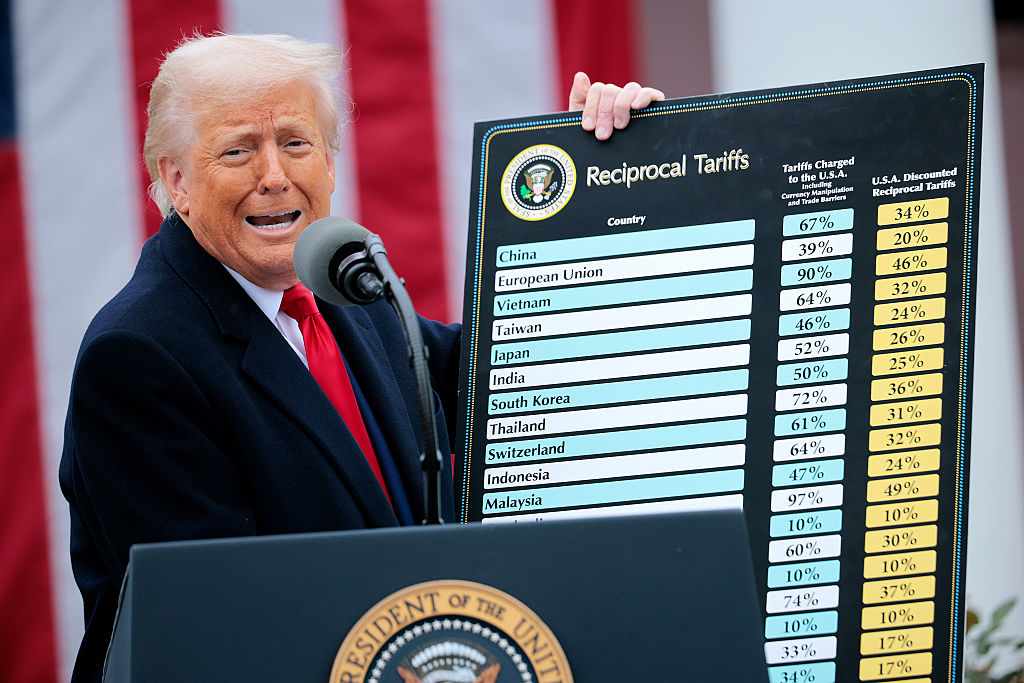
When President Donald Trump unveiled his vast tariff regime targeting imports from almost every country in the world last year, he promised foreign countries would pay the levies and that Americans would reap the rewards.
[time-brightcove not-tgx=”true”]
But a new study published Monday by researchers at the Kiel Institute, an independent economic research institute based in Germany, found that American consumers and importers are paying for the tariffs by an overwhelming margin.
“Foreign exporters absorb only about 4% of the tariff burden—the remaining 96% is passed through to U.S. buyers,” the authors of the research wrote in a study, which analyzed $4 trillion of shipments between January 2024 and November 2025.
Read More: How Trump’s Foreign Policy Gambits Are Reshaping the World
The research found that exporters to the U.S. raised prices to account for the tariffs, or kept prices the same while reducing shipments.
The study concludes that the $200 billion increase in customs revenue that the U.S. government raised in 2025 was a “tax paid almost entirely by Americans.”
Trump unveiled his sweeping “Liberation Day” tariffs, a signature economic policy that defined his first year in office, on April 2, 2025. The tariffs included a baseline 10% tariff on almost all imports, higher country-specific rates for many trading partners, and additional sector-specific tariffs on autos, steel, and aluminum. Several sporadic tariff announcements followed over the year.
Read more: Trump, Tariffs, and the Rewiring of the American Empire
Researchers at the Kiel Institute specifically examined Brazil and India, both of which faced sharp tariff increases in August 2025, and in both cases, exporters did not “eat” the tariffs—a claim Trump often made. The researchers argued that this could be because exporters found competitive markets elsewhere, or because they “believe tariffs may be temporary or subject to negotiation,” in which case they’d have less incentive to cut costs to maintain volume.
In the immediate future, it said consumers are the “ultimate bearers of the burden.”
“Whether through higher prices on imported goods, higher prices on domestically produced goods that use imported inputs, or reduced availability and variety of products, American households pay for the tariffs,” the study found.
This corroborates findings from other think tanks and institutes that have tracked corporate activity since the tariffs dropped. According to the Institute on Taxation and Economic Policy (ITEP), in disclosures at the end of 2025, “industry executives have publicly told investors they are protecting profits by passing the costs of tariffs on to consumers.”
Other researchers at the Harvard Business School, the libertarian think tank Cato Institute, and the Brookings Institution have also argued that consumers are most affected by tariffs.
Trump has given varied justifications for the use of tariffs in his second term—both as an economic measure and a foreign policy tool. Over the weekend, Trump announced new tariffs on European allies who sent troops to Greenland after Trump threatened to annex the island.
“Starting on February 1st, 2026, all of the above mentioned Countries (Denmark, Norway, Sweden, France, Germany, The United Kingdom, The Netherlands, and Finland), will be charged a 10% Tariff on any and all goods sent to the United States of America,” he said on Truth Social on Jan. 17, adding that these tariffs would increase to 25% on June 1, and would remain in effect “until such time as a Deal is reached for the Complete and Total purchase of Greenland.”
The Supreme Court is set to release a much-anticipated ruling on the legality of Trump’s tariffs in the coming weeks. Two lower courts have already found that Trump overstepped his authority by imposing tariffs under the International Emergency Economic Powers Act (IEEPA).