

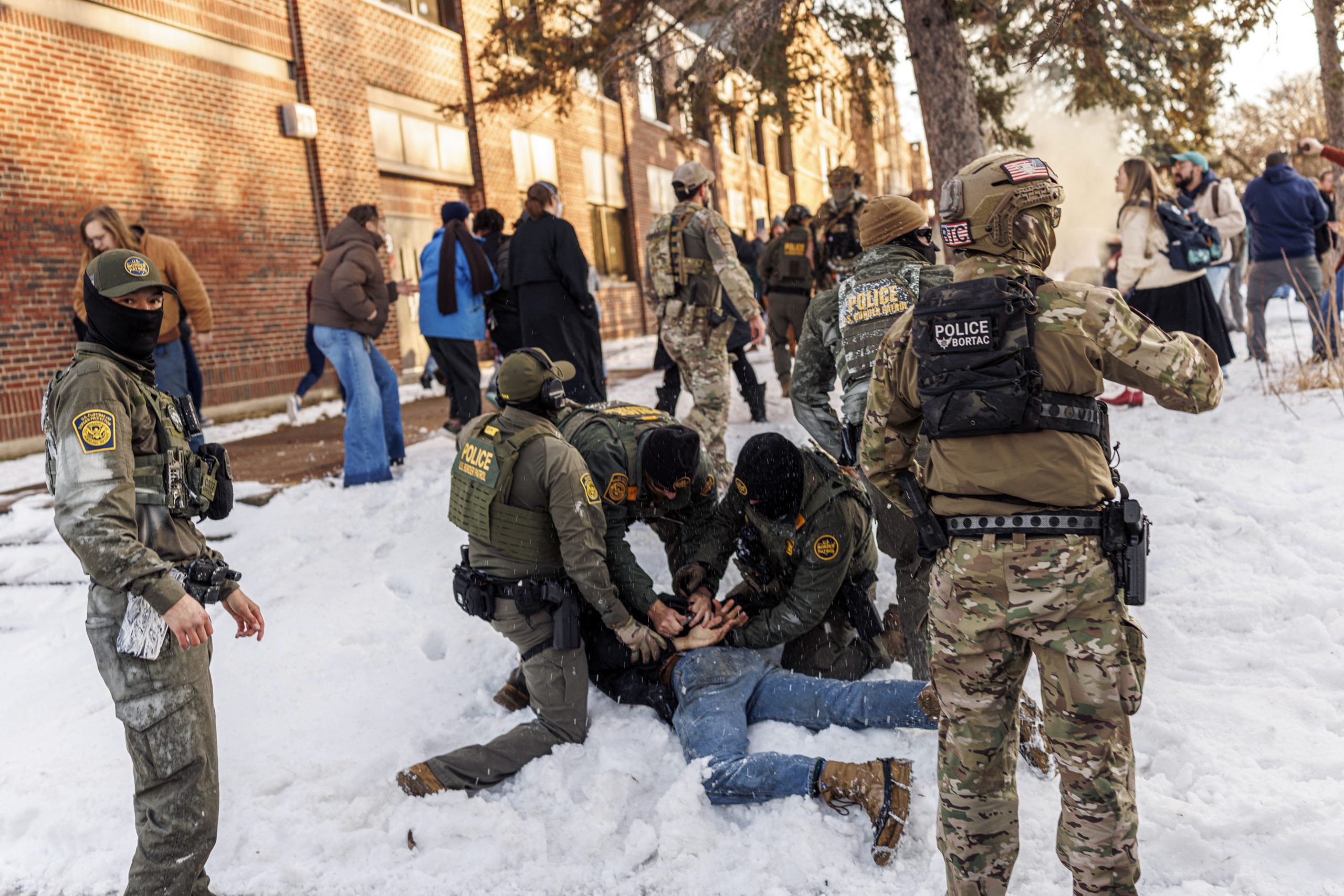
In the hours after the killing of Minneapolis mother Renee Good earlier this month, teachers at Roosevelt High School, some three miles away, were holding a meeting to discuss the impact it might have on the students. It was at that moment that federal agents arrived.
“Most of the staff got up and ran outside, and we came out to a very confusing, loud scene, a bunch of trucks, a bunch of agents out there, and a lot of community members,” a teacher at the school tells TIME.
[time-brightcove not-tgx=”true”]
The agents had been pursuing a woman who was not affiliated with the school in a pickup truck when the car chase ended up in front of the school property. In the chaos that followed, federal agents pepper-sprayed protesters and detained a school staffer.
Read more: Judge Imposes Sweeping Restrictions on the Tactics ICE Can Use Against Protesters in Minnesota
Just a week later, ICE agents detained a parent at another school’s bus stop in a suburban area of Minneapolis, according to a statement from Robbinsdale Area Schools superintendent.
Those incidents, two among many similar cases across the country, highlight how schools have not escaped the pitched battles that have erupted across the country as a result of President Donald Trump’s mass deportation effort.
More than 3,000 federal agents from Immigration and Customs Enforcement (ICE) and Customs and Border Protection have descended on Minneapolis and St. Paul in recent weeks as part of an immigration enforcement surge. Protests against that surge, and against the shooting of 37-year-old Good, have spilled over into local businesses and schools.
In response, the Minneapolis Public Schools are now offering online learning options through Feb. 12, and said it is committed to “maintaining a safe and welcoming learning environment for all of our students.”
“Nobody’s sure how to handle school,” the teacher at Roosevelt, who asked to remain anonymous because they are not authorized to speak publicly, says.
Teaching in a crisis
The teacher described a scene of chaos and confusion when federal agents came to the school that day.
There were about 10 or 12 students present, according to the teacher. Some staff members had herded them back into the school, and some students ran into the public library across the street before the federal agents drove away.
The teacher said that immediately after they saw what was happening, many people, including the assistant principal, started calling the local police, but they never arrived.
“This encounter lasted for about 35 minutes. The police had received many calls that this was happening, and they did not come to the school, they did not come to the school anytime,” the teacher says.
The school security staff member was released later that day.
“I think local officials, local law enforcement, either don’t feel like they have the authority or don’t know what to do when federal law enforcement is in town,” the teacher added.
TIME has reached out to the mayor’s office and the Minneapolis Police Department for comment.
The Department of Homeland Security (DHS) told local TV station KARE in a statement that it was pursuing a U.S. citizen who was “actively trying to impede operations,” adding, “At no point was a school, students, or staff targeted, and agents would not have been near this location if not for the dangerous actions of this individual.”
‘It’s very scary’
The incident at Roosevelt High School prompted students and parents to organize to protect each other’s safety, according to the teacher.
“Many parents of white students or students or parents who are not as impacted by these ICE raids, have been very mobilized to patrol around the school, to help arrange rides to and from school for students who don’t feel safe taking the bus,” the teacher says, adding that families who have been impacted by the ICE raids have been connecting with teachers and staff members to ask for various support, from school materials to rent and grocery deliveries.
But inside the school, the teachers face a challenge of maintaining a sense of normalcy while acknowledging what’s happening outside the classroom.
“I think teachers are trying to balance, how much content do they teach? How much do we talk about what’s going on? How much do we allow space for kids just to focus on school work, but also being empathetic to many students who are fearing for the safety of their families, fearing for their own safety, having worries about rent or food insecurity,” the teacher says.
Many students are choosing to stay home. The teacher says that about a fourth of his class is participating in online learning.
While the teachers can be flexible with how to post assignments and give lessons, there is no guidance on how to teach during a crisis.
“When our school shut down for COVID, it was kind of like, oh, there’s this unknowable thing, and we’re listening to government guidance. When the government is the one doing this to you, it’s very scary. It’s very isolating,” he says.