

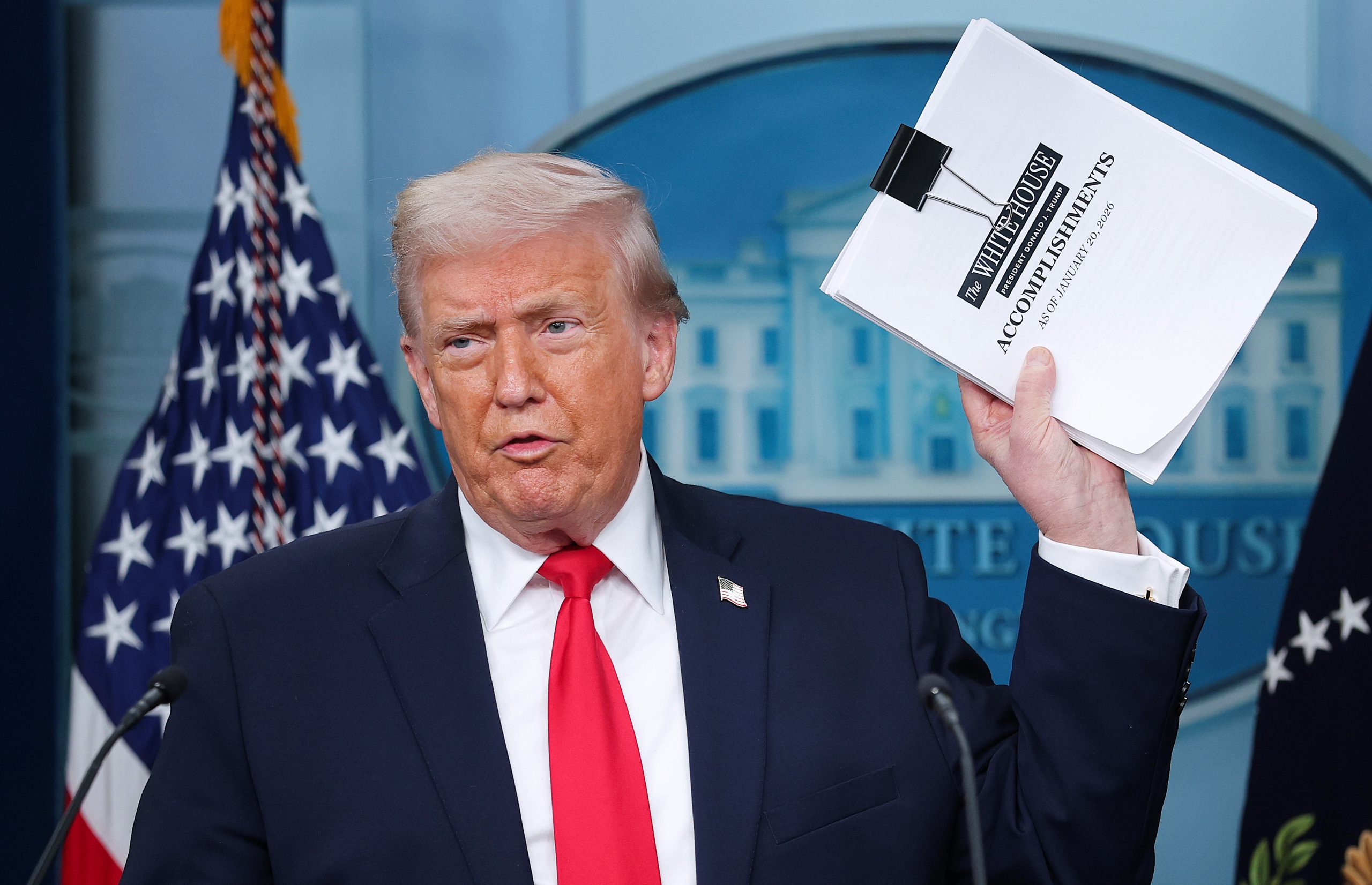
President Donald Trump’s renewed push to annex Greenland, seemingly at any cost, has led to calls for his removal from office.
When asked how far he will go to acquire the Kingdom of Denmark territory, Trump told reporters on Tuesday: “You’ll find out.” The ominous response came after weeks of the White House refusing to rule out using military force to annex the island. Trump sparked global outrage over the weekend by threatening to tariff European allies until Denmark sells Greenland to the U.S. He’s set to come face-to-face with some of those countries’ leaders at Davos.
[time-brightcove not-tgx=”true”]
Rep. Don Bacon of Nebraska, who is among the Republicans to denounce Trump’s Greenland efforts, has said he would “lean” toward impeachment if the U.S. were to invade the territory.
“I don’t want to give you a definite yes or no, but I would lean that way. It would be a total mistake to invade an ally. It would be catastrophic to our allies and everything. It’s just the worst idea ever in my view,” Bacon told the Omaha World-Herald.
Other critics have suggested alternative means of removing Trump from office.
Trump, in a letter to Norway’s Prime Minister Jonas Gahr Støre, reportedly linked his failure to win a Nobel Peace Prize to his efforts to acquire Greenland. He’s quoted as saying “no longer feel[s] an obligation to think purely of peace.” In response to the reports, one Democratic Senator called for Trump to be removed from his Commander-in-Chief position by way of the 25th Amendment.
“Invoke the 25th Amendment,” said Sen. Ed Markey of Massachusetts. Democratic Rep. Yassamin Ansari of Arizona expressed a similar sentiment, arguing: “The 25th Amendment exists for a reason—we need to invoke it immediately.”
After Trump posted a flurry of late-night social media posts on Monday, during which he said there was “no going back” on Greenland, other lawmakers raised concerns.
Democratic Rep. Sydney Kamlager-Dove of California said of the President: “He’s risking the safety of every American. Invoke the 25th.”
This isn’t the first time the 25th Amendment has been mentioned in reference to Trump. In a 2018 anonymous op-ed in the New York Times, a “senior official in the Trump Administration” said there “were early whispers within the cabinet of invoking the 25th Amendment” during Trump’s first term. (Miles Taylor, the former chief of staff in the Department of Homeland Security, later claimed ownership of the op-ed.)
As renewed calls grow for the 25th Amendment to be invoked, here’s what you need to know about the U.S. legislation.
What is the 25th Amendment?
The 25th Amendment ensures that “the United States will always possess a functioning President and Vice President” and that in the event of the President’s removal from office, it “provides for the prompt, orderly, and democratic transfer of executive power,” according to the Constitution.
It was introduced following the assassination of President John F. Kennedy in 1963 and ratified by Congress in 1967 to establish a constitutional procedure to transfer Presidential powers.
The law is implemented across a number of scenarios, including if the President dies or resigns while in office under Section 1 or the President themselves withdraws from the position, which can be temporarily, under Section 3.
If it is decided that the President is “unable to discharge the powers and duties of his office,” Section 4 of the Amendment can be used. In such scenarios, the Vice President will take up the position of President.
Now, lawmakers are calling for the Amendment to be applied within Section 4, with many Democrats expressing the opinion that Trump is unfit for office and should be discharged.
When was the last time the 25th Amendment was invoked?
Section 3 of the Amendment, which gives the President the ability to transfer power to the Vice President, has been used a number of times, most recently by President Joe Biden in November 2021 when he was anesthetized for a routine medical procedure.
The same scenario occurred twice during George W. Bush’s Presidency, in 2002 and 2007, for medical reasons. These transfers of power to the Vice President have typically only lasted a few hours each time.
Section 4, in which the Vice President and the majority of the 15-member cabinet can vote to discharge the President, has never been formally invoked.
Can the 25th Amendment be used to remove Trump from office?
In order for the 25th Amendment to be implemented, there first must be concerns regarding one’s ability to perform their duties as President.
Per Section 4, this could come in the form of serious health issues, which some previously cited as an argument to remove Biden from office.
For Section 4 to be carried out, the Vice President and a majority of the 15-member Cabinet must declare the President unable to perform their duties. But the threshold for this scenario is “incredibly high” says Nicholas Cole, a senior research fellow at Pembroke College, Oxford University.
As TIME magazine previously noted of the Amendment’s ratification in 1967: Under the amendment, an incapacitated Chief Executive can himself declare in writing that he is unable to continue in office, and the Vice President can take over—at least temporarily. If an ailing President is unable or unwilling to step aside voluntarily, the Vice President and a majority of the Cabinet can send a written statement to Congress declaring that the President is incapable of holding office. If the President were to challenge such a resolution, Congress itself would vote on the question. The amendment also authorizes the President to appoint, and Congress to confirm, a new Vice President if a vacancy occurs in that office.
“This idea that the Vice President and the President’s own cabinet are going to take the view that a set of policy decisions indicate that the President has [some kind of] incapacity is a case I can’t see,” says Cole.
He adds that should lawmakers, Republicans or Democrats, be unsatisfied with the President’s ability to perform his duties, then impeachment is a far more suitable avenue to pursue.
In the unlikely scenario that the Vice President did issue such an order with a Cabinet majority, they would assume the President’s role, informing Congress of the decision. Trump would then likely immediately contest the decision, and Congress would hold a vote within 48 hours, Cole says.
“It would take a two thirds vote of the Congress to side with the Vice President. So that threshold is the same as for impeachment. If you think you’ve got the votes to do that, you go for impeachment,” he says.