

Atop a slope at Banger Park in Scharnitz, Austria, in July, freestyle skiers and snowboarders from a host of countries—Poland, Spain, Switzerland, Ukraine—have begun training in earnest for the upcoming Milano Cortina Winter Olympics, which kick off Feb. 6. The athletes, mostly male and mostly dressed in baggy sweats or cargo pants, take turns riding down a dry synthetic ski surface, flying off a ramp, and doing aerial tricks before falling onto an airbag. On occasion, they consult with their coaches about technique, but some also spend ample time goofing around. A few play reggae music and mug for cell-phone cameras.
[time-brightcove not-tgx=”true”]
Then there is Eileen Gu.
Gu, the double-Olympic champion who made the controversial decision to represent China instead of her native U.S. at the 2022 Beijing Games, is wearing a sleek black ski suit, embroidered with her gold personalized logo and an army of serpents—it’s the Year of the Snake on the Chinese lunar calendar. Two Latin phrases are inscribed on her uniform: Non Ducor, Deco (I am not led. I lead) and Veni, Vidi, Vici (I came, I saw, I conquered).
After almost every jump, Gu huddles with her mother and confidante, Yan, to review footage Yan recorded on her phone. They break down her flips and twists in technical detail, with Gu dropping references to motor-neuron activation, momentum, and axis rotation that require advanced study to decipher—fitting, as Gu has taken quantum physics at Stanford. In her sport, Gu says, “it’s not too cool to try too hard. I’m super unapologetic about it. That’s the fun part for me. It’s super addicting. I’m totally obsessed with it.”
To that end, Gu asks X Games and world champion Swiss free skier Andri Ragettli, who is also training that day, to examine her takeoff on a new complex trick she’s trying. Ragettli watches Gu’s run, then gives his assessment to Yan: Gu isn’t generating enough power yet to pull off a difficult “blunt” maneuver—reaching back and grabbing the tip of a ski with her same-side hand midair. His advice? Try something easier first.
When Yan shares Ragettli’s feedback with her daughter, Gu rolls her eyes. “All right, bro,” she says. “I don’t want to hear ‘You can’t do it.’ I don’t believe in limits.”
There is, indeed, little Gu can’t do. Her performance in Beijing, where she became the first action-sports athlete to win three medals at the same Games—golds in big air and halfpipe, silver in slopestyle—made her a global superstar. The all-time leader in free-skiing World Cup wins, Gu has continued to rack up victories, including a first-place finish in December at the inaugural freeskiing competition, outside Beijing, for the Snow League, the new freestyle-sports organization started by Olympic champion snowboarder Shaun White. “The thing that really sticks out,” says White, “is that she’s a once-in-a-generation athlete that has the whole package.”
Fans in China, where Gu is so popular she can’t walk outside without stirring a commotion, waved Eileen Gu flags at the bottom of the halfpipe. “The numbers say that I’m, competitively, the best free skier that’s ever lived,” says Gu. Since her Snow League victory, she has won two more World Cups, bringing her total to 20.
Since those Beijing Games, Gu, 22, has hopscotched the world to appear at fashion shows and events—modeling for Victoria’s Secret in New York City and Barcelona, and for Louis Vuitton in Paris; opening and closing the Bosideng show in Milan; closing the Brunello Cucinelli show in Shanghai; and posing for the Sports Illustrated swimsuit issue. She’s also kept sponsor commitments to brands like Red Bull, Tiffany, and Porsche, and Chinese companies such as Anta Sports, Mengniu Dairy, and Luckin Coffee, while enrolled at Stanford. (Gu finally heeded Yan’s advice to take 2025 off from school for Olympic prep, but not without protest.)
“I’m a full-time student who’s really athletic,” says Gu. “I can have a conversation with a physicist and stand my ground, and I can also walk a runway show the next day. I think that is pretty revolutionary, especially as a young person. Because the whole multihyphenate thing often happens in different stages in life. It’s important to show young people that you don’t have to wait until you’re older. You can do it all now.”
But while her fame has extended far beyond the quadrennial event, her journey has not been without strife. During the Beijing Olympics, some commentators criticized Gu’s choice to suit up for China, given that she grew up in the Bay Area and spent time with the U.S. team as a younger athlete. They blasted it as a betrayal. At the same time, despite her massive popularity in China, some Chinese critics have cast her as an interloper. She also, like other Olympic champions, struggled with mental-health issues after the event.
Read More: How to Watch the Winter Olympics
The upcoming Olympics will do little to ease the pressure, as not only do the U.S. and China continue to lock horns, the current occupant of the White House has shown a willingness to lash out at athletes. So Gu enters these Games as more than just an extremely talented skier. She’s a test of humanity’s collective ability to refrain from weaponizing a single Olympian during what’s supposed to be a two-week celebration of athletic excellence.
A refusal to be swayed by outside voices has served Gu well so far, even if she can’t totally block out the noise. Having spent the past four years getting a real taste for what’s out there, she is clear on why she is returning to defend her medals and extend her glory. “I’m doing this because I’ve seen the world and the best that it has to offer,” she says, “and I think that this is the best thing in the world.”
For a time growing up, Gu aspired to join the cross-country team at Stanford, but her skiing talent won out. Still, because she continues to appreciate the head-clearing benefits of a jog, I join her after practice for a run on a backwoods trail that crosses the border into Germany, asking questions about her upbringing until she takes off and I’m unable to keep up. Gu tells me she played imagination games with her friends until she was in about sixth grade. They’d pretend they were on grand adventures. Yan—who emigrated to the U.S. from China in the 1980s, obtained an M.B.A. from Stanford, and worked in finance—grew concerned that her daughter was a bit too old for this sort of thing. Gu, however, believes this habit is still paying dividends. After all, she regularly imagines herself executing a trick before doing it. “There’s so many signs now of a correlation between visualization and actually performing a movement,” she says.
Gu started skiing when she was 3, picked up freestyle at 8, and by the time she was 9 won a national junior title. Yan, who raised Gu as a single parent, would drive her daughter from their San Francisco home to train in the Lake Tahoe area on the weekends, a four-hour trip each way. Gu spent that time sleeping, eating, doing homework, and bonding with her mother. “It was integral to our relationship,” she says.
During the summers, Gu studied in Beijing, where Yan had graduated from Peking University. As a biracial young woman, she stood out. She’d call a taxi driver for a ride to school and speak perfect Mandarin, but the driver would often pass right by her at the intersection. “They would see me visually and be like, that can’t be the person I just talked to on the phone,” says Gu. “I’d be late to class every morning.” Still, she grew to love Chinese culture. In the summer of 2015, at age 11, Gu was teaching other young girls how to flip on a trampoline when she heard that Beijing would host the 2022 Olympics. She told Yan she’d be at those Games, thanking people in Chinese.
Representing China was always on her radar. Freestyle skiing barely existed there, and Gu figured she could inspire more people in the country, especially girls, to take up the sport. “The U.S. already has the representation,” says Gu. “I like building my own pond.” She insists the potential to earn more representing Chinese companies didn’t cross her mind. “I’m glad that there’s enough money in the sport now for people to think that’s a consideration,” she says.
She competed in three World Cups for the U.S. during the 2018–2019 season, finishing 11th, second, and first in three slopestyle events. Aware that Gu was drawing considerable interest from China, Tiger Shaw, then president and CEO of U.S. Ski and Snowboard, met with her and her mom in Park City, Utah, and laid out a plan for how the U.S. could support her. Both sides characterized the gathering as amicable. “We took our best shot,” says Shaw. “We were sad to lose her, but we were very happy for her when she triple-medaled in Beijing. What a storybook.”
In June 2019, Gu, who was 15, posted on Instagram that she’d compete for China, calling it an “incredibly tough decision.” As the hometown favorite in Beijing, Gu—dubbed the Snow Princess in China—faced extreme pressure to deliver. Meanwhile, before the opening ceremonies, Tucker Carlson called Gu’s decision to represent China “dumb” on his prime-time Fox News Channel show. Guest Will Cain called Gu “ungrateful” and “shameful.”
During her first event, big air—in which competitors skied down a 200-ft.-high ramp to showcase their most magnificent tricks—Gu knew she’d have to try something spectacular in her final run. She decided on a double cork 1620, 4 1/2 spins in the air while rotating twice off axis, a trick she had never even attempted in practice. Gu shared her plan with Yan, who was at the venue, over the phone. Yan, concerned for her daughter’s safety, remembers her initial response as: Oh my God, no, no, no, no, no.
Gu reminded her mother they had always talked about the importance of trying to break new ground. “My whole thing was, it’s all upside,” says Gu now. “Because if I land, I will win the Olympics. If I don’t land, then I get to make history as the first person to ever try this trick in such a situation. It’s a decision that I would be super proud of and live with forever.”
“Eileen, you have less than one minute until drop,” Yan told her. “We have no time to talk about philosophy.”
Gu let out a cathartic scream when she landed the 1620. “It was like the definition of a perfect play,” says NBC commentator Tom Wallisch. Thomas Bach, the president of the International Olympic Committee at that time, told Yan it was the most emotional moment he had witnessed at an Olympics. “With all the discussions in the U.S. and China, everybody felt obliged to make comments, extremely stupid some of them,” says Bach, who stepped down from his position in June 2025. “I don’t need to be so diplomatic anymore.”
Questions about Gu’s citizenship status, rather than the dramatic victory, dominated the post-event press conference. Olympians must be citizens of the country they represent, and China does not allow dual citizenship. But no evidence suggests that Gu has renounced her American citizenship. So did China make an exception for Gu? During an hours-long interview in the Scharnitz rental house she’s sharing with Yan, Gu declines to engage on the citizenship question. “I don’t really see how that’s relevant,” she says. (The Chinese Olympic Committee did not respond to a request for comment.)
She tried not to take the backlash personally. “There are geopolitical factors at play, and people just hate China generally. So it’s kind of difficult when I’m lumped in with this evil monolith that people want to dislike,” says Gu. “It’s never really about me and my skiing.” In late 2024, the Chinese government announced that around 313 million people had taken up ice and snow sports, or related leisure activities, since the 2022 Olympics. “I’ve made a lot of positive impact at nobody’s expense,” says Gu. “And I genuinely mean this without a hint of sardonic humor: use the time and creativity that it takes to craft some of these insults to think about what your talents are, and how you can use them to make the world better.”
She doesn’t believe it’s her place to comment on, say, China’s checkered human-rights record. For example, the U.S. government has accused China of abuses against its majority-Muslim Uighur population. “I’m not an expert on this,” she says. “I haven’t done the research. I don’t think it’s my business. I’m not going to make big claims on my social media.” But as a Stanford international-relations major, she could surely do her homework on this issue, no? “I’m just more of a skeptic when it comes to data in general,” says Gu. “So it’s not like I can read an article and be like, ‘Oh, well, this must be the truth.’ I need to have a ton of evidence. I need to maybe go to the place, maybe talk to 10 primary-source people who are in a location and have experienced life there. Then I need to go see images. I need to listen to recordings. I need to think about how history affects it. Then I need to read books on how politics affects it. This is a lifelong search.”
So if she’s asked about Donald Trump’s China tariffs during an Olympic press conference in Italy, don’t expect a weighty answer. “I would just say, ‘I didn’t know I got promoted to trade minister,’” says Gu. “It’s irresponsible to ask me to be the mouthpiece for any agenda.”
One thing Gu had researched, going into the Beijing Games, was the phenomenon of post-Olympic depression. Star Olympians, most notably Michael Phelps, have opened up about the difficulties of the comedown. But although Gu tried to be prepared for the blues, they still got the best of her, thanks in large part to the severe restrictions facing participants of those COVID-era Games in China. Those Olympics were mentally draining enough for athletes, given their limited mobility in a COVID bubble, fears of testing positive and missing competitions, and inability to soak up the experience with fans and friends. But then Gu quarantined for a few weeks after the Games in the nearly deserted Olympic village. “I’m actually living in the shadow of my past,” says Gu of her experience at the time. “Every corner I turn is an empty village, and that’s how I feel inside.”
One morning Gu opened her blinds in a Beijing hotel and saw her likeness on five or so billboards outside. “Everything was me,” she says. But she began to wonder if her life had peaked at 18. Gu describes herself as an introvert who enjoys solitude. In the months after the Olympics, however, she experienced a troubling shift. “I felt alone with myself, which I don’t think I had felt before,” she says. “It was harder for me to be in my own company and feel at peace.” Negativity seeped in. “There was a lot of guilt, a lot of ‘I should be doing more,’” says Gu, as if making Olympic history as a teenager weren’t enough. “But I can’t muster the energy, or assign the meaning, to want to do it. If all the motivating power and energy that you draw to do something is fear-based, as opposed to desire-based, that’s a dangerous spiral to be in.”
Read More: Meet the U.S. Olympic Figure Skating Team
“I was pretty worried,” says Yan, who admits she wasn’t always sure how to handle her daughter’s difficult moments. “She is always the more mature person. She said, ‘Mom, you can’t be mad when I’m vulnerable. This makes the situation worse.’ And I’m like, ‘How are you so logical?’ She said, ‘That’s how it works. When I’m down, you pick me up.’”
Gu smiled at events like the Met Gala. But beneath a glamorous veneer, she was struggling. “I always wanted to leave no matter what situation I was in,” she says. “I wanted to go home when I was out, and I wanted to go to sleep when I was awake. I never felt like I was where I was meant to be.” What’s more, some people in China were taking shots at Gu, framing her as an opportunistic outsider. In 2024, for instance, she says she saw messages implying that she had blond highlights in order to downplay her Chinese identity, giving preference to her white American side. “Because I’m mixed, it’s not OK,” says Gu. “But if I was fully Chinese and I dyed my hair blond, it actually would be fine. It’s so random.” Bot armies, she says, began harassing her. “I was pretty bothered,” says Gu. “I wanted to argue back, because it was just so unjust and violating. But if I clapped back at every single thing that’s factually incorrect, I would have no life.”
Gu attended the Paris Olympics, where she ran the public marathon and posed for a photo with Chinese swimming medalists after an event. Critics accused her of stealing their spotlight. Others were upset that she fraternized with Léon Marchand, the French swimming standout who was accused of racist behavior for allegedly blowing off a Chinese coach who went to shake his hand. (Marchand later said he didn’t see the coach and apologized; the pair exchanged gifts.) “It really blew up into a whole thing,” says Gu. “And honestly, I was really surprised. Do we really have nothing better to do?”
Stanford, where she enrolled in the fall of 2022, helped calm some of the chaos. Gu threw herself into student life, joining a sorority and even forming an informal coed basketball operation, the Gu-League, which had some 40 members playing for different teams. She organized friend outings to a local playground for games of freeze tag and to a trampoline park. “A sense of whimsy,” Gu says, “is one of the most underrated qualities in this day and age.”
“She’s very, very present,” says Sawyer Williams, one of Gu’s close friends at Stanford. “When she’s at school, she’s 100% at school. When she’s skiing, she’s 100% skiing. When she’s modeling, she’s 100% modeling. Separating those parts of her is why she’s able to be so good at everything she does.”
Still, Gu couldn’t quite shake those post-Olympics feelings, even as she appeared to be managing a full and varied life, using long flights to knock out schoolwork. “I haven’t watched a movie on a plane in years,” she says. During a two-week stretch of 2023, she attended a sorority formal at Stanford, walked for Victoria’s Secret in Barcelona the next night, and appeared at a Louis Vuitton show in Italy three days later. She then flew to the U.S., where she helped plan a surprise party for a friend, brought friends to an Asian street-food market in San Francisco the following night—Gu wore sunglasses and a black hoodie so she wouldn’t be recognized—went back to Paris for a nobility ball, then returned to Northern California, where she served as graduation speaker for a K-8 girls’ school four days later. Then she took her Stanford finals.
Read More: Ralph Lauren Unveils Team USA’s Winter Olympic Uniforms
Amid this flurry of activity, Gu went on a run in the Presidio. On her phone, she shows me a picture from it: Gu, pale and staring miserably into the camera. She’d just had a panic attack. It wasn’t her first, nor would it be her last.
The woman I meet in Austria certainly resembles the one in the photo, but she also looks wholly different. She’s comfortable and loose. At one point during their stay in the country, she and her mother switched rental spaces. Gu sized up their new digs, a condo with a bachelor-pad feel—fireplace, sauna, hot tub, humongous grill. “This is very manly,” she says. “Raaaaaah. We’re here, we grill.”
How did she go from those lows to this high? Gu offers no magic bullet, but the passage of time and the ability to focus her energy on fewer things seem to have played a role. “You get to see me in my ideal environment,” she says. “I get to do my favorite thing in the morning, and then do my second favorite thing in the afternoon, and then hang out in this nice house in this small town where no one knows me or can bother me, and I’m just in my house with my mom, and then I just get to be by myself.”
Gu tells me about a run she went on around Scharnitz in 2024—with Yan accompanying her on her bike—where she jogged over to the side and almost vomited. Another panic attack. A year later, on a similar run, not even pouring rain could stop her continuing into a small German town where people were huddled in cafés to avoid the shower. “It was 90 minutes of like, ‘Wow, it’s so nice not being depressed anymore,’” says Gu.
Daily reports from Stanford friends have also helped her perspective. They’re working long hours at jobs and internships. They’d love to see some sunlight and get in a workout more than once every three weeks. Gu’s occupation releases dopamine on a daily basis, draws in fans who enjoy watching her win, and sparks some of them to try a new activity. “It has a broader social good,” says Gu. “It is the most fulfilling job I could think of.”
Plus, she’s spent the past four years in what she describes as “data collection” mode, crisscrossing the globe, trying on different hats, and “erasing FOMO.” “I think then I was doing what I knew how to do,” she says of her first Olympics. “Now I feel like I’m doing what I want to do. If I wanted to retire and rest on my laurels for the rest of my life, hypothetically, I could do that. I could support myself and my family and feel good for the rest of my life. The fact that I still want to do it means that I’m choosing to do it of my own free will and volition, which I think is more impactful and requires more agency, which in a lot of ways is more rewarding.”
Gu, who will return to Stanford as a junior after the Olympics, already has a post-skiing dream job in mind. But she’s unwilling to share it. “I don’t want to commit myself to something and close other doors,” she says. She is, however, closing the door on serious relationships, at least for now. Yan encourages her daughter to date. But Gu is content with her life as is. “When I’m not skiing, I’m recovering aggressively,” she says. “I’m cooking nutritious meals for myself. I’m going to the gym. I’m sleeping early. If nothing else, I’m sitting by myself quietly and reading. Those are all value-added things in my life. And I honestly feel having other people here would objectively just make my life worse. I have to then restructure my run so that I can have dinnerrrrr? I feel like it’s so stupid and annoying.”
She’s got enough going on right now—specifically, the potential to best her Beijing performances and sweep her three freestyle skiing events in Italy. “It’s a much bigger challenge to do something multiple times than to do it one time,” says Gu. “What you don’t want to do is enter the defense thing, where you’re fearful. ‘Everybody’s on my tail. I’m looking back.’ That’s all wrong. And I don’t think that’s what I’m doing.”
Gu has disciplined herself to practice as if she’s a rookie. She still spends hours tinkering with tricks in adverse conditions while her compatriots run for cover in the lodge. But she can also draw on experience during the nerve-rattling moments of major events. “I train like I’ve never won,” says Gu during our final conversation in Austria, over dinner in Innsbruck. “And I compete like I’ve never lost.”
A few days later, during a Sunday practice session at Banger Park, Gu again tries that complex trick she was working on, the one with the difficult grab that the Swiss X Games champ, Ragettli, told her to build up to.
She lands it.
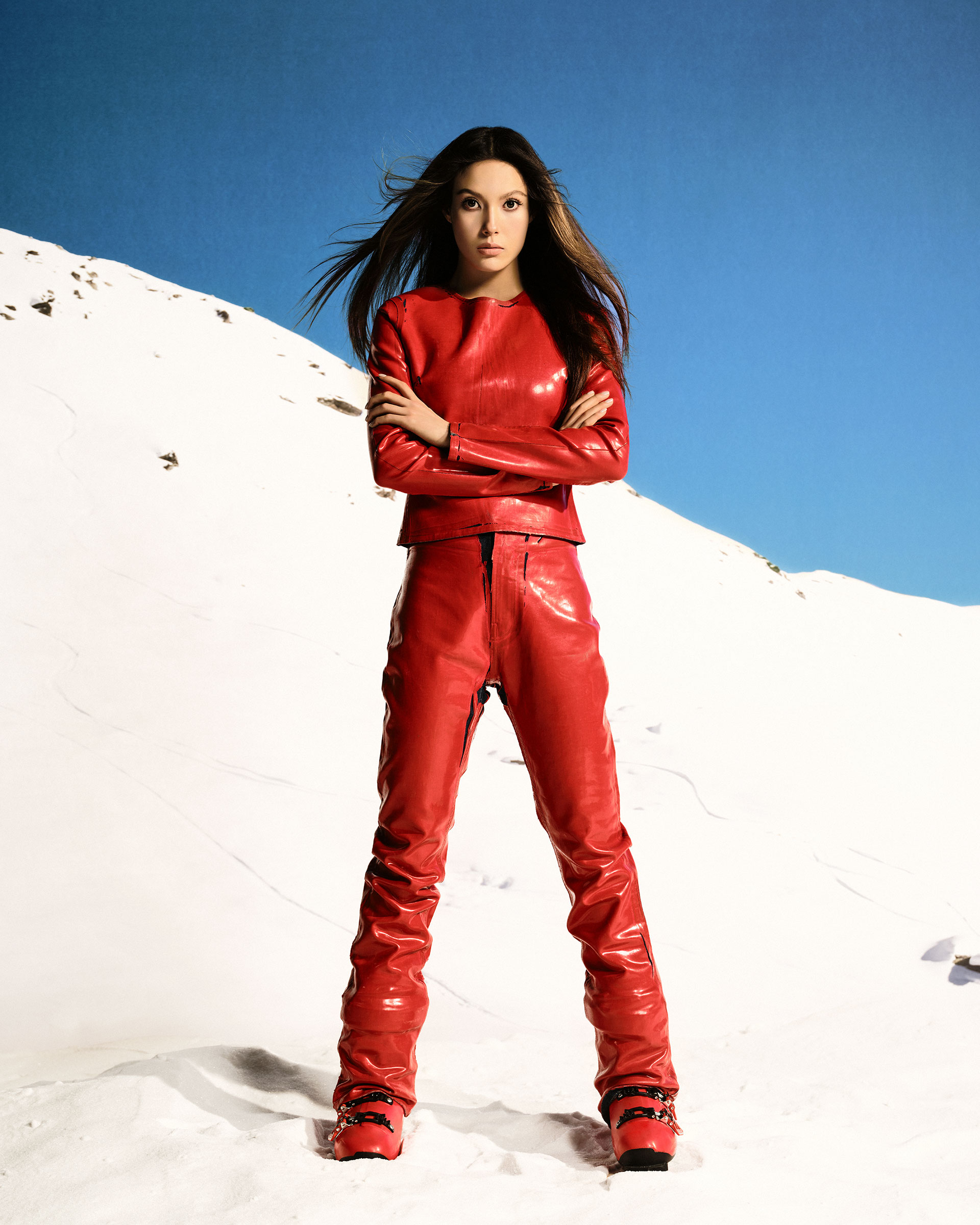
Set Design and Production by Adam Chen; Styling by Jeff Lee; Hair by XiaoTian Xu; Makeup by He Lei