

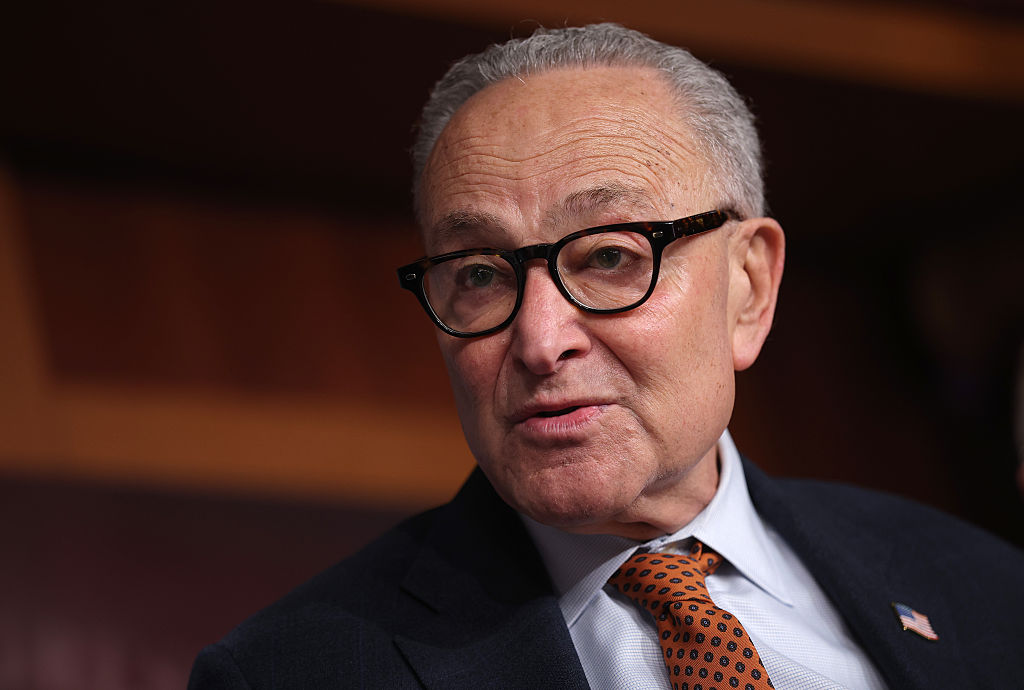
Senate Democrats on Wednesday revealed a set of demands to overhaul U.S. Immigration and Customs Enforcement, tying the changes to a must-pass spending bill as Congress raced toward a partial government shutdown that could begin early Saturday.
After a closed-door caucus meeting, Senator Chuck Schumer of New York, the Democratic leader, said his party had coalesced around three legislative objectives that they say are necessary to rein in ICE, which they accuse of operating with little accountability under President Donald Trump. Those demands include tightening ICE’s warrant requirements, introducing a uniformed code of conduct for its agents, and requiring all ICE agents be unmasked and with operating body cameras, he said.
[time-brightcove not-tgx=”true”]
“We want to end roving patrols,” Schumer said, laying out Democrats’ first demand. “We need to tighten the rules governing the use of warrants and require ICE coordination with state and local law enforcement.”
Second, he said, Democrats want to “enforce accountability,” including a uniform federal code of conduct and independent investigations into alleged abuses. Federal agents, he argued, should be held to the same use-of-force standards as local police and face consequences when they violate them.
Third, Schumer said, Democrats are demanding “masks off, body cameras on,” a reference to proposals that would bar agents from wearing face coverings, require they wear body cameras and mandate that agents carry visible identification. “No more anonymous agents, no more secret operatives,” he said.
“These are common-sense reforms, ones that Americans know and expect from law enforcement,” Schumer added. “If Republicans refuse to support them, they are choosing chaos over order.”
The Democratic push follows the fatal shooting of Alex Pretti in Minneapolis by a federal immigration agent last weekend—the second such killing in the city this month—which has inflamed tensions in a divided Congress as the Senate confronts a Friday night deadline to fund much of the federal government.
While Democrats say they are prepared to pass five of the six remaining appropriations bills before the Senate, they are insisting that the Department of Homeland Security funding measure be separated out or rewritten to include statutory limits on ICE.
“They violate constitutional rights all the time, and deliberately,” Schumer said. “This is not law and order. This is chaos created at the top and felt in so many of our neighborhoods.”
A White House official tells TIME that the Trump Administration is “committed to avoiding a shutdown, and to productive dialogue with Congress,” but argued that Democrats were effectively demanding a partial government shutdown by conditioning funding for the Department of Homeland Security on legislative reforms less than 48 hours before the deadline.
The official asserted that the bipartisan appropriations package—which passed the House last week with seven Democratic votes before Pretti was killed— should move forward as written, and accused Democrats of walking away from that agreement. “The White House urges congressional Democrats not to subject the country to another debilitating government shutdown,” they said.
But Senator Patty Murray of Washington, the top Democrat on the Appropriations Committee who helped craft the bill, said the latest Minneapolis killing marked a turning point. “The brutal killing of Alex Pretti was an inflection point for this country,” she said. “We are saying enough.”
Murray rejected Republican claims that separating the DHS bill would be procedurally impossible with the House out of session, and not due back in Washington until next week. “It’s not like the House can’t come back and vote on this too,” she said, noting that lawmakers have returned from recess before to resolve funding disputes. “So there’s no good reason for Republicans not to work with us here.”
Republican leaders have pushed back sharply, warning that Democrats are risking a shutdown that would disrupt disaster relief, air travel and national security operations—while doing little to affect ICE itself.
Senator John Thune of South Dakota, the Republican majority leader, argued that the existing DHS funding bill already includes other changes Democrats have sought, including $20 million for body cameras and funding for de-escalation training. He also noted that passing a short-term continuing resolution to keep DHS operating would actually provide more money to ICE than the negotiated bill would.
“The ironic thing about this is that the DHS funding bill, if enacted, would spend less on ICE than a continuing resolution,” Thune said. He emphasized that the bill also funds FEMA, the Coast Guard and the Cybersecurity and Infrastructure Security Agency. “That’s a lot of pretty important stuff.”
Thune and other Republicans have also stressed that ICE would not be severely affected by a shutdown because the agency already received substantial funding last year through Trump’s sweeping domestic policy law, dubbed the “one Big, Beautiful Bill.”
“It doesn’t really affect ICE,” Thune said of a shutdown. “It would affect funding for some really important agencies of government that the American people rely on, like FEMA—particularly at a time when we’ve got a lot of weather-related disasters.”
Senator John Barrasso of Wyoming, the Republican majority whip, echoed that warning, saying a shutdown heading into the weekend would halt FEMA funding as major storms batter parts of the country and disrupt TSA operations and air traffic control. “Democrats will be causing chaos all across America,” he said.
Republicans have also cautioned that amending the DHS bill would require sending the entire six-bill package back to the House, which passed it last week and is not scheduled to return until Monday. Thune described that prospect as a “steep hill to climb,” especially given opposition from the conservative House Freedom Caucus, a bloc of hard-right Republicans in the lower chamber which issued a warning on Tuesday that they would potentially tank procedural votes required to advance any alternative funding package.
Republican Rep. Chip Roy of Texas, a member of the Freedom Caucus, posted on X shortly after Schumer’s announcement that he would demand “no sanctuary city funding” if the DHS bill opened back up, a reference to cities in which local law enforcement doesn’t routinely work with federal immigration authorities.
Democrats quickly rejected proposals from some Republicans that they settle for executive promises from the Trump Administration related to changes in ICE’s protocols. “The White House has had no specific, good concrete ideas in terms of what we want,” Schumer said.
“It’s now on Leader Thune to separate out the DHS bill, just as Speaker Johnson did in the House, and start working with Democrats to rein in ICE, imposing oversight, accountability and empowering local law enforcement in our communities,” he added. “Our communities deserve it. The American people deserve it.”
Still, it remains unclear how far Democrats are ultimately willing to go to force the changes they are demanding. Just months ago, several Democrats backed down and ended a record 43-day government shutdown over healthcare funding without securing their core demand.