

The profound crisis facing the United States—masked security forces aggressively preventing people from lawful protest, disappearing people into detention centers, deporting people without due process, denying them access to lawyers and families, and killing them in the streets for bearing witness—reminds me of battles my father fought against a dictatorship in Africa.
[time-brightcove not-tgx=”true”]
As a teenager in Kenya, I watched my father defend political detainees in court—people who dared to criticize the government. Kenya choked under the dictatorship of Daniel arap Moi, who ruled from 1978 to 2002. Some of my most formative memories are of critics disappearing into the basement of Nyayo House in Nairobi, a notorious torture and detention center where the vanished would not be heard from for weeks, months, or even longer. Their crime was raising their voices against a repressive government that relied on brute force and surveillance of its citizens for its survival, a regime whose authority rested on force and fear. It was a terrible time.
The start of the downfall of the Daniel arap Moi dictatorship belongs, among others, to a small group of courageous Kenyan lawyers who at great risk dared to challenge these government abuses in court. They broke the silence that eventually led to nationwide demands for democratic openings. One of those lawyers was my father, Pheroze Nowrojee.
Pressure from the U.S. and other multilateral donors at Paris Club meetings during those years also helped shape Kenya’s tumultuous transition to a fledgling democracy. After the end of the Cold War, Washington began to champion a trinity of values: human rights, democracy, and free markets. In March 1998, President Bill Clinton embarked on a tour of Africa, and at a rally in Accra, Ghana, he declared, “Democracy requires human rights for everyone, everywhere.” American governments would routinely speak up to support democratic champions who spoke out against regimes defined by a similar lexicon of terror in Latin America, Africa, or Asia.
Many years later, I followed my father’s example and spent my career as a human rights lawyer, documenting how repressive governments erode the rule of law and operate without accountability to consolidate their power and silence critics. I have watched this pattern across continents, and the mechanics of repression are unsettlingly consistent: vulnerable populations are demonized, the people who stand with them in solidarity are targeted, and each unpunished abuse becomes the norm. I am sad to see it play out it in the United States.
How accountability dies
The killings of Renee Good and Alex Pretti were not isolated incidents. Countless videos on social media show masked federal agents escalating encounters with the public: smashing car windows, dragging people from vehicles without apparent cause, confiscating cellphones to prevent documentation, disproportionately targeting people of color, and roughing up peaceful protesters who attempt to record their actions.
America is not merely witnessing overzealous immigration enforcement but a systematic expansion of government overreach. Consider the pattern: When federal agents execute a nurse peacefully protesting, holding a cellphone, not brandishing a gun, the victim is being posthumously recast as a violent threat. When the attorney general demands sensitive voter data as the price for ending armed operations in a state, she is transforming extortion into official policy. When military assets are deployed into American communities under the guise of immigration enforcement, there is a steady erosion of the boundaries that constrain permissible state violence.
This is how the architecture of accountability is dismantled. Every American should be alarmed, regardless of their position on immigration. This is no longer about border policy; it is about whether Americans want America to be a country where masked law enforcement officials are allowed to behave violently, illegally, and with complete impunity. Once these precedents are established, the targets can be anyone the Administration perceives as its enemy. Immigration officers have already detained lawful permanent residents and citizens by mistake. Good and Pretti were both American citizens.
The U.S. Immigration and Customs Enforcement (ICE) agency was created to enforce the law. Under this Administration, it has become an instrument of unchecked state power, operating beyond accountability, transparency, or truth. Many agents conceal their faces and operate without body cameras. In Minneapolis, ICE officers testified under oath that such equipment was never issued to them. When video evidence surfaces, official accounts crumble.
The incentives favor repression over law. While most federal agencies face budget cuts and workforce reductions, ICE is expanding—offering new recruits Wall Street-style signing bonuses and student debt forgiveness. Speed and volume are prioritized over careful training.
Following last year’s “Big Beautiful Bill,” ICE became the largest and most lavishly funded federal law enforcement agency in U.S. history. The design is deliberate: a license to use overwhelming force, generous pay, and minimal constraints. What is being created is not a law enforcement agency but a domestic army authorized to operate outside the law.
There is no longer even pretense of remorse or accountability. In the past, government agencies exceeding their authority would at least pause when exposed. Senior officials would call for reviews, pledge transparency, and promise answers. Now they double down, declare the killings justified before investigations begin, sometimes before the bodies are cold.
Alex Pretti’s killing exemplifies this new reality. He had a permit to carry a concealed firearm as allowed by the Second Amendment of the Constitution. He never touched the weapon. He was disarmed before the first shot was fired, and then he was shot in the back ten times, execution-style. Interestingly, Second Amendment advocates are silent while the White House condemns an American citizen for exercising his constitutional right. The tools of state security are being selectively wielded against critics.
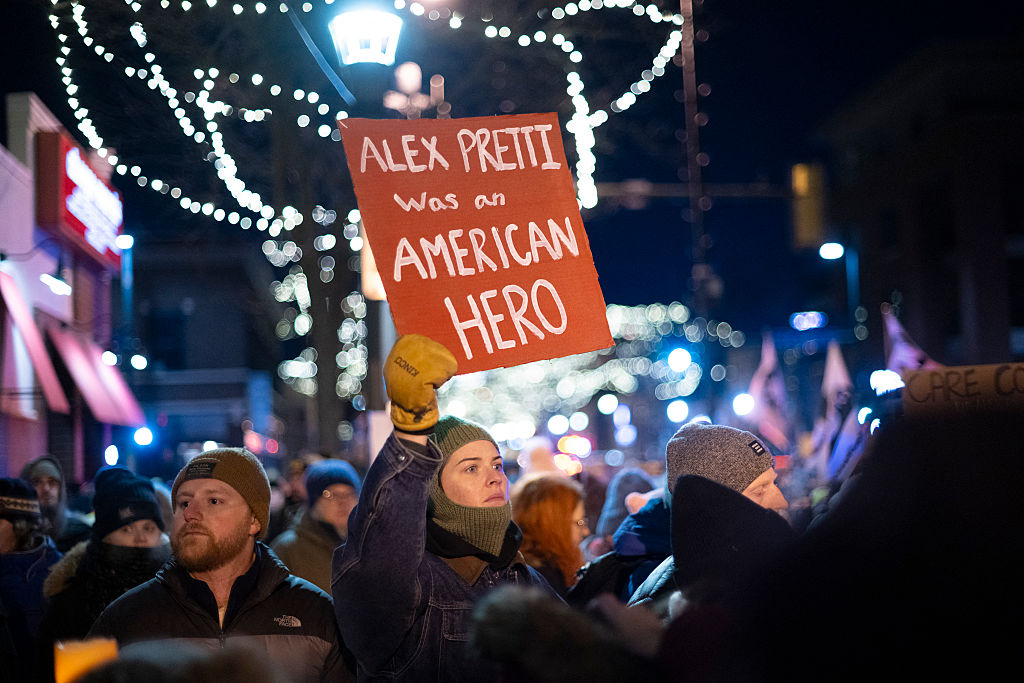
A federal law enforcement agency has effectively become an occupying force in states that did not vote for this president. Peaceful protest by state authorities and citizens is being met with disproportionate force, tear gas, and now bullets. Alex Pretti was killed for bearing witness because when he saw federal agents shove a woman to the ground, he intervened, wrapping his arms around her protectively. He was among an estimated 50,000 people who marched through Minneapolis in subzero temperatures to demand accountability after another citizen, Renee Good, was murdered by ICE agents in Minnesota, also for trying to document their actions.
The power of resistance
Resistance follows repression. Ordinary citizens in Minnesota have rallied in large numbers to defend constitutional freedoms. Tens of thousands of Minnesotans have trained as legal observers. Faith groups, veterans, and ordinary citizens have organized to support their neighbors through documentation and accompaniment. Neighborhood and state leaders have been roughed up and arrested, only to be released by federal court order. These citizens wield the most powerful tools available to them: their phones, their whistles, their voices raised in song, and their courage.
Video footage has repeatedly debunked official accounts. The administration knows this, which is why ICE agents knock phones from people’s hands, beat those who film them, and target documenters with arrest and violence. But the cameras keep rolling. This is what democracy looks like when citizens refuse to be silenced, when they stand up for the rule of law, for justice, and, most importantly, for recognizing our shared humanity.
And they are not alone. More than 60 Minnesota chief executives—including the leaders of Target, Best Buy, 3M, General Mills, and UnitedHealth—have called for immediate de-escalation. Republican governors are raising concerns. Kevin Stitt of Oklahoma said Americans “don’t like what they are seeing” and that the president “is getting bad advice.” Phil Scott of Vermont went further: “It is not acceptable for American citizens to be killed by federal agents for exercising their God-given and constitutional rights.” Cardinal Joseph Tobin of Newark called ICE a “lawless organization” and urged Catholics to vote against its funding. Even the National Rifle Association has rebuked a federal prosecutor who suggested that approaching law enforcement with a gun justifies being shot.
A better way forward
Immigration enforcement is essential. Americans and foreigners deserve an orderly, functional process that ensures safe and legal pathways for immigration. Indeed, some of those being detained and deported are in the process of having their applications adjudicated by immigration courts. This is a country built on immigration, but now immigrants are being categorized as criminals, roughed up by ICE agents, and assumed guilty based on the way they look—often before they can even show their papers.
But there is a better way. Communities across America—cities, towns, states—can and should have a meaningful role in deciding how many newcomers they can absorb, based on actual capacity. Immigration should feel like something that happens with communities, not to them. Interior enforcement can have real consequences without terrorizing entire neighborhoods or requiring a federal agency that operates like a violent, masked occupying force. These are not radical propositions. But none of this is possible when the government responds with escalating violence, outright lies, and the clear targeting of anyone who raises questions.
Voices are rising—from ordinary citizens, from business leaders and clergy, even from within Republican ranks. Ordinary Minnesotans are demonstrating courage in standing up for the rule of law, for the Constitution, and for justice. They are not just defending their neighborhoods or even their state. They are defending the promise of democracy. What unfolds there now could mark the turning point that reverses the dangerous path that the U.S. is going down. This is not the time to wait. Silence, in such moments, becomes another name for surrender.