

This article is part of The D.C. Brief, TIME’s politics newsletter. Sign up here to get stories like this sent to your inbox.
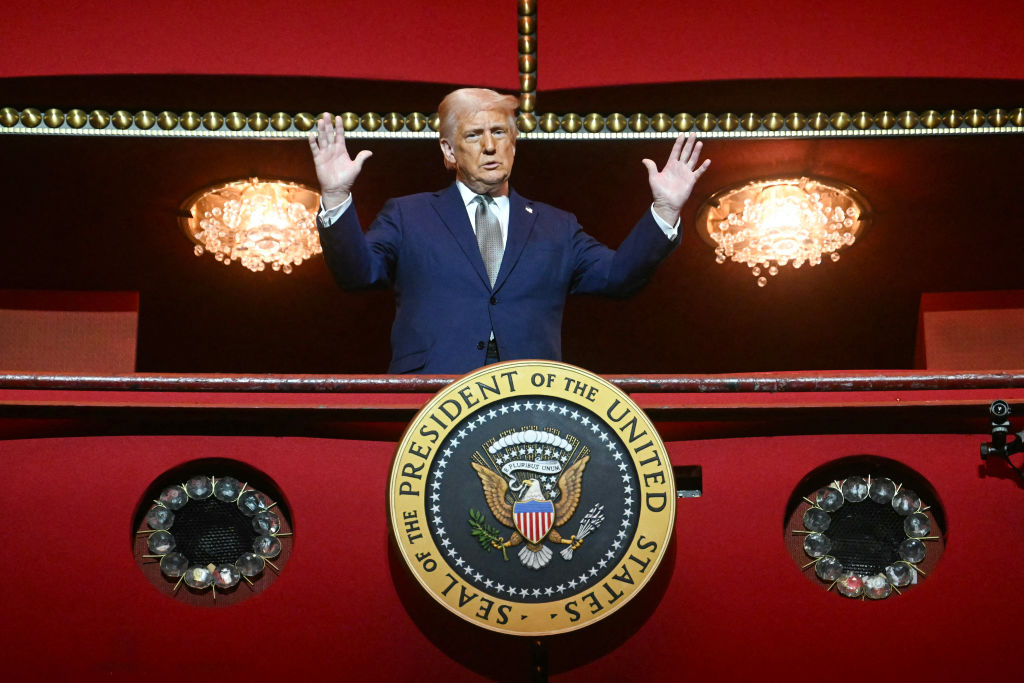
President Donald Trump last year successfully wrestled control of the U.S. Capital’s dominant performing arts stage with unheard-of efficiency. He ousted its leader, installed a loyalist at the helm, made himself the chairman of its reconstituted board, scrambled its programming calendar, alienated cultural leaders, exiled its resident opera company, declared himself the emcee of its biggest fundraising gala, and treated it like an annex of the White House for events that very often featured him in a central role.
[time-brightcove not-tgx=”true”]
Just so no one doubted his total ownership, in December he put his name on the building formerly known as The John F. Kennedy Memorial Center for the Performing Arts. (Naturally, Trump took top billing as its true star.)
Now, barely a year back in Washington, Trump abruptly announced on social media Sunday night that he is shuttering the Kennedy Center entirely for two years—basically the rest of his term—so he can reopen it in the waning days of his last year in power with a ballyhooed blitz. In a city already numb to Trump’s capricious moves, this one still left everyone doing a double-take. As one former Kennedy Center staffer messaged me in disgust: “He really does think this whole place is The Boardroom of The Apprentice, doesn’t he?”
Trump’s latest move came with no warning to the Kennedy Center’s staff, let alone the star-studded roster of artists who had performed there over the years, or were perhaps hoping to do so in the coming two years. It’s a loss that cuts at a pillar of Washington’s performing arts community, or would if the Kennedy Center’s place in local and national culture hadn’t taken such a dramatic nosedive over the last year.
Trump claims the building is in disrepair and in need of years of improvements. It’s not clear if this means he takes a dim view of the $250 million expansion the Kennedy Center unveiled in 2019 (yes, that was during Trump’s first term), or if this isn’t really about building repairs, as some in Washington privately suspect. Speaking with reporters Monday, Trump hinted that he intended to take the building down to its shell.
“I’m not ripping it down. I’ll be using the steel. So we’re using the structure, we’re using some of the marble and some of the marble comes down,” Trump said.
In his social media post, Trump asserted he had the money needed for upgrades already secured, adding he would rebuild the fortress, considered for a half century as the cultural main stage for the United States, as a world-class complex to put the nation’s best foot forward. It’s just going to take a long time and bring with it a cultural blackout in a building he once deemed too woke to exist.
It’s a dizzying turn for a hallowed artistic institution that spent half a century dodging politics with very few exceptions. From the start, the Kennedy Center was widely accepted to be one of those institutions that showcased what it meant to be American. Occasionally, it could be a little messy, as was the case when the center opened with Leonard Bernstein’s “Mass,” which famously offered a hold-up-a-mirror challenge to mid-century Americans fighting a war in Vietnam.
In the decades since, the venue has served as a cultural anchor and a diplomatic tool for soft power, so much so that Secretaries of State are mandated to be on the board. Lesser known is the role it played as a pipeline for Broadway, as it regularly hosted workshops of in-development plays and musicals that eventually pivoted to the Great White Way. (This current Tony season alone will include at least three shows—Schmigadoon and the revivals of Chess and The 25th Annual Putnam County Spelling Bee—that have been workshopped at the Kennedy Center in recent years.)
To be sure, all shows weren’t for everyone; visiting church groups might want to skip the Gay Men’s Chorus’ Pride concert (which was, of course, canceled last year). But by and large, the Kennedy Center was a steady presence that found new ways to promote American identity, whether that be Condoleezza Rice joining Yo-Yo Ma for a surprise classical duet or Diana Ross joining the National Symphony Orchestra for a night of disco. It was in the simplest of terms, a roulette wheel of high and low, formal and feisty. It was where world-class soprano Renée Fleming could record a podcast on neuroscience, The Roots could serve a hip-hop residency, Turandot could find a new ending, and Holland Taylor could take on the role of Texas Gov. Ann Richards in a one-woman play. All the while, more than a million students rotated through for educational visits.
Then came Trump.
A developer and branding master before jumping into politics, Trump has long confused disruption with distinction. He was so divisive in his first term that artists refused to set foot in the Kennedy Center if he were there. The Kennedy Center Honors, the campus’ biggest gala, went on during his first term only after Trump promised to stay away. It was a slight that Trump did not forget, and he returned to Washington with a grievance to gut the place.
Within weeks of coming back, Trump dismissed the widely respected president and put in her place his former spy chief, Ric Grennell. Artists canceled quicker than the list could be updated, from a production of Hamilton to a sold-out Issa Rae show. “There’s no way I would set foot in it now,” Wicked composer Stephen Schwartz said when he canceled his role in an upcoming National Opera fundraiser. (While the Administration’s policies were a major deterrent, the changes at how the Kennedy Center was being run certainly played a role. As another Kennedy staffer noted to me, Trump broke decades of tradition in booking shows that featured performers that were not part of the stage union. There was also plenty of evidence rival venues were booking shows that would have normally taken their turn at the Kennedy Center.)
The cancellations escalated when Trump had his name installed on the meeting. Just last week, Philip Glass pulled a work commissioned by the National Symphony, saying Trump’s posture toward the arts was in conflict with his intentions behind a work paying tribute to Abraham Lincoln. That led to the National Symphony’s chief conductor to lament to The New York Times: “I cannot make everybody happy.”
The public has noticed the tumult. Ticket sales have dropped off dramatically and it’s not uncommon to have plenty of empty seats greeting performers who have been vocal about wanting politics out of their auditoriums. Instead, at most programs, the National Anthem serves as an overture.
The dissonance around Washington has not bent Trump. When it came time for last year’s Kennedy Center Honors, Trump dictated the list himself and hinted the next season’s schedule would be of his making, befitting the nation’s 250th anniversary. Instead, it’s going to a season of silence, starting on July 4. (The future of the Kennedy Center Honors and another high-profile event, the Mark Twain Prize, remain an open question, as does a home for existing residents like the National Symphony.)
Maybe that’s the lowest level of drama available. Things had become increasingly problematic for the center as marquee acts declined to book their Washington tours at the Kennedy Center, opting instead for venues around town that previously would have struggled to compete for such shows when the Kennedy Center was offering their space. Even the Washington National Opera—which increased its endowment from $8 million to $30 million since 2018—left the center to find a home elsewhere rather than continue under the baton of Maestro Trump and his terms.
It fits with the broader pattern of Trump demolishing—in some cases, literally—traditionally staid institutions in Washington. He already has leveled the East Wing of the White House, paved over the Jacqueline Kennedy Rose Garden, slapped his name on a State Department building, annexed D.C.’s golf courses, mulled a new terminal for the region’s main international airport, even edited text about him in Smithsonian exhibitions to erase his past impeachments. There is talk of a Paris-style arch named after him, too, that would dwarf the nearby Lincoln Memorial.
But the unilateral decision to close the Kennedy Center for two years of upgrades—or a teardown perhaps—is a step beyond. The Kennedy Center is a quasi-governmental arts organization, chartered by Congress but funded mostly with private dollars and ticket sales, meaning it is not exactly clear how Trump is getting away with his summary closure. (Don’t look now, but talk has already turned to pardons to excuse what’s unfolding.)
Democrats in Congress, of course, have questions. But they also had questions when Trump remade the board of trustees and put his name on a building that was designated by law to be a memorial to Kennedy. Answers never made their way to those asking. Instead, the show goes on without any sign of a rewrite.
Even Grennell, the Kennedy Center’s Trump-picked chief, acknowledged in a note to staff that this was an on-the-fly operation. “We recognize this creates many questions as we plan to temporarily close most of our operations. We will have more information about staffing and operational changes in the coming days,” he said in a memo. In a public statement, Grennell followed-up with Trumpist bravado: “I am confident this sets the stage for a stronger, revitalized National Cultural and Entertainment Complex.”
A stage, of course, dictated by Trump’s aesthetics and that puts him at center stage. After all, in his mind, America is but a one-man show.
Make sense of what matters in Washington. Sign up for the D.C. Brief newsletter.