

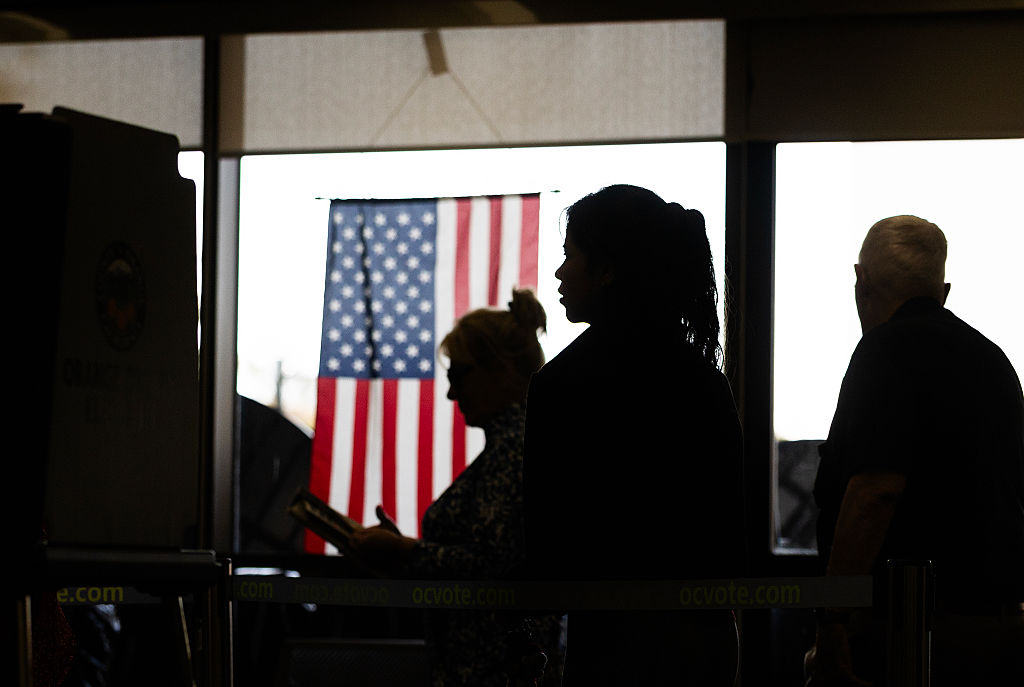
As President Donald Trump continues to allege widespread electoral fraud benefitting Democrats, his latest attempt to upend U.S. elections in the name of correcting that fraud is a call for the Republican Party to “nationalize” voting.
Dialing in Monday on the podcast of former FBI Deputy Director Dan Bongino, who stepped down last month and returned to podcasting, Trump repeated unsubstantiated claims of noncitizen voters skewing election results, saying it is “amazing that Republicans aren’t tougher on it.”
[time-brightcove not-tgx=”true”]
“The Republicans should say, ‘We want to take over, we should take over the voting, the voting in at least many, 15 places,’” Trump told Bongino. “The Republicans ought to nationalize the voting.”
Trump didn’t elaborate. Asked for clarification, White House spokesperson Abigail Jackson pointed to how the President urged Congress to pass legislative proposals like the SAVE Act—which requires documentary proof of U.S. citizenship before voters can register to vote in federal elections—among other measures that would extend some federal oversight over voter rolls. “President Trump cares deeply about the safety and security of our elections,” Jackson told TIME.
The call to nationalize elections follows other attempts by the Trump Administration to assert more control over the voting process, which critics and political opponents have denounced as overreach. Last year, Trump issued an Executive Order that sought major changes to how states handle elections, including requiring voters to prove their U.S. citizenship and preventing the counting of mail-in ballots received after Election Day. Democrats and voters’ advocacy groups sued Trump and his Administration in response, and federal courts have since blocked parts of the order, citing the President’s lack of authority. Trump even floated canceling the upcoming midterm elections altogether, which Republicans are expected to fare poorly in, though the White House has insisted the President spoke in jest.
What the Constitution says
The Constitution decentralizes the U.S. election process and has specifically left the President out. Article I, Section 4, Clause 1 states that “the Times, Places and Manner of holding Elections for Senators and Representatives, shall be prescribed in each State by the Legislature thereof; but the Congress may at any time by Law make or alter such Regulations, except as to the Places of chusing [sic] Senators.”
In practice, this means local officials across thousands of jurisdictions administer elections and tabulate votes, with safeguards built in that the American Bar Association says makes it “almost impossible for systems to be breached on a scale to affect federal or state results.”
A federal takeover of elections would encounter pushback, including from some Republicans. Rep. Don Bacon (R, Neb.), a regular Trump critic, posted on X, “I opposed nationalizing elections when Speaker [Nancy] Pelosi wanted major changes to elections in all 50 states. I’ll oppose this now as well.” And the Heritage Foundation, the right-wing thinktank behind the controversial conservative transition playbook Project 2025, from which Trump has patterned many of his policies, says on its website that it “will always oppose a federal takeover of our elections by Washington elites.”
Speaking to CNN, former U.S. District Judge John E. Jones III said that federalizing elections would be “flatly unconstitutional,” adding that the President “needs to read the Constitution.”
Allegations of fraud
At the heart of Trump’s push are repeated accusations that previous U.S. elections were rigged. Trump has claimed that he won the 2020 presidential elections over his then-opponent Joe Biden, despite state and federal officials as well as numerous courts rejecting such claims. “The 2020 election, I won that election by so much,” Trump told Bongino. “Everybody knows it.”
“We have states that are so crooked, and they’re counting votes,” Trump told Bongino. “We have states that I won, that show I didn’t win.”
GOP elections reform bill
Some GOP members of Congress have tried to advance Trump’s election agenda. In the House, Rep. Bryan Steil (R, Wis.) recently introduced the Make Elections Great Again (MEGA) Act, a bill proposing what he describes as “commonsense” policies to avoid electoral fraud.
The proposed policies include requiring photo IDs for voting, requiring states to verify citizenship of individuals for voter registration, as well as a ban on ranked-choice voting and universal vote-by-mail, among others.
Voters’ rights groups and congressional Democrats have asserted that such policies undermine the elections. Advocates against voter ID measures claim that many eligible citizen voters lack easy access to provide such documentation and would be disenfranchised by such requirements.
Democracy Docket described in a Jan. 29 article that the new elections reform bill from Republicans is “a catastrophic proposal for democracy.” Rep. Joe Morelle (D, N.Y.) described the proposal as a “voter suppression” bill, adding that “President Trump and House Republicans are terrified of the American people” and “are desperate to rig the system so they can choose their voters.”
Sen. Alex Padilla (D, Calif.), meanwhile, accused Republicans of “desperately trying to rig the rules for future elections” instead of trying to win on their policies. “The right to vote is fundamental, and Congress should be working to make it easier, not harder, for eligible Americans to participate.”