

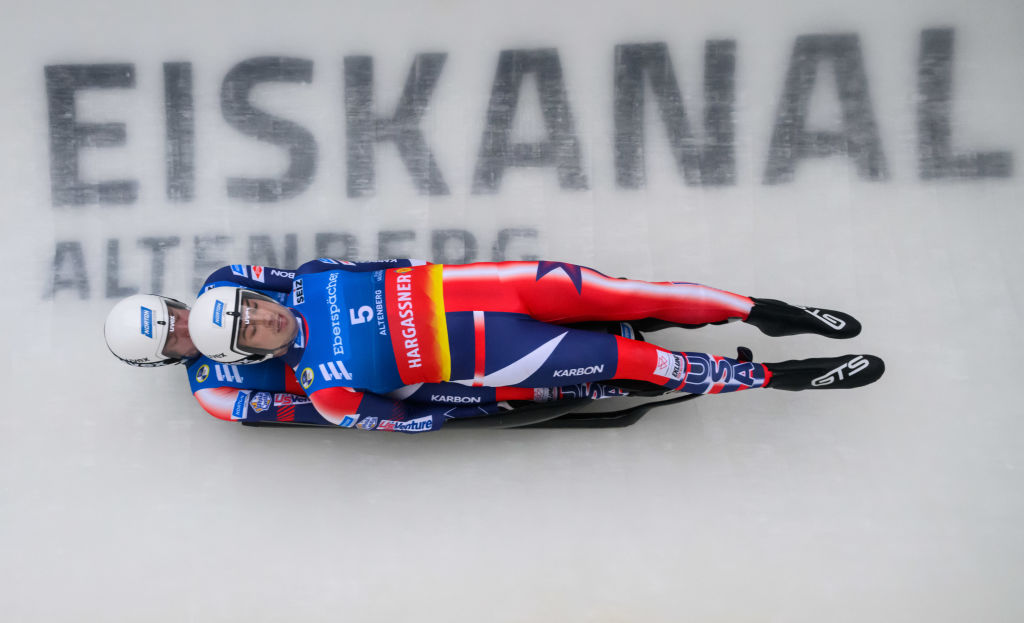
An Olympic sport that sleighs? That’s luge—French for sled—in which athletes lie on their backs on a small sled, feet outstretched, and race down an ice track at about 100 mph without mechanical breaks.
Lugers compete in singles or doubles, and for the first time at the 2026 Milano Cortina Winter Olympics, women will compete in the doubles event, marking a step toward gender parity in the sport. This year, U.S. luge athletes Chevonne Forgan and Sophia Kirkby will compete in the women’s doubles event.
[time-brightcove not-tgx=”true”]
Here’s what to know about the origins of what the Olympics calls “the fastest sport in the Winter Olympics.”
History of luge
Luge was invented in Switzerland, and Davos hotels organized the first international luge contest in February 1883 on a road between St. Wolfgang and Klosters. But sledding itself has an even longer history.
“Sleds were used thousands of years ago to transport food supplies and people across snow and ice,” says Claire DelNegro, VP of Sport for the International Luge Federation.
According to the website of the Adirondack Luge Club in Lake Placid, N.Y., one of America’s main luge centers, sledding enthusiasts would sled down logging roads from the alpine forests to the villages. Luge first appeared at the Winter Olympics at the 1964 games in Innsbruck in Austria.
Germany has long dominated the sport, boasting many school programs to train the next generation of athletes. Before the Berlin Wall came down, East Germany and West Germany had their own tracks and “there was a lot of competition between just those two countries,” says Ron Rossi, who competed in men’s doubles luge during the 1984 Winter Olympics in Sarajevo.
Notable luge athletes
At 38, Germany’s Natalie Geisenberger has long been known for being the most decorated Olympic luge athlete with seven medals, including six gold medals in Singles and Relay events. Geisenberger retired from the sport in 2023.
Star luge Singles athlete Germany’s Georg Hackl became the sixth person in the history of the Winter Olympics to win the same individual event three times at the 1998 Nagano Games in Japan. He boasts three Olympic gold medals for Singles events.
When Italy’s Armin Zöggeler won the bronze in Sochi, Russia, in 2014, he became the first athlete in history to win six medals at six consecutive editions of the Olympic Winter Games (1994-2014). Known by the nicknames “the ice-blooded champion” and “the cannibal,” he earned six Olympic medals, including two gold medals.
American doubles partners Mark Grimmette and Brian Martin are considered the most decorated USA Luge athletes, with more than 75 international medals—including a Silver Olympic medal at the 2002 Salt Lake City winter games and a Bronze in Nagano in 1998.
The skill of the game
The objective is very simple, “Get down the hill as fast as you can,” says Gordy Sheer, a three-time Olympian who boasts a 1998 Olympic silver medal in men’s doubles and now serves as a marketing director for USA Luge. The winning athlete gets from the starting line to the finish line with the fastest time.
However, getting from A-B is not so simple. In singles, the athlete steers using shoulders and feet, and in doubles, a person lying in back of the sled does the shoulder steering, while a person lying at the front of the sled does the foot steering.
One of the biggest misconceptions is that luge athletes just lay back in the sled and don’t do anything. As DelNegro explains, “I like to compare it to telling somebody to get on a pair of skis and go down a double black diamond if you’ve never skied before and don’t steer.”
Zack DiGregorio, a 2022 Olympian, points out that the luge athletes “who look like they’re doing nothing are normally the fastest.” Fellow 2022 Olympian Sean Hollander says they do a lot of shoulder strength training in the weight room, bodyweight jumps, medicine ball workouts, and volleyball games as cross-training to practice the quick movements needed for steering and takeoff. As Hollander explains the effort at the starting line: “You have to be in this very explosive, full attack mode because that’s the only part of the run where you can accelerate yourself. Then as soon as you pull off and finish the start, you have to relax into this kind of flow state. And this all happens within three seconds.”
Sheer explains Luge athletes have to master the art of driving the sled within about an inch of “an imaginary perfect line” down the track: “It’s not like it’s spray painted in red, and you just follow it. You have to know that, you have to feel it, and then you have to be very relaxed. You have to fight the urge to keep your head up, because if you pick your head up, you’re creating aerodynamic drag. And all of this is happening at potentially north of 90 miles an hour, so there’s a lot going on, and you’re processing a tremendous amount of information as you’re sliding down the hill. So that’s what’s happening on the sled.”
When asked why people should take up luge as a winter sport instead of skiing or snowboarding, DiGregorio cites adrenaline, describing luge as “a roller coaster that you can control.” DelNegro argues that it has a certain natural appeal: “I think every kid knows how to get on a sled and go down a hill and have fun, so for me, it’s the most natural sport to evolve into.”