

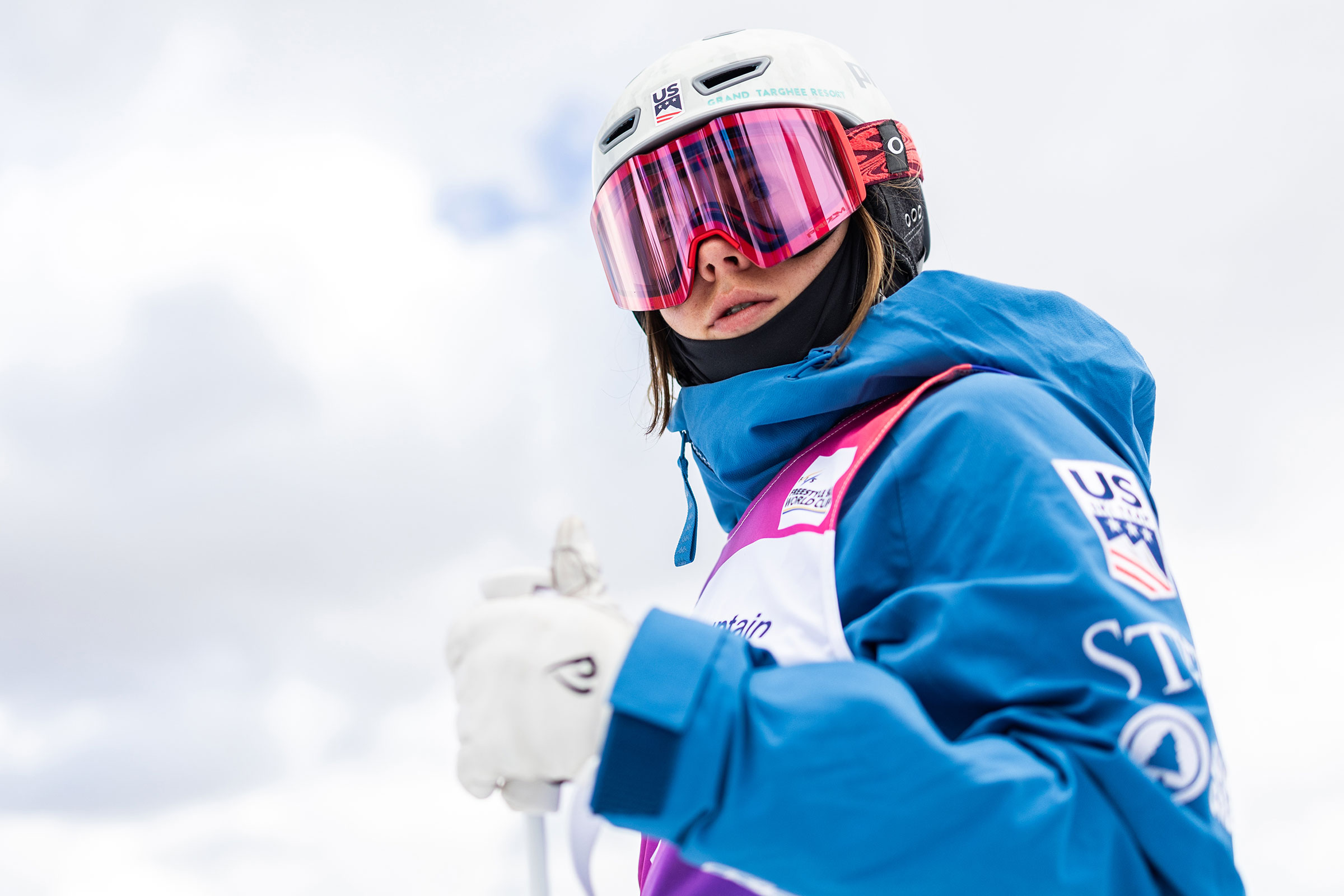
While growing up in Wyoming’s Teton Valley, American Jaelin Kauf didn’t immediately take to moguls, the skiing discipline in which athletes navigate a bunch of snowy bumps down a mountain while also performing a pair of aerial tricks. Sure, Kauf’s parents, Scott and Patti, were professional moguls skiers, so she had the genes. But at first, Kauf preferred entering alpine racing contests. “I wasn’t sold on moguls,” says Kauf during a September interview from Park City, Utah, where the U.S. team trains. “It was definitely a slow, slow burn.”
[time-brightcove not-tgx=”true”]
Several factors, however, ultimately tipped young Jaelin toward moguls—and ultimately becoming a gold-medal contender at the Milano Cortina Olympics. First, her brother Skyler, older than Jaelin by a year, skied moguls. “I wanted to do everything he did and be just like him,” says Kauf. At a competition in Sun Valley, Idaho, when she was around 8, Kauf crashed multiple times during her run and face-planted at the finish line. Still, as the youngest competitor in the field, she won her age group. “I was super stoked,” she says.
The bulkier moguls apparel also helped. “I was pretty stoked to not be in the little speed suit freezing cold on the mountain,” she says.
Ultimately, the key reason Kauf pursued moguls was that it combined all she loved about skiing in an efficient bundle. “It has the speed, it has this turn focus, it has the airs,” she says. “And then you pack it all together in a 30-second run.”
Even during the Winter Olympics, the moguls races—which compete for attention against signature sports like figure staking, alpine skiing, and hockey—rarely generate much buzz. That may change this year in the U.S., thanks to Kauf’s excellence on the mounds. In 2025, Kauf, who is making her third Olympic appearance, won her sport’s triple crown, securing the title in overall moguls, single moguls, and dual moguls—an event making its Olympic debut in Italy. (In dual moguls, skiers race down the mountain at the same time in a knockout tournament format. But first to the finish doesn’t always win. The judged elements of moguls—graceful turns and aerial excellence—together are given far more prominence in the scoring than speed.)
The most common question Kauf, 29, gets about her sport: does skiing moguls hurt her knees? Those bumpy dashes down the mountain look like an orthopedic surgeon’s dream. But while all that twisting can indeed stress the knee joints, Kauf finds the back more susceptible to pain. “I’m not going to say there’s no wear and tear on the knees, but the knees, at least, are somewhat meant to do some sort of absorption and motion like that,” she says. “Between the moguls and the jumping and the landings, it’s a lot of compression on the back.” So Kauf incorporates Pilates and core work into her training.
Kauf, who also has 16 World Cup victories and a world championship to her name, finished seventh in moguls in PyeongChang. The run-up to Beijing was unpleasant. Kauff qualified for those Games based in large part on her performance in the prior season, so she used the pre-Olympic World Cups to attempt new tricks. Some less than stellar finishes, however, caused the moguls community to wonder if Kauf deserved her spot on the U.S. team. “I was hearing and reading all of that over and over,” she says. “It really got to me. I really started to get down on myself and buy into that. That was definitely the hardest moment in my career.” During a two-week pre-Olympic camp in Utah, Kauf cried every day.
Read More: ‘I’m Up for It.’ Alex Hall Is Ready to Be an Olympics Leading Man
She turned to former U.S. moguls skier Shannon Bahrke, a two-time Olympic medalist, for advice on how to approach her second Olympics. Bahrke suggested that she keep a journal and write down daily affirmations. “She honestly changed everything for me,” says Kauf. “It was a pep talk every day.” She won silver.
Kauf attributes her success last season, in part, to a tactical switch. She felt more confident landing a difficult aerial trick—a cork 720, or two full off-axis rotations—at the top of the run, rather than at the bottom. “It just kind of clicked, where I was able, whether I hit a great takeoff or not, to land it and ski out of it,” she says. She’s stuck to this strategy this World Cup season, and she won a dual-moguls event in Canada in July.
Kauf insists this will be her final Olympics. “I feel like I’ve given so much of my life to this sport and am ready for something new, something different,” she says. “I am not positive what that will be.” In December, she earned a degree in environmental and sustainable studies from the University of Utah. “Maybe I’ll put that degree to use in something,” she says.
But make no mistake: improving on her silver from Beijing—in two events for the first time at the Olympics—is top of mind. She’s pumped about the possibility. “I’ve had an amazing career, and I can be happy with everything I’ve accomplished,” she says. “But for this Olympics, I really want to showcase myself to the world and leave it all out there every time. And hopefully I can end up on some boxes.”