

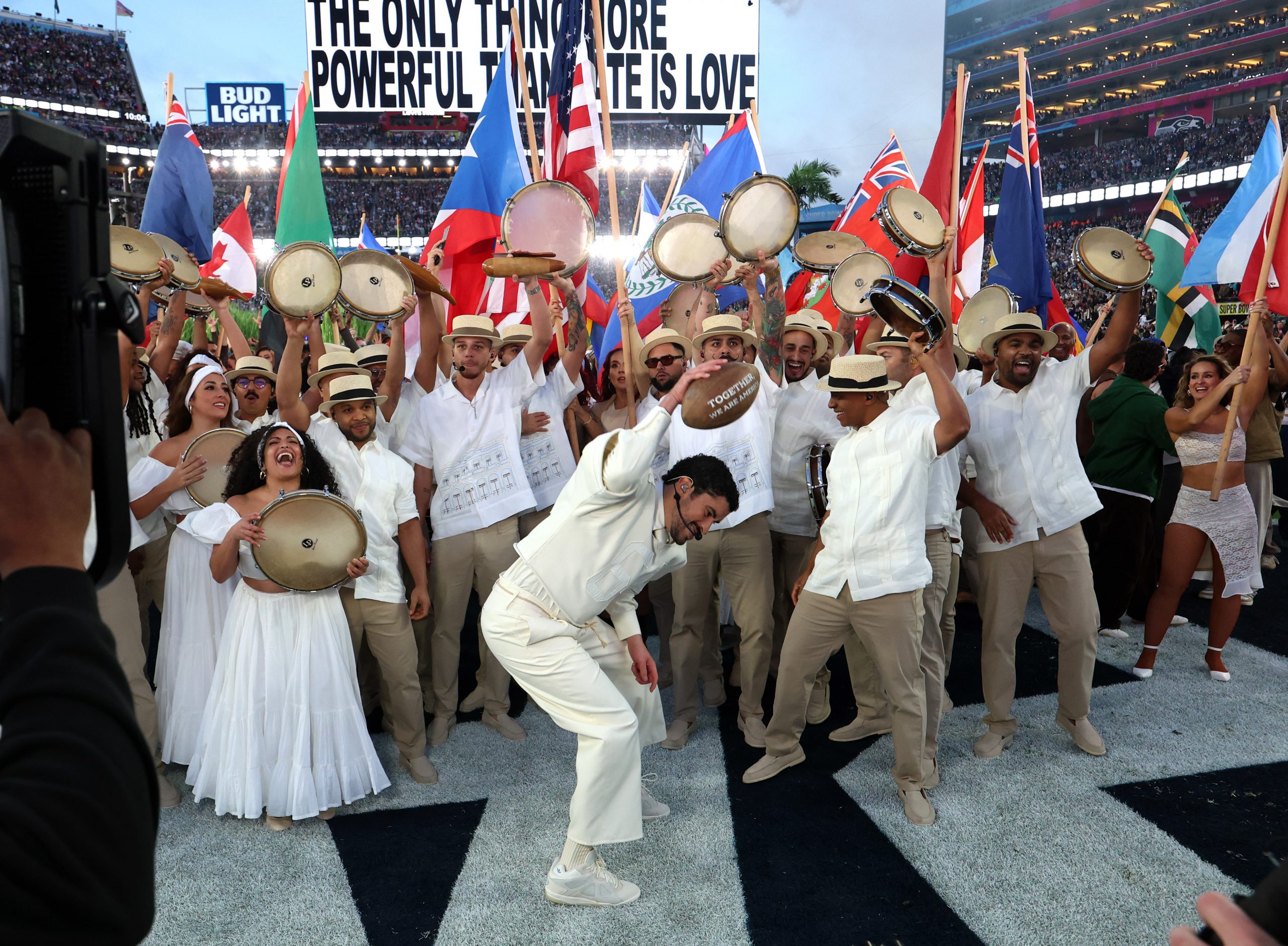
Towards the end of his Super Bowl LX Halftime Show performance, as Bad Bunny walked alongside flag bearers who represented a coalition of countries that compose the American continent, black-and-white text appeared on the stadium’s jumbotron: “The only thing more powerful than hate is love.”
On arguably the United States’ biggest stage, Bad Bunny chose not to play into the hands of those who assumed that United States Immigration and Customs Enforcement would be the nucleus of his performance. Instead, he centered his love for Puerto Rico, and in the process, he showed America what love is.
[time-brightcove not-tgx=”true”]
Bad Bunny gave a hint about what was to come during his acceptance speech for Best Música Urbana Album at the 68th Annual Grammy Awards: “If we fight, we have to do it with love,” he said.
What is a greater hit against a presidential administration that characterizes itself as the party of family values than marrying two people in love on stage? Than gifting a young boy a Grammy as a way to legitimize his dreams of a profession in the creative arts? Than allowing Ricky Martin, one of the faces of the Latin Explosion, to fully sing in his mother tongue, something that he was discouraged from doing as one of the few Latin artists who successfully crossed over into the American music industry in the late 1990s?
That’s why it was so powerful, as the United States prepares for its 250th anniversary, to see Bad Bunny preaching not a gospel of hate, but one of love.
Because through him, a Puerto Rican man—whose body has been politicized since before he was born, whose nation has been denied its own independence, and whose land has been ravaged by the plantation industry—stands in the face of his oppressors, not in the militaristic attire of the Young Lords, but in all white.
In the poetry of his performance, Bad Bunny showed that love is not domination. Love is not colonization. American writer bell hooks perhaps describes it best: “Love is mostly about the action.” Love is equal parts care, commitment, knowledge, responsibility, and trust. And on Sunday night, Bad Bunny’s actions displayed a love that encompasses the entirety of every country in the Americas.
The United States has drawn in generations of immigrants. But this is not an inherent sign of a loving society. Decades of foreign policy, and most recently, the decimation of foreign aid, has created conditions in which people across the Americas must migrate for survival.
Colonialization exacts a heavy toll. Conversations around reparations in the United States are not new, nor are conversations about the legitimacy of Puerto Rico being its own country, separate of American influence and control.
The love that Puerto Ricans have for their country is unmatched. Long before the Spanish-American War, Puerto Ricans have fought for their independence. In fact, their fight for independence is longer than ours in the United States. Yet, without ceasing, another generation of Puerto Ricans pick up the mantle to chant in the streets and fight for their country, out of love for their forefathers and foremothers.
In a 1970 documentary, American essayist James Baldwin spoke of the revolutionary power of love to British filmmaker Terence Dixon: “Love has never been a popular movement,” Baldwin said. “The world is held together, really it is held together, by the love and the passion of a very few people.”
Bad Bunny is one of them.
As much as Bad Bunny is a world builder, he is also a world connector. He stitched the voices of Tego Calderón, Daddy Yankee, and Don Omar, pioneering reggaetoneros who laid the foundation for his monumental success in the present day, in his halftime performance.
He acknowledged the island’s connection to the Puerto Rican diaspora in New York and featured stewards of Nuyorican culture, such as Toñita, a Brooklyn community leader who owns one of the last Puerto Rican social clubs in New York City.
He also made space for the pain: the harvesting of sugar cane and the unreliability of Puerto Rico’s power grid. These two events, both historical and contemporary in nature, resulted in the loss of many Puerto Rican lives.
Death is not the absence of love, but a catalyst for joy. It makes the smiles of elderly men paying dominoes in plastic chairs along the streets of San Juan brighter. It makes the dances among family members and loved ones at weddings livelier. It makes the grinding of hips and collusion of bodies against one another at the casita more passionate.
Bad Bunny’s performance showed that life is for living. Life is for love to be fully present and ingrained in every action that one chooses to do.
Bad Bunny decided to perform love for his Super Bowl LX Halftime performance, because love is the only thing that will save us. Together, we are America, not a nation of hate, but a continent of love.