

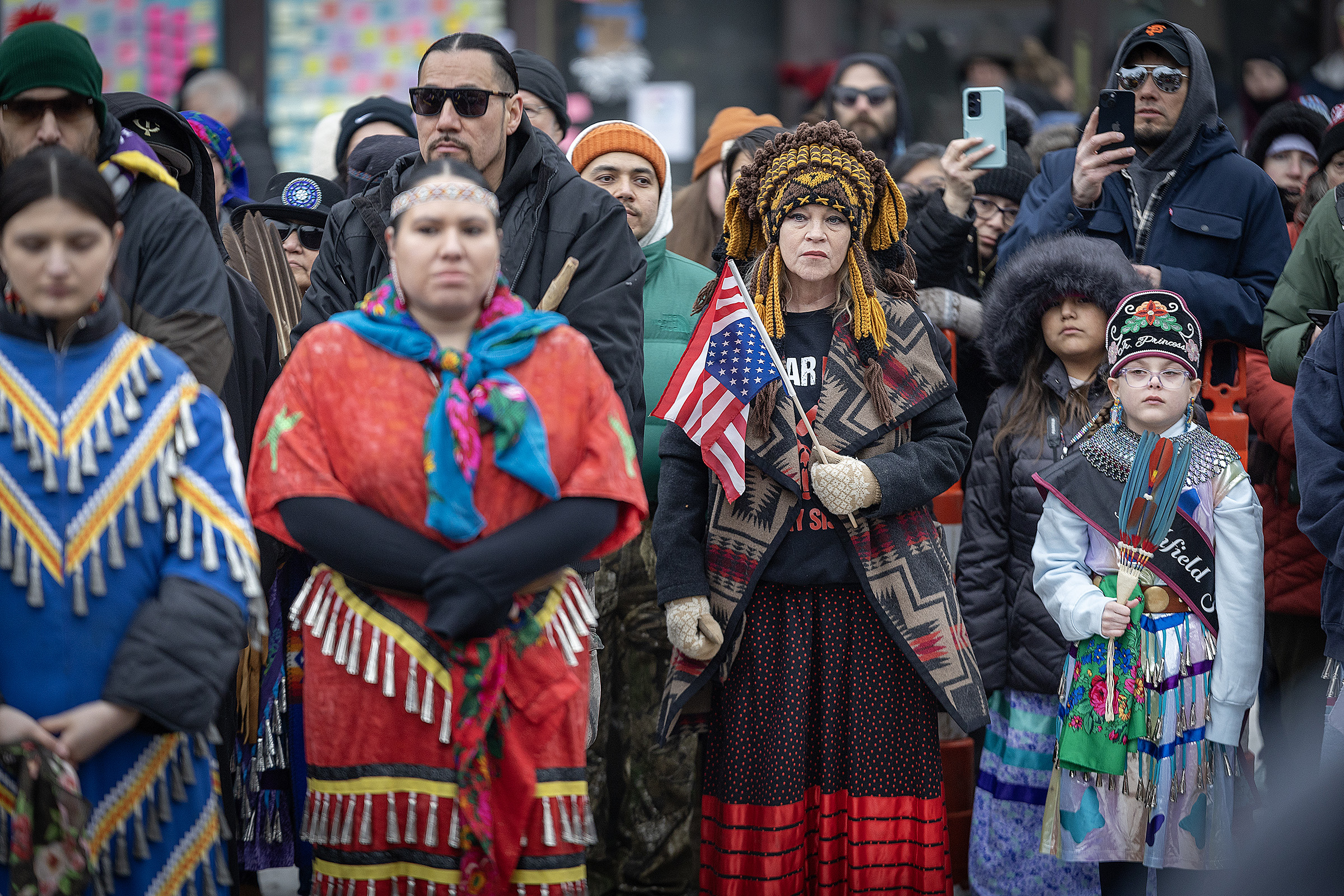
For Native American leaders, the recent wave of immigration arrests has felt less like an isolated enforcement effort and more like a pattern: federal action first, explanations later.
That anxiety intensified after reports last month that four members of the Oglala Sioux Tribe were detained during a sweeping immigration operation in Minneapolis. When Frank Star Comes Out, the tribe’s president, learned of the arrests, he said he immediately called the Department of Homeland Security.
[time-brightcove not-tgx=”true”]
Read more: ICE’s Largest Prison Contractors Hail ‘New Growth Opportunities’ as Revenue Reaches All-Time High
“We were in contact with DHS, but they wanted names, and I said, ‘Well, we want names, too. What are you doing? Detaining Native Americans?’ But they couldn’t answer that. So that conversation just went nowhere, stalemate,” President Frank Star Comes Out tells TIME.
Star Comes Out, who received the report from a tribal member doing street outreach work with homeless Native American people in the Twin Cities, said he reached out to Bureau of Indian Affairs (BIA) officials for help without much success.
“I’ve asked the BIA officials, and I asked him, how do we identify these people? And how do we know? Their safety is in jeopardy, and we have treaties in place that protect us, the federal government has a duty under our treaties to protect us,” he added.
The detention of the four Oglala Sioux people quickly made national headlines, prompting outcry from Native American communities demanding their release and resulting in outright ICE bans on several reservations.
But a month after the report, President Star Comes Out still has not received any information regarding their identities, their encounter with ICE, their detention, or whether they have been released.
In a statement to TIME, the DHS said they have not been able to verify any claims that ICE agents arrested or encountered members of the Oglala Sioux tribe. It also said that it had not uncovered any claims by individuals who are members of the tribe in its detention centers.
Although ICE detainees’ information can be found on its online locator website, the agency is not legally obligated to notify the detainee’s family or attorney about the initial detention. When transferring a detainee to another facility, ICE is required to notify the lawyer on file no later than 24 hours after the transfer happened. It is unclear if the four Oglala Sioux members have any legal representation.
Since the beginning of the Trump administration’s sweeping immigration operation, ICE has not provided figures for U.S. citizens arrested or detained in Minnesota or other states. However an investigation by ProPublica documented more than 170 U.S. citizens’ detention across the country and according to AP, there are even cells designated for citizens in a Minnesota ICE facility.
The reports of ICE arrests of Native Americans all over the country have put tribal leaders on high alert. Last November, Indigenous actress Elaine Miles said she was detained by an ICE officer who said her tribal ID “looked fake.” On Jan. 8, 20-year-old Jose Roberto Ramirez, a member of the Red Lake Nation, was dragged from his car and detained by ICE officers, which was captured on camera by his aunt. A week later, local media reported a Navajo man in Arizona said he was detained by ICE despite having several forms of ID.
“The people that are off the reservation, they’re all in a state of panic because of what’s happening,” said President Kathleen Wooden Knife of the Rosebud Sioux Tribe in South Dakota, adding that tribal officials went out to multiple Midwestern cities, including Minneapolis, to help homeless Indigenous people obtain tribal IDs.
Back home, tribal leaders are also faced with communities that are looking for constant assurance that ICE is not conducting operations in their communities, even after the leaders issued bans on ICE activity on their reservations.
Following the detention of the four men, the Oglala Sioux Tribe also declined to sign a legal agreement with ICE, known as the 287(g) agreement, that would have given agents access to the reservation. Without prior permission or consultation, any federal law enforcement officers entering native reservation is a violation of the treaty and technically “an act of war,” according to Star Comes Out.
“We’ve seen these people here [saying] ‘Is this ICE?’ And we have to assure them, because there are fearmongers among the people that think that they see a stranger in out-of-state plates, and right away, they’re in a state of panic saying, ‘ICE is here,’” Wooden Knife added.
Behind the fear of being stopped without an ID lies a deeper problem: systemic poverty that has pushed many Native Americans off reservations in search of work. Some tribes in South Dakota, like the Rosebud Sioux Tribe and Oglala Sioux Tribe, face unemployment rates above 80%, some of the highest in the nation, according to the Department of the Interior.
“We still have members without electricity and water. That’s just the way some of our tribal members were forced to live in a third world country,” Star Comes Out said, adding that people who leave the reservations usually don’t have much support from back home.
According to a report from the Department of Housing and Urban Development, Indigenous populations make up five percent of the homeless population, despite accounting for one percent of the overall U.S. population. As ICE vowed to detain and deport violent criminal immigrants, homeless shelters have become a frequent target of the immigration operations across the country.
“It’s really sad that this has to be happening this way…People of color are getting hit, and it’s not right, it’s not fair,” Wooden Knife said.
For Indigenous communities, those enforcement actions add to a longer history of federal decisions being made without their input, which Wooden Knife said has gotten worse under this administration. According to the latest watchdog report, the BIA has experienced an 11% staffing cut as a part of the Trump administration’s push to fire government employees en masse, exacerbating chronic staff shortages that make it difficult to provide services to tribal communities.
As a part of the spending bills passed by Congress earlier last month, the Indian Health Service (IHS), which provides health care services to more than 2.5 million Native Americans, cut its budget by more than $170 million from last year and is more than $54 billion short to fully fund the agency at a level recommended by IHS’s own workgroup.
Tribal leaders tell TIME that they feel left out on some key policy decisions on the federal level that would impact their day-to-day lives, such as law enforcement, health care and transportation. The treaties between the federal government and their tribes signed centuries ago guarantee the federal government’s protections. Instead, they are getting “broken promises.”
“We’ve been at some of the same consultation meetings, and it’s really frustrating because the people there are not the decision makers. They only hear us and take back what we say,” Wooden Knife said. “The information is taken back, it’s discussed, but is it really heard? A lot of times I don’t feel like it is.”