

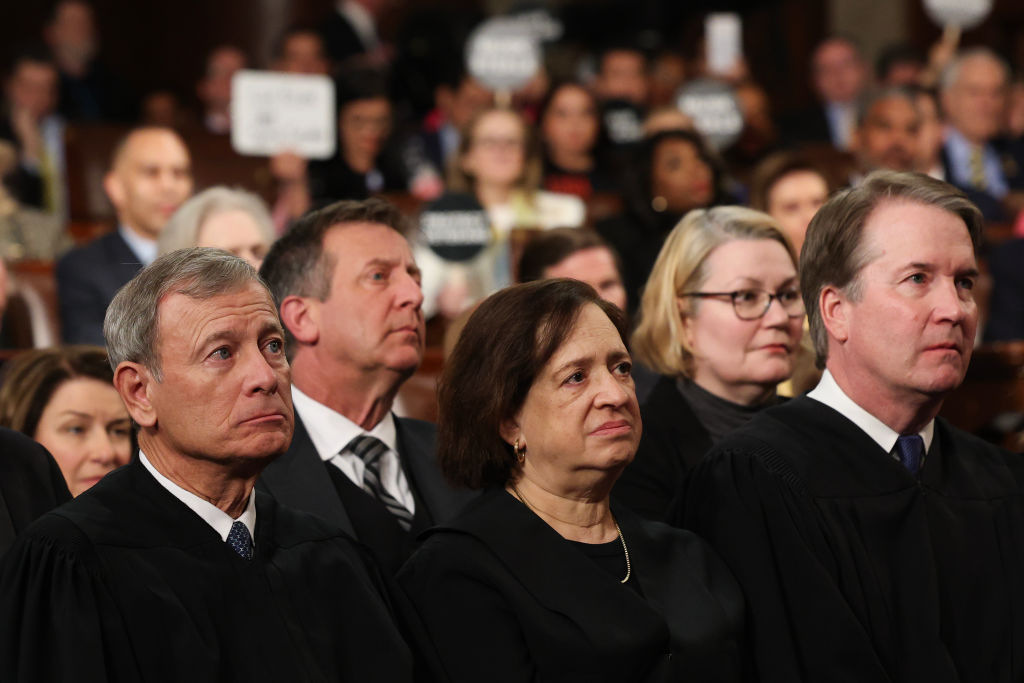
The Supreme Court on Friday struck down President Donald Trump’s emergency tariffs, dealing a sharp blow to the centerpiece of his economic agenda and setting firm limits on how far presidents can go in using emergency powers to reshape global trade.
[time-brightcove not-tgx=”true”]
In a 6-to-3 decision that cut across ideological lines, the Justices ruled that Trump lacked the authority to impose sweeping import taxes by claiming a national emergency. The ruling immediately invalidates a broad set of tariffs that Trump imposed last year on nearly all imports, including so-called reciprocal duties on dozens of countries and additional levies tied to the fentanyl crisis.
The ruling was authored by Chief Justice John Roberts, who was joined by the court’s three liberal justices and two Trump-appointed Justices, Neil Gorsuch and Amy Coney Barrett. It’s a rare rebuke of Trump’s power from the nation’s highest court whose 6-3 conservative majority he helped shape.
The decision not only curtails a policy Trump has repeatedly credited with strengthening American leverage abroad, but also carries major financial and legal consequences. The government will no longer be able to collect tens of billions of dollars in tariff revenue under the International Emergency Economic Powers Act, or IEEPA—a 1977 statute intended for national emergencies—and is likely to soon face a wave of claims from companies seeking refunds for duties already paid.
Scores of businesses that paid the now-invalidated emergency tariffs are expected to press for refunds, setting up potentially complex litigation over billions of dollars already collected. As of mid-December, the tariffs had raised roughly $130 billion, revenue the Administration had counted on to help finance tax cuts enacted last summer.
Read more: Americans Are Paying For Trump’s Tariffs, Study Finds
Writing for the court, the majority emphasized that the Constitution assigns the power to impose taxes and duties to Congress, and that IEEPA—which has historically been used to freeze assets and impose sanctions—does not clearly authorize the President to levy tariffs of indefinite scope and duration.
“The President asserts the extraordinary power to unilaterally impose tariffs of unlimited amount, duration, and scope,” Roberts wrote. “In light of the breadth, history, and constitutional context of that asserted authority, he must identify clear congressional authorization to exercise it.”
“We hold that IEEPA does not authorize the president to impose tariffs,” Roberts continued.
Justices Clarence Thomas, Samuel Alito, and Brett Kavanaugh dissented.
A test of emergency power
The case centered on Trump’s April 2 announcement of what he called “Liberation Day” tariffs: a baseline duty of 10% on most imports, along with higher tariffs on certain nations that failed to reach trade agreements with the United States, and additional levies on certain goods from China, Mexico and Canada. The Trump Administration argued that persistent trade deficits and the flow of fentanyl across U.S. borders constituted national emergencies that justified invoking IEEPA.
No president had ever used the law to impose tariffs before Trump’s second term. The IEEPA allows presidents to “regulate” economic transactions during an “unusual and extraordinary threat” to the nation, but it does not mention tariffs. Lower courts concluded that the law could not be read to grant what one judge described as “unbounded tariff authority” to the president, and the Supreme Court agreed.
During oral arguments, Roberts noted that “the imposition of taxes on Americans” has always been a core power of Congress. Justice Elena Kagan pressed the Administration’s lawyer, Solicitor General D. John Sauer, on the statute’s text, saying that while IEEPA authorizes many emergency actions, “it just doesn’t have the one you want.”
Several Justices also signaled unease with the breadth of the government’s theory. Justice Neil Gorsuch questioned whether Congress could constitutionally hand over such sweeping authority over tariffs to the President at all, warning that it would amount to an abdication of responsibility over foreign commerce. Justice Sonia Sotomayor rejected the Administration’s effort to distinguish tariffs from taxes, calling them “exactly what they are—money generated from American citizens.”
The court’s reasoning tracked what has become known as the “major questions doctrine,” under which presidents must point to clear congressional authorization before taking actions with vast economic and political consequences. The same principle was used to block President Joe Biden’s student loan forgiveness plan, and several Justices suggested it applied squarely to Trump’s tariff regime.
Tariffs as leverage
Trump has long viewed tariffs as both an economic weapon and a diplomatic tool. During both of his terms, he has used tariffs to try and protect American industries, force trading partners to the negotiating table and generate revenue to offset domestic tax cuts. In his second term in particular, he has gone further, claiming that the threat of tariffs deters foreign conflicts by strengthening U.S. leverage.
Even as polls have shown growing public opposition to Trump’s tariffs, particularly among small businesses facing higher costs, Trump has warned that curtailing his authority would leave the nation “defenseless.”
“If we didn’t have tariffs, we would be exposed as being a nothing,” Trump told TIME in the Oval Office in October. “Tariffs are a very important tool for our defense, for our national security.” He claimed that he prevented a war between India and Pakistan by threatening both nations with 250% tariffs. “Within 24 hours the war ended,” he recalled. “That would have been a nuclear war.” (India and Pakistan have disputed Trump’s claim that trade incentives led to the ceasefire.)
Trump then told TIME that he believes the Supreme Court case on the legality of his tariffs is “one of the most important cases in the history of our country” and that “if we don’t win that case, we will be a weakened, troubled financial mess for many, many years to come.”
What survives—and what comes next
The ruling does not invalidate all of Trump’s tariffs. Duties imposed under other statutes—including tariffs he has levied on steel, aluminum, automobiles and certain other products justified by national security findings under Section 232 of the Trade Expansion Act of 1962—remain intact. Those measures are based on Commerce Department investigations and were not challenged in this case.
Still, the decision dismantles the most expansive part of Trump’s trade program and leaves his Administration with narrower options. If it cannot rely on IEEPA, there are provisions of the Trade Expansion Act it could invoke to impose temporary tariffs—but those may last only a few months. Such authority is capped—generally at rates of up to 15% and for no more than 150 days—and requires the Administration to provide specific economic findings that may get challenged in court.
The Administration could also initiate new investigations into unfair trade practices under Section 301 of U.S. trade law, a process that could eventually lead to levying tariffs but typically takes months or longer. Trump could also ask Congress to pass new legislation explicitly granting him broader tariff authority, a prospect that appears unlikely given the slim Republican majority in both chambers.
For now, companies that had to pay the tariffs may be able to seek a refund from the Treasury Department. But Justice Kavanaugh, writing in dissent, noted that “refunds of billions of dollars would have significant consequences” and warned that the “process is likely to be a ‘mess.’”
“The Court says nothing today about whether, and if so how, the Government should go about returning the billions of dollars that it has collected from importers,” he added.
The tariffs decision is the most significant legal defeat Trump has suffered since returning to the White House and comes as the Supreme Court prepares to rule on other contentious initiatives, including his efforts to curb birthright citizenship and remove a member of the Federal Reserve’s board.
This is a breaking news story and will be updated.