

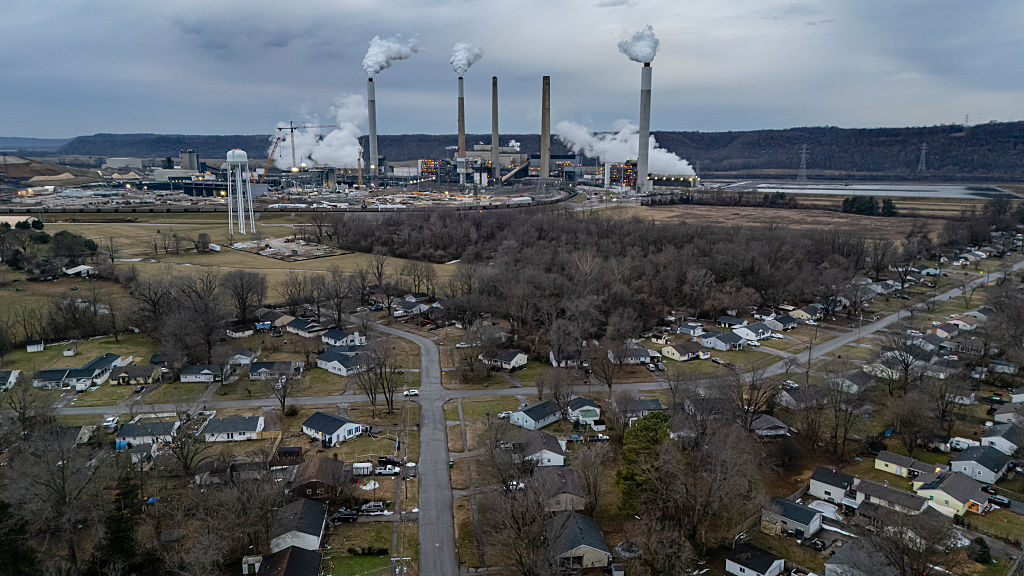
The Environmental Protection Agency (EPA) announced today that it would loosen restrictions on coal-burning power plants, allowing them to release more heavy metals, such as mercury and lead, into the air.
The move, first proposed in June 2025, targets Biden-era amendments to a rule commonly known as the Mercury and Air Toxics Standards for power plants (MATS). The amendments strengthened limits on mercury and other hazardous air pollutant emissions from coal-burning power plants and required them to continuously monitor emissions.
[time-brightcove not-tgx=”true”]
Of all fossil fuels, coal emits the most carbon dioxide per unit of energy, and burning it releases deadly pollutants into the air. Exposure to pollution from coal-powered plants has been linked to asthma, lung cancer, and respiratory infection, among other illnesses.
Coal-fired power plants are also the largest source of airborne mercury emissions in the United States, the EPA has previously said. Mercury is a neurotoxin, and can have toxic effects on the nervous, digestive and immune systems, and on lungs, kidneys, skin and eyes. MATS regulations have been extraordinarily effective at limiting these health risks. Within six years of taking effect, the 2012 restrictions caused mercury emissions from the power sector to drop 90%
MATS has gone through a number of challenges, however, since it was first established. “It’s been a bit of a seesaw,” says Bryan Hubbell, senior fellow at Resources for the Future, who previously managed the EPA’s Office of Air Quality Planning and Standards Risk and Benefits Group and worked on the original 2012 MATS rule.
After the Obama Administration first set the standard, the Supreme Court struck it down, saying that the EPA did not properly consider the costs of emissions reductions to the power plants. In response, the EPA published a supplemental finding in 2016 concluding that it remained “appropriate and necessary” to regulate power plants’ emissions.
The first Trump Administration kept the Obama era standards in place but removed the “appropriate and necessary” determination, minimizing the EPA’s authority to regulate hazardous air pollutants and limiting the scope of the Clean Air Act.
In 2024, the Biden Administration strengthened MATS beyond the original 2012 standards, instituting continuous emissions monitoring and stricter pollution limits for particulate matter and mercury. While the 2024 ruling has been repealed, coal plants will still be held to 2012 standards, which placed emission limits for mercury, acid gases, and other toxic pollution from power plants. Nearly all coal plants in the United States have already met the 2012 requirements, according to the New York Times.
“Technology evolved that could lead to more stringent regulations of these emissions, and the Biden Administration found that there were very significant health benefits through these reductions,” says Richard Revesz, professor of law at New York University, who specializes in environmental and regulatory law and policy.
Friday’s announcement is part of a larger effort by the Trump Administration to revitalize the coal industry—even though coal is among one of the most costly power sources and has been linked to a number of adverse health effects. The Energy Department previously ordered several coal-burning plants that had been slated for retirement to stay open. Earlier this month, Trump announced that he had ordered the Pentagon to purchase more coal-based electricity, and that the Department of Energy would allocate $175 million in funding for six projects to upgrade coal plants in four states.
The EPA has said that today’s rule change is expected to save an estimated $670 million. “The Biden-Harris Administration’s anti-coal regulations sought to regulate out of existence this vital sector of our energy economy. If implemented, these actions would have destroyed reliable American energy,” EPA Administrator Lee Zeldin said in a statement. “The Trump EPA knows that we can grow the economy, enhance baseload power, and protect human health and the environment all at the same time. It is not a binary choice and never should have been.”
But experts say that figure doesn’t consider the cost to public health. “There were very large health benefits to those standards, and the Trump Administration has erased all those health benefits,” says Revesz. “They pretend that the only real consequence of repealing the standard is saving costs to regulate industry, but they’re completely ignoring the foregone benefits that will now be imposed on American people. The American people will now be significantly less healthy because of this action.”
The ruling also relaxes limits on a number of other pollutants released by burning coal, such as arsenic, cadmium, chromium, lead, and nickel.
“Trump’s EPA is making an attack on public health with the repeal of the 2024 MATS,” Nicholas Morales, Earthjustice attorney, said in a statement. “This unlawful repeal will result in higher levels of mercury, soot, and other hazardous pollution into our air and communities. With this move, the Trump administration is wiping out health protections critical for protecting children from toxins like mercury just to save the coal industry some money.”
Hubbell says that, like most of Trump’s recent environmental rollbacks, the move is likely to face legal challenges. “This is just one amongst many likely deregulatory efforts,” he says. “I think folks want to make it clear that we’re not going to just let them go incrementally.”