

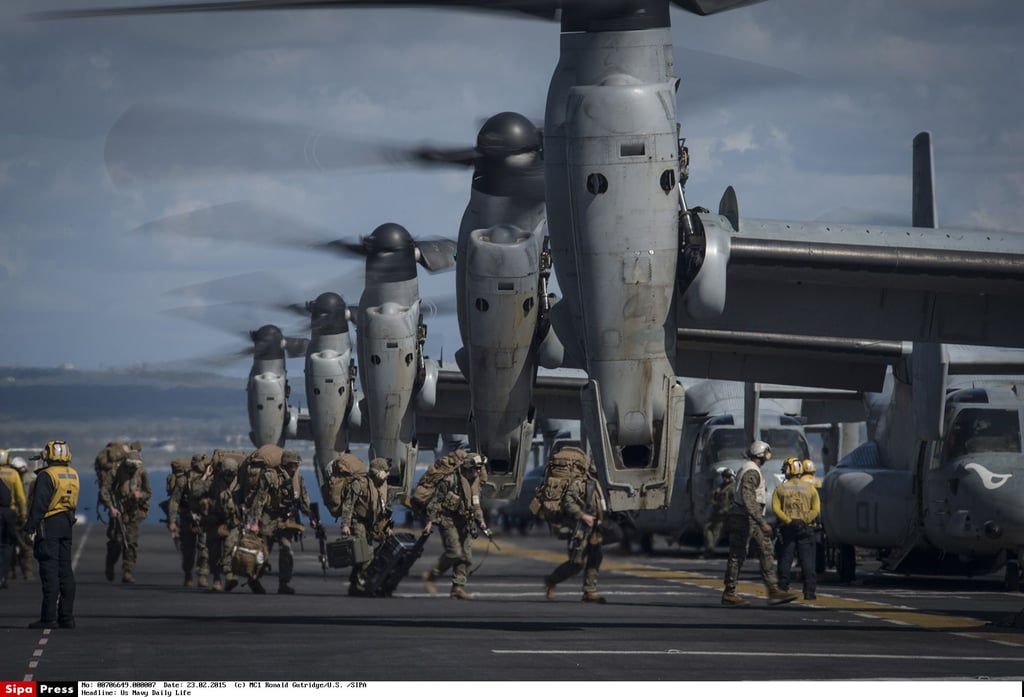
The United States military is deploying thousands of Marines and several more battleships to the Middle East, even as President Donald Trump’s top officials are reportedly engaged in talks to potential end to the war with Iran.
Some 2,200 Marines from the 31st Expeditionary Unit, traveling aboard the USS Tripoli, are due to arrive in the region on Friday, according to the Wall Street Journal, along with an amphibious landing dock, the USS New Orleans.
Around 2,500 more from the 11th Marine Expeditionary Unit, nicknamed the “Pride of the Pacific,” are on their way from California with the USS. Boxer.
Read More: Kharg Island: What To Know About the Iranian Oil Hub in Trump’s Sights
Senior military officials are also reportedly weighing a possible deployment of a combat brigade from the Army’s 82nd Airborne Division, which serves as an “Immediate Response Force” of about 3,000 soldiers capable of deploying anywhere in the world within 18 hours.
The troop movements are taking place against the backdrop of the first tentative signs of ceasefire talks since the conflict began on Feb. 28. After giving Iran an ultimatum to open the Strait of Hormuz or face the destruction of its power grid, Trump wrote on Truth Social on Monday that he had “constructive conversations” with the Iranian leadership, “regarding a complete and total resolution of our hostilities in the Middle East.”
Iran has denied that talks had taken place. A statement from Iran’s foreign ministry, reported by the semiofficial Mehr News Agency, said Trump’s statements were designed to “reduce energy prices and gain time to implement his military plans.”
Military experts interviewed by TIME suggest that the suspicion may not be far-fetched.
“Adding the 11th tells me that there’s something bigger afoot happening,” Michael “Mick” Patrick Mulroy, the former Deputy Assistant Secretary of Defense for the Middle East during Trump’s first term from 2017 until 2019, tells TIME. “To me, it indicates that somebody’s planning to do something with these units, and they need them both.”
What are Marine Expeditionary Units?
The United States already has 50,000 troops deployed across the Middle East, but most of them are not infantry units designed to invade a country.
Marine Expeditionary Units (MEUs) are different. They are amphibious assault forces that operate from the sea, forward-deployed, and often the first to arrive at a conflict site.
They consist of ground combat units with hundreds of infantry troops, armed vehicles and artillery, helicopters and attack jets, a logistics combat element, and a command team. MEUs were used in the invasions of Afghanistan in 2001 and Iraq from 2003 onwards, and specialise in amphibious assaults.
“They have a completely integrated, self-contained air support capability. They’re very much a contained force that can go anywhere in the world, that you can access from the sea and pretty far inland and do these assaults,” Mulroy says.
These units, says Jason Campbell, a senior fellow at the Middle East Institute, are designed for crisis response operations, rather than a longer-term occupation.
“The MEU and the other assets that are attached to them are not made to be a holding force for a longer duration,” Campbell, who served for two years as the country director for Afghanistan in the Office of the Secretary of Defense for Policy, says. “They’re extremely capable, but for limited operations of limited duration.”
What could the Marines be used for?
Trump’s key focus now, according to his public statements and leaks from his own officials, is reopening the Strait of Hormuz.
The Strait is a narrow waterway through which a fifth of the world’s oil passes, and it has been effectively closed by Iran since Feb. 28, causing a massive disruption to the global oil market. This weekend, Trump threatened to destroy Iran’s power grid if it did not reopen the Strait, which prompted Iran to threaten to hit U.S. and Gulf energy infrastructure in retaliation.
One strategy Trump is reportedly considering to reopen the Strait is the capture of Kharg Island, a strategic oil hub 15 miles offshore of Iran that processes 90% of Iran’s crude oil exports, Axios reported, citing four sources familiar with the matter.
Some officials believe capturing the island would give the U.S. leverage over Iran to force it to reopen the Strait.
Although Kharg Island is central to Iran’s oil industry, the operation would place troops in an intense line of fire from Iran, and would be a “high risk, minimal reward” situation, Campbell says.
The island has lost most of its defenses from U.S. bombardment, making it easier to seize, but the troops stationed there would likely not have much protection from Iranian retaliation.
“Kharg is only 15 miles off the coast of Iran. You would need considerable resources to hold this for a long period of time,” Campbell says, noting how much closer the troops would be to Iran than the American bases in the Gulf. “They will be under near constant bombardment from anything from rockets, drones, missiles, in the waterway.”
These forces could be used to hold Kharg until a larger force comes, but the island—though small—also has a population of thousands of people, and taking it would be “super escalatory,” Mulroy says, and potentially not even “strategically” in the U.S. interest.
Beyond Kharg, the Marines could be used in other tactical locations, including on the smaller islands right around the Strait of Hormuz, fighting to “get the terrain so that they can help to get the coastal positions that are putting the boats at risk,” Mulroy says.
‘We mean business’
Even if the U.S. does take Kharg, “[Iran is] still going to be able to likely export some oil, and they’ve demonstrated already that they can get by for a fair duration of time without being able to export the just over a million barrels a day that they’ve, built up to over these last few years,” Campbell says. “They’ve demonstrated resilience there.”
Iran could also bomb vulnerable energy and oil infrastructure in Gulf countries, which could raise oil prices even higher than they’ve already surged, and could take an incredibly long time to rebuild.
Mulroy also warns of the reported 5,000 naval mines that Iran could deploy, which, if used, he says would be “catastrophic.”
The troops may be heading toward action. Or—consistent with the way that Trump has conducted foreign policy in his second term—they could be “a signal to Iran that, look, we mean business when we say we’re considering boots on the ground,” says Campbell, “and hope that that alters their decision calculus.”
“Is this just to spook Iran? I don’t think it’ll work,” Mulroy says.