

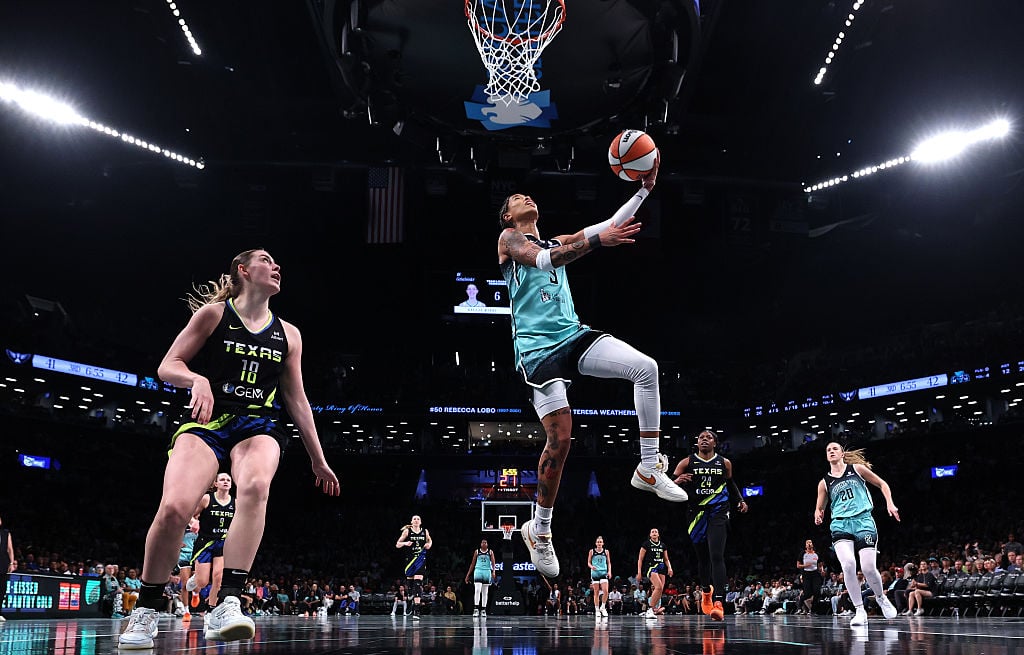
My earliest memory of professional women’s basketball is the 1996 Olympics. The All-Stars on Team USA pushed the sport to a point where it could no longer be ignored. I recorded features about that team on VHS and watched them over and over. Lisa Leslie, Sheryl Swoopes, Dawn Staley, and Rebecca Lobo didn’t just win gold; they expanded our imagination of what women’s basketball could be.
The WNBA was born of that ‘96 team, and the New York Liberty alongside it. Thirty years later, the WNBA’s cultural and economic influence can no longer be denied.
During this time, the Liberty have evolved from a founding franchise to an industry leader—on the court and in the boardroom. In 2024, we delivered a professional basketball championship to New York City for the first time in 50 years. In 2025, Forbes named us the most valuable women’s sports franchise in the world. We now stand positioned to become the first WNBA franchise valued at $1 billion.
As a whole, the WNBA is taking off. The league broke viewership and attendance records in 2025. And this season, WNBA players are set to become some of the highest-paid women athletes in the world.
That kind of growth prompts a harder question: Why did it take so long?
Growth requires investment
The answer isn’t a lack of belief. From the beginning, there was optimism and real conviction about what women’s basketball could become. But belief and scale are not the same thing. The early years proved the concept; they did not yet build the engine. You cannot grow a billion-dollar enterprise on enthusiasm alone. Sustained growth requires sustained infrastructure. Elite performance requires elite conditions.
In graduate school, I wrote my thesis on the urgent need for education and marketing around the WNBA. I myself was a collegiate basketball player, but I rarely saw ads or information about the league—even though I was, presumably, the target audience.
Fans can’t invest in what they don’t see or what they don’t understand. Before people can care, they need to know who the players are, what the teams stand for, and why it matters.
There was no blueprint for how a women’s professional franchise would fit into the broader sports ecosystem, how it would claim space, command media coverage, and scale alongside leagues that had decades of structural advantage. So we built one ourselves.
From the start, the Liberty played big. In 1997, we faced the Los Angeles Sparks at the Great Western Forum and drew more than 5 million viewers. By 2006, we became the first WNBA team to air our entire regular season on television. New York was sending a message about what was possible.
But visibility alone is not sustainability. Real change required structural commitment.
The inflection point for the Liberty came when belief met meaningful investment. When Joe Tsai and Clara Wu Tsai acquired the franchise in 2019, they recognized early that the Liberty were not an auxiliary property but a flagship opportunity: elite athletes competing in the world’s most influential sports market. They backed that belief with infrastructure, most notably an $80 million state-of-the-art practice facility in Brooklyn, along with upgraded player amenities, performance resources, and business operations designed to compete at the highest professional standard.
If you want championship outcomes, you must build championship conditions.
Reaching new audiences
When I became CEO during the pandemic, the franchise was in transition, and the world was in crisis. We chose to operate as if we were already filling 17,000 seats every night. I never wanted our players to look up at their circumstances and mistake them for their ceiling.
We also chose to focus less on surface-level demographics and more focused on values. What do our fans believe in? What do they stand for? What kind of community are they seeking? Our greatest asset is not just the product on the court; it is the community built around shared purpose.
The LGBTQ community has been with the Liberty from the beginning. We chose to stand just as visibly with them, becoming the first WNBA franchise to appear on a Pride float and helping define what a Pride Night in professional sports could look like: an unapologetic celebration of identity and belonging. Sue Wicks’ decision to come out publicly in 2002 was historic not just for our franchise, but for professional sports. Our commitment to visibility and inclusion has never been performative; it is embedded in our culture.
Communities of color have also found a home in women’s basketball. As a woman of color, I know firsthand that the traditional sports landscape was not designed with me in mind. I carved my path and found my professional home with the Liberty, where I have grown alongside an organization unafraid to evolve. Even our mascot, Ellie the Elephant, reflects the creativity and cultural fluency of Black women who helped shape her persona, proof that women’s sports brands can drive culture, commerce, and community simultaneously.
For too long, businesses of all kinds have ignored these communities. And for years, we were considered radical for centering these values. Today, they are recognized as competitive advantages.
Generational fandom
The Liberty’s 2024 championship was proof of concept. It was the culmination of years of structural investment, strategic discipline, and cultural clarity. But it was also a signal: women’s sports are no longer asking for validation. They are setting the pace.
We are now entering the era of generational fandom. Children are growing up with Liberty gear hanging next to Yankees caps. Fans who once cheered for Teresa Weatherspoon and Lisa Leslie are now bringing their own children—sons and daughters—to WNBA games.
In my own family, the impact is deeply personal. My daughter sees women celebrated as powerful, skilled, and central to the sports world. But in many ways, it is just as important for my son. He is growing up seeing women’s excellence in sports as normal, not niche. That normalization is how cultural change and new consumer behaviors take root.
The business case for women’s sports is no longer speculative; it’s structural.
Ahead of the 2024 season, we negotiated a landmark distribution agreement with WNYW FOX5 New York, the network’s first partnership with a women’s professional sports team, reaching more than 7.5 million households. Local viewership increased 129% year over year, leading to a multi-year extension. Then, in 2024, the Liberty set the WNBA’s all-time single-game gate revenue record, twice. And in 2025, we secured 52 corporate partners, 20 new to the WNBA, driving sponsorship revenue growth of more than 60% year over year.
This is what it has taken to grow a WNBA franchise. Investment creates opportunity. Momentum creates headlines. Infrastructure creates enterprise value.
Our ambition is unapologetic: to become the first billion-dollar women’s sports franchise. Not as a vanity milestone, but as evidence of structural correction in how women’s sports are valued.
Chronic undervaluation has held the WNBA and other women’s leagues back for decades. But the next 30 years will not be about proving women’s sports belong. It will be about defining what modern sports leadership looks like.
Leadership comes with one rule: you set the standard, and you don’t take your foot off the gas.