

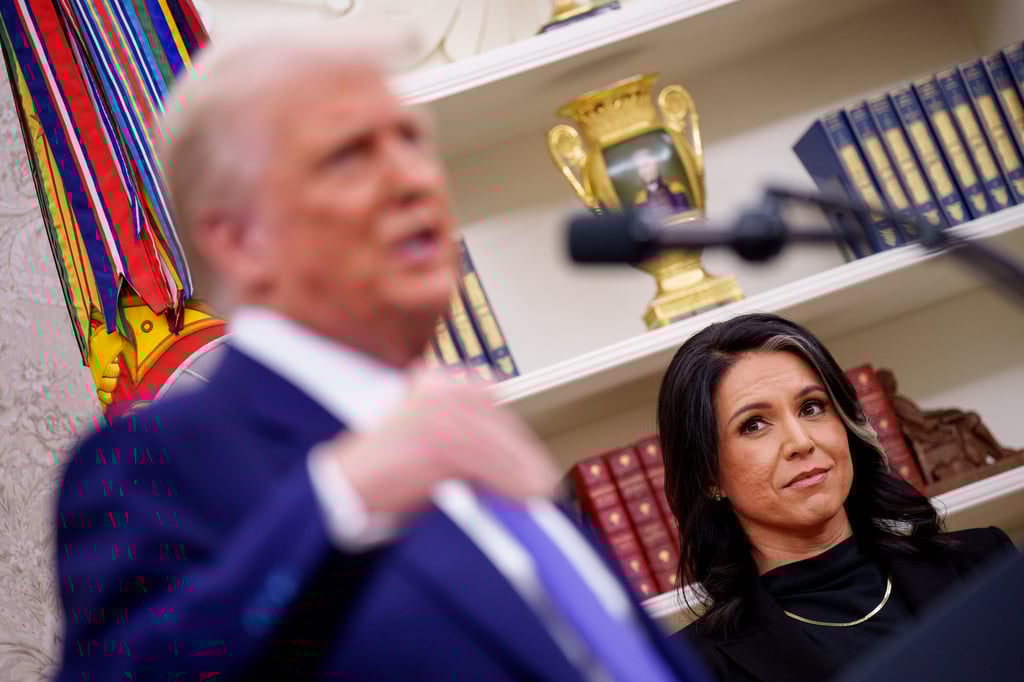
President Donald Trump acknowledged that he and intelligence chief Tulsi Gabbard are “a little bit different” in how they approach the matter of Iran’s nuclear capabilities.
Asked by reporters aboard Air Force One whether he still had confidence in Gabbard as his Director of National Intelligence (DNI), Trump said he did, but followed up by outlining where they differ on Iran.
“She’s a little bit different in her thought process than me, but that doesn’t make somebody not available to serve,” he said late Sunday. “I would say that I’m very strong in the fact that I don’t want Iran to have a nuclear weapon, because if they had a nuclear weapon, they would use it immediately. I think she’s probably a little bit softer on that issue, but that’s okay.”
When approached for comment, the Office of the DNI offered TIME a statement from White House communications director Steven Cheung, saying: “As President Trump said in his remarks, he has confidence in Director Gabbard and the tireless work she is doing.”
Gabbard was questioned about Iran nuclear intelligence claims during a tense Senate Intelligence Committee hearing on March 18.
The intelligence chief, who previously served as a Democratic Congresswoman before leaving the party, said Iran had not rebuilt its uranium enrichment program following joint U.S.-Israel strikes on three key Iranian nuclear sites in June last year.
“As a result of Operation Midnight Hammer, Iran’s nuclear enrichment program was obliterated,” Gabbard wrote in her opening statement ahead of the hearing. “There has been no efforts since then to try to rebuild their enrichment capability. The entrances to the underground facilities that were bombed have been buried and shuttered with cement.”
Gabbard did not include the part of her statement about Iran not having rebuilt its enrichment capability when she read it during the hearing’s opening.
Her assessment appeared to contradict one of Trump’s core justifications for launching strikes against Iran on Feb. 28.
“If we didn’t hit within two weeks, they would’ve had a nuclear weapon,” Trump insisted during a meeting with congressional leaders on March 4.
Trump repeated this sentiment during a speech in Florida on March 27.
“Remember, they were two weeks away,” he said. “They were two weeks away (…) If we didn’t knock the hell out of them, they would have had a nuclear weapon within two to four weeks.”
The differing rationale offered by the Trump Administration for the Iran war—along with the escalating cost of the conflict—has prompted criticism and concern across party aisles.
Trump acknowledged the difference in approach, but suggested that broader support for the war remains strong.
When discussing Gabbard, Trump indicated to reporters that “most people” are in favor of the Iran war. “Most people are saying thank you very much for doing what you did,” he said.
Director of the Defense Intelligence Agency Tulsi Gabbard (center) during a Senate Intelligence Committee hearing in Washington, D.C. on March 18, 2026. —Andrew Harnik–Getty Images
Disapproval of U.S. military action against Iran
Despite Trump’s claims, various polls suggest Americans are largely in opposition to the war.
According to a Pew Research poll published on March 25, about 61% of Americans disapprove of Trump’s handling of the conflict, while 37% approve.
A Quinnipiac University poll, also released on March 25, found that 42% of registered U.S. voters believe the war makes the world less safe.
The war has exposed divisions among U.S. officials, too.
Top counterterrorism official Joe Kent stepped down on March 17 over the decision to go to war with Iran, arguing in a resignation letter addressed to Trump that Iran posed “no imminent threat.”
“I cannot in good conscience support the ongoing war in Iran. Iran posed no imminent threat to our nation, and it is clear that we started this war due to pressure from Israel and its powerful American lobby,” Kent wrote.
During a House Intelligence Committee hearing on March 19, Gabbard said “yes” when asked if Kent’s statement about Israel concerned her.
Trump, meanwhile, dismissed Kent’s departure, describing him as a “nice guy,” but “very weak on security.”
Vice President J.D. Vance, who has previously voiced an anti-interventionist stance, criticized Kent’s approach, arguing that the Administration’s responsibility is to support the President by making his decisions “as effective and successful as possible,” whether they personally agree with them or not.
Trump scrutinized for swaying from campaign promise to avoid foreign wars
There are growing signs of tension within parts of the MAGA camp, with some allies arguing that Trump has strayed from his campaign promises.
Trump ran in 2024 on a campaign that swore to avoid dragging the U.S. into foreign wars, instead focusing on home prosperity.
In February, days before the initial strikes against Iran, the White House referred to him as the “President of Peace.”
But that moniker has since been called into question.
From Iran to Venezuela, Trump has ordered strikes on several countries and areas in his second term, and on Monday, he threatened further military action if a U.S.-Iran deal is not reached shortly.