

Defense Secretary Pete Hegseth said Tuesday that the U.S. bombing of Iran will continue until Iran agrees to a deal to end their ballistic missile and nuclear weapons program.
Iranian officials have denied they are in negotiations with the U.S., but Hegseth said the talks “are very real.”
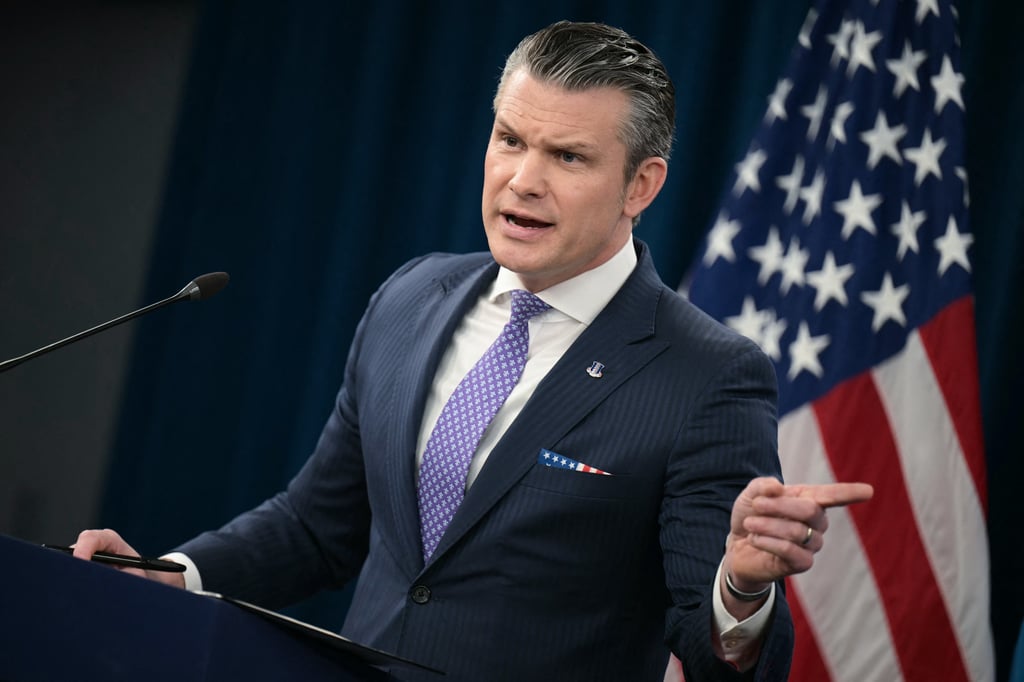
During a briefing with reporters at the Pentagon, Hegseth claimed Iran’s defense industrial base is “nearly completely destroyed” and U.S. warplanes are able to fly freely over Iranian airspace and blow up mobile missile and drone launchers as they come into the open.
“We don’t want to have to do more militarily than we have to, but I didn’t mean it flippantly when I said in the meantime we’ll negotiate with bombs. Our job is to ensure that we compel Iran to realize that this new regime, this regime in charge, is in a better place if they make a deal,” Hegseth vowed.
Hegseth said he visited U.S. military bases in the Middle East over the weekend to meet with U.S. troops. Upon his return, he met on Monday with the team President Donald Trump has tasked with talking to Iran’s leadership—Middle East envoy Steve Witkoff, Trump’s son-in-law Jared Kushner, and Secretary of State Marco Rubio.
The deployment of thousands of U.S. Marines and 82nd Airborne troops near Iran is also intended to put pressure on Iran at the negotiating table, Hegseth added.
Asked why additional combat troops were sent to the Middle East, he said that “the point is to be unpredictable.”
“Our adversary right now thinks there are 15 ways we can come at them with boots on the ground, and guess what, there are,” he said. “If we needed to we could execute those options on behalf of the President of the United States and this department, or maybe we don’t use them at all—maybe negotiations work.”
Since U.S. and Israeli bombardments inside Iran began on Feb. 28, the U.S. has hit 11,000 targets, said U.S. Chairman of the Joint Chiefs of Staff Dan Caine, who stood next to Hegseth during Tuesday’s press briefing.
In recent days, U.S. warplanes have increased the pace at which they destroy mobile rocket and drone launchers moving into the open inside Iran.
The thousands of additional elite combat units deployed in the region could be used in many different ways, Caine said. One of them, he added, is that their mere presence is intended to put pressure on Iranian negotiators to make a deal.
“The range of military options that those forces can offer are extensive, not the least of which is Iran should note that they’re out there and they are a pressure point so they should carefully consider at the diplomatic level—not my job as the chairman but, at the diplomatic level—what’s in front of them,” he said.
Iran in recent weeks has roiled oil markets by menacing shipping lanes in the Strait of Hormuz.
After some negotiations with Iranian officials, a few shipments have been allowed to move through safely in recent days. But the standoff has spiked gas prices.
Trump wrote in a Truth Social post on Tuesday morning that allies should be doing more to defend shipping from Iran, arguing that it isn’t solely the responsibility of the U.S.
He told nations who refused to actively get involved with the Iran war that they should just go to the Strait of Hormuz and “take” oil if they’re worried about shortages. “You’ll have to start learning how to fight for yourself. The U.S.A. won’t be there to help you anymore, just like you weren’t there for us,” Trump warned.
Hegseth endorsed the message and indicated that Trump is ready to make a cease-fire deal with Iran.
“If Iran is wise, they will cut a deal,” Hegseth said. “President Trump will make a deal. He is willing.”