


Donald Trump’s war with Iran has dealt a high cost to American wallets, and on the final days of March, the conflict broke a new threshold.
For the first time since 2022, following Russia’s invasion of Ukraine, the national average retail price of gasoline crossed $4 per gallon, according to price-tracking service GasBuddy and the American Automobile Association.
This marks an increase of more than $1 from last month’s prices before the war began on Feb. 28.
Read more: Trump Says U.K. and Others Should Go to Strait of Hormuz and ‘Take’ Oil
Why gas prices have crossed $4 per gallon
The surge is being driven by rising global oil prices tied to the conflict, which has threatened supply and raised fears of disruption along key transit routes, including the Strait of Hormuz.
Patrick De Haan, GasBuddy’s head of petroleum analysis, warned that a $4 per gallon national average breaches a “psychological wall.”
Jeremy Siegel, senior economist at global asset manager WisdomTree wrote in a note earlier this month that compared to similarly reported spikes in crude oil prices, gasoline is “the most visible price in the economy for consumers, and when that price jumps it hits psychology immediately.”
The Trump Administration has tried to campaign on affordability ahead of the midterms this year, but the war has only exacerbated an already struggling U.S. economy. Not only does the conflict threaten global energy resources; it also upends food supply and production, travel, and shipping costs, all of which push the U.S. further toward a possible recession.
And, despite ongoing negotiations, there’s no sign the conflict will let up anytime soon, meaning gas prices could still rise further, especially if the Strait of Hormuz, through which about a fifth of global oil supply travels, remains disrupted.
“The situation remains highly volatile and unpredictable,” De Haan said in a March 30 blog post.
How much gas prices have risen since the Iran war began
Latest data from GasBuddy shows that gas prices per gallon have gone up $1.04 from last month’s average of $2.97. AAA recorded a similar increase compared to a month ago: posting $2.98 on Feb. 26, to $3.98 on March 26, and to $4.02 on March 31. A seasonal spring break travel demand has also pushed gas prices up.
Parts of the West Coast, particularly California, have posted even higher gas prices. GasBuddy recorded the average on March 31 as $5.87 per gallon. The state’s mandate for a special blend of gasoline, a lack of petroleum infrastructure connections, and high gas taxes contribute to higher fuel costs. Energy economist Philip Verleger wrote in a note, reported by Reuters, that the U.S. West Coast “will become the poster child for the consequences of the attacks on Iran.”
Why diesel prices are surging and what it means for consumers
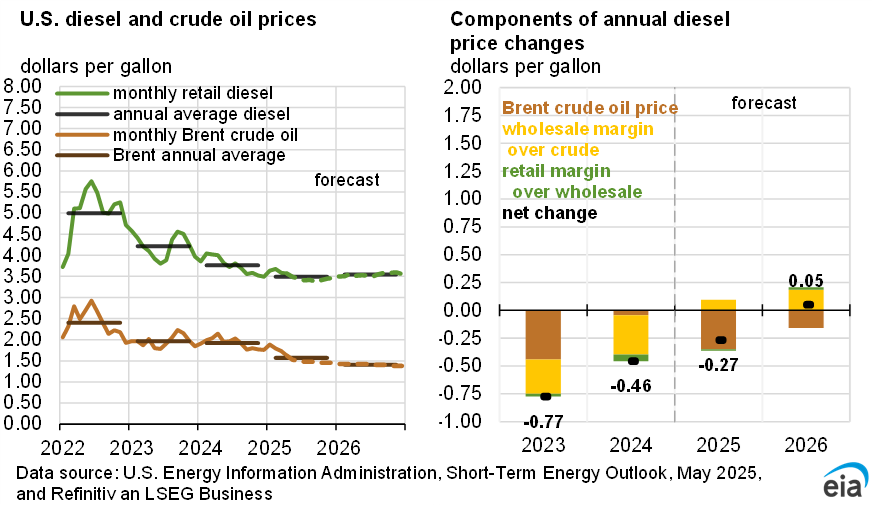
Prices of diesel, the primary fuel across many critical sectors like transportation, shipping, construction, and agriculture, hit $5.45 on Tuesday, according to AAA, up 45% since the start of the war. A rise in diesel cost could have a trickle-down effect on supply chains: Joe Brusuelas, chief economist at audit, tax, and consultancy firm RSM US, estimated to Bloomberg that a 10% rise in diesel could push up the headline consumer price index by 0.1%.
While the U.S. is a major oil producer, gas prices are still tied to global crude markets, and diesel cost is largely affected by these global benchmarks, according to data from the U.S. Energy Information Administration. Diesel refinement costs, distribution, and levies also increase its price.
The Administration has tried to mitigate the war’s impact on pump prices. Earlier in March, Trump ordered the Department of Energy to release 172 million barrels from the Strategic Petroleum Reserve, which would take around 120 days to deliver.
Trump also waived the Jones Act for 60 days, allowing foreign-flagged vessels to ship goods between American ports, which could mitigate shipping costs, and he has allowed the sale of higher-ethanol gasoline blends—normally prohibited for summer sale due to concerns over smog—to try and lower gas prices.
How high gas prices could rise from here
Analysts forecast that pump prices have nowhere to go but up. “More than likely there is more to come, because there’s usually a lag between crude prices and what consumers pay at the pump,” Phil Flynn, senior market analyst at Price Futures Group, told Fox Business.
Robert Yawger, commodity specialist at Mizuho Securities, told the Wall Street Journal earlier this month that a $10 increment in the per-barrel price of crude oil can lift gas prices by 10-15¢ per gallon, while BloombergNEF estimates that with the same $10 per-barrel increase in cost amid escalating tensions, gas prices could go up 30-40¢.
Should the situation continue, as is, the U.S. is likely to see the national gasoline average “push beyond the $4-per-gallon mark,” De Haan from GasBuddy said in the March 30 blog. Diesel, on the other hand, could reach $6 per gallon, De Haan said, and could even “set new records if conditions fail to improve.”
Strategists from Australian firm Macquarie Group warned that if the war extends to the summer, oil prices could hit $200 per barrel, which could push pump prices to as much as $7 per gallon. These analysts reportedly put the probability of such an outcome at 40%, while a different scenario, which they assigned a likelihood of 60%, would see conflict in Iran ending this month and oil prices subsequently falling, though the price would remain higher than pre-war levels.
“Prices go up like rockets, and they come down like a feather,” Michael Mische, a supply chain expert and professor at the University of Southern California, told Fox Business.
Speaking to Reuters, analysts also said that if Kharg Island, a key Iranian oil hub, were to be damaged amid the conflict, Brent prices could hit $120 per barrel, with some analysts forecasting levels as high as $200.
In its March 2026 short-term outlook, the Energy Information Administration projected Brent crude oil prices would remain above $95 per barrel for the next two months, before falling below $80 in the third quarter of 2026 and ending the year around $70 per barrel.
The EIA also said in its report that its annual average forecast for 2026 retail gas prices was $3.34 per gallon and that crude oil prices could push retail gas prices to around 60¢ per gallon higher in March and about 70¢ per gallon higher in the second quarter of 2026, after which it is projected to fall back to close to $3 per gallon by the end of the year. But those projections rest on several assumptions, including that shut-in oil production will peak in early April and transit through the Strait of Hormuz will improve. And that remains to be seen.