

When you’re playing a Super Mario game and you jump into a bottomless pit or get killed by a waddling Goomba, you restart the stage and hopefully avoid making the same mistake as your gameplay improves. The Super Mario Galaxy Movie, sequel to the wildly successful Super Mario Bros. Movie from three years ago, leveled up when it came to what was almost universally regarded as the worst part of the 2023 film. There are essentially no needle drops or licensed pop songs in the new movie. Yahoo!
Super Mario is one of the most iconic franchises in all of pop culture, and both the first movie and this new one (now in theaters) jam the screen with red-and-white mushrooms, question-marked Power Blocks, and all sorts of recognizable characters and critters. The music of Mario is almost just as iconic—even a casual gamer can probably hum at least a half-dozen themes. Composer Brian Tyler took these themes, which were originally created by Koji Kondo over the decades he’s worked on dozens of Mario games, and turned them into a cinematic score that felt large enough for the big screen while still triggering nostalgia. The problem with the first movie was that, in several sequences, Tyler’s music got pushed to the side in favor of licensed tunes that totally took audiences out of the Mushroom Kingdom.
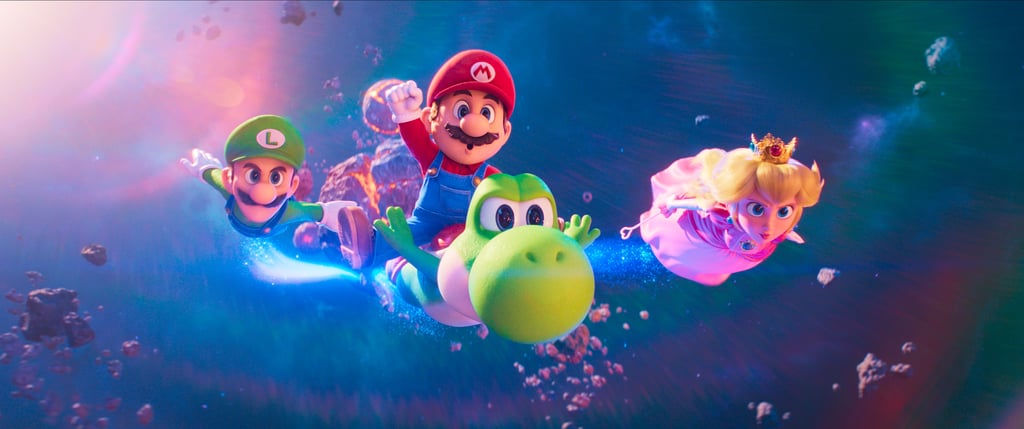
Toad, Yoshi, Luigi —Courtesy of Universal
When Mario and Princess Peach enter the land where Donkey Kong resides in the first movie, the synthy falsetto of A-ha’s “Take on Me” plays instead of a jungly tune; a seemingly arbitrary music choice whose only connection to the events on screen seems to be “The Donkey Kong arcade game also came out in the ’80s.” When Mario and Co. are building vehicles before hitting Rainbow Road, AC/DC’s “Thunderstruck” plays, rather than a cut from a Mario Kart soundtrack. When Bowser first threatens the penguins at the beginning of the movie, “Battle Without Honor or Humanity,” a piece of music best known for its inclusion in Kill Bill, tracks the scene.
In addition to not matching the tone of the movie, these are uninspired choices. What joy is there to be found in recognizing highly recognizable songs when the gamers in the audience really want to be recognizing the beeps and boops of Mario music? Who are these pop culture needle drops for? The kids watching were born decades after A-ha’s heyday and hopefully haven’t seen Quentin Tarantino’s R-rated action epic. Adult moviegoers, meanwhile, have been playing Mario games for 40 years; hearing iconic 8-bit tunes come to life is itself an immersion in nostalgia.
The use of these pop songs in the first movie was widely criticized. Viewers who didn’t like the first movie complained about how jarring and out of place they were, and even fans of the movie admitted that the needle drops were a misstep. (In line for an early screening of The Super Mario Galaxy Movie, I heard somebody say their only hope for the new movie was that it didn’t have any pop songs.) It’s unclear why, exactly, Universal, Illumination, and Nintendo thought they had to put pop songs inside the Mario Bros. Movie. To make things worse and more inexplicable, there are original compositions on the soundtrack that do not appear in the actual movie but match almost perfectly with the action for sequences that have pop needle drops. This suggests that the decision to put A-ha and AC/DC in the movie might’ve been a late one that came at the expense of a more Mario-centric score.
Princess Peach and Mario in the Galaxy Movie —Courtesy of Universal
Galaxy has its own problems (it’s shoving the premise of at least three different Mario games and also a Star Fox game into one overstuffed movie, and it shows), but at least its creators took feedback on the first movie’s soundtrack to heart. There is really only one needle drop in the whole movie, and it’s somewhat excusable. When Yoshi first meets the Bros. and recounts his brief misadventures in Brooklyn before he escaped through a Warp Pipe, a bit of “Hypnotize” by The Notorious B.I.G. plays. Biggie Smalls’ whole vibe doesn’t fit within the Mushroom Kingdom, but it does fit, famously, in Brooklyn. The first film’s use of the Beastie Boys’ “No Sleep Till Brooklyn” during the Brooklyn-set opening is similarly easier to swallow. Real-world songs make a certain amount of sense in the real world; they’re jarring in the video game fantasy land. (There is an additional pop song in Galaxy but it’s minor; the credits list a sampling of The Bar-Kay’s 1976 funk song “Too Hot to Stop,” which plays during an early party scene as some penguins and Yoshi dance. It’s subtler than any needle drop in the first movie while still not totally matching the vibe.)
With these exceptions, though, the rest of the music in The Super Mario Galaxy Movie is music that sounds like it belongs in a Mario movie (or, briefly, a Star Fox movie) instead of a jukebox musical. Without a mixtape of classic rock hits to spoil the fun, moviegoers can more easily get lost in the Mushroom Kingdom and galaxies beyond. It’s much better this way. Super Mario is not some sacred IP that can’t be turned into silly kids entertainment, but Mario is iconic enough that the movies don’t need to bring outside pop culture into the fiction. These aren’t the DreamWorks Trolls movies, folks. It’s-a Mario.