

—Man Sum Lai—TIME
“Well, it’s not starting. This is awkward.”
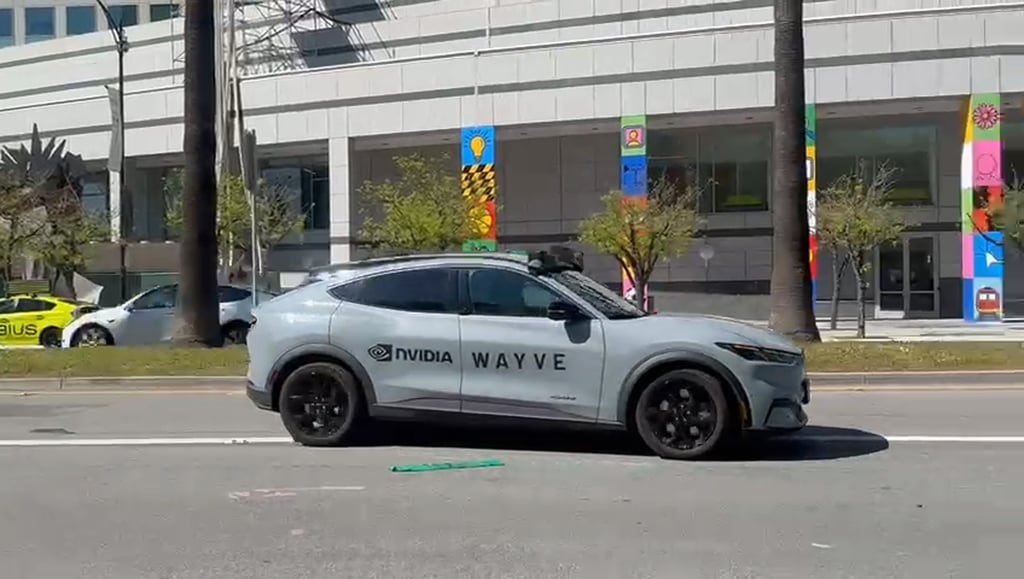
Wayve CEO Alex Kendall is prodding the touch screen panel in our Ford Mustang Mach-E, trying to coax his multi-billion dollar company’s software into taking us for a ride around San Jose. An assistant reaches in through the passenger window, does something like a “turn-it-off-and-on-again” move, and a map appears on the screen. Kendall pulls the car past a line of cones that cordons off an Nvidia GTC conference venue, then hits start. We’re pushed back in our seats gently as the car accelerates into the lane, eager to hit the road.
In autonomous driving, as in many other AI-related domains, getting in first counts for a lot. Capturing customers early means collecting data that improves your product, starting a flywheel that can allow incumbents to devour the market. Waymo operates 3,000 robotaxis in ten U.S. cities, bringing in an annualized revenue of over $350 million as of January. Tesla has over six million vehicles collecting data for its Full Self-Driving mode.
Wayve is an underdog. In February, the London-based startup was valued at $8.6 billion—a few weeks after Waymo, which was spun out of Google in 2016, was valued at $126 billion. Kendall isn’t daunted. “What we’ve built is a paradigm shift from what you see driving around in Shanghai or San Francisco,” he says, referring obliquely to Waymo and its Chinese competitors, which include Pony.ai and WeRide. However, the startup has yet to prove itself in a widespread deployment.
Wayve promises to bring partial automation—the vehicle drives itself, but a human must remain alert behind the wheel just in case—to almost any modern car. “The automotive industry is now just building cars that have the right sensing and hardware at millions-of-scale volume to deploy an AI like this,” says Kendall, gesturing at the car’s console, which is stewarding us calmly through the busy streets. The hope is that widely deploying its partially autonomous AI will allow Wayve to collect data to develop one that is capable of fully autonomous driving.
As long as it restricts itself to partial autonomy, Wayve can use cheap and widely accessible hardware, which currently powers features such as adaptive cruise control and automatic emergency braking in many cars. The cameras and computer chips built into the Ford Mustang Mach-E cost a few hundred dollars, according to Kendall. “This is about bringing this technology to any vehicle,” he says.
At first glance, this is an impressive edge over Waymo’s custom-built robotaxis, which use 13 cameras, six radar units, four LiDAR units, and cost in the tens of thousands of dollars according to some industry estimates. However, the comparison is not apples to apples: to drive fully autonomously with no human behind the wheel, Wayve would need more sensors, too.
If Wayve does get its software on the road, it may soon be driving all over the world. In 2025, the company ran a 1.45 million-kilometer “road trip” across 500 cities globally, many of which the cars had never previously driven in, relying only on the “standard navigation maps” that a human might use to get around. Waymo creates detailed initial maps for each new service area where it operates, which takes “weeks,” according to a Waymo spokesperson. The Waymo spokesperson also noted that its cars autonomously navigate some unmapped areas, such as construction zones.
Wayve’s versatility across cars and countries’ opens markets that have, so far, gone untapped by its competitors, according to Kendall. The market for car sales is worth roughly $2 trillion, ten times the taxi market in which Waymo currently competes. Tesla, which, like Wayve, develops partial automation software, does not currently offer its software to other car companies. “The largest opportunity … is to license technology to any fleet or any automaker,” says Kendall. “I think by the 2030s … if you’re selling a car and it doesn’t have hands-off and eyes-off driving, the demand for that product is going to be near zero.”
Wayve plans to begin running its own rides in London and Tokyo in 2026, through Uber, one of its investors, with safety drivers behind the wheel for backup. The deployments will help collect data to train the AI driver and develop “world models:” simulated worlds that Wayve and Waymo use to test how their AI will respond to new environments. “Data is the biggest bottleneck in robotics—it’s extremely time-consuming and expensive to gather,” says Anastasis Germanidis, co-CEO of Runway ML, which makes world models.
But in the meantime, some of Wayve’s advantages are eroding. Waymo’s latest vehicle requires 42% fewer sensors than its previous generation, weakening Wayve’s claims about the gap in hardware costs. More concerning for Wayve, perhaps, are Waymo’s moves toward expanding beyond robotaxis, to offer its self-driving AI for personally owned vehicles. In April 2025, the company reached a preliminary agreement with Toyota “focused on accelerating the development and deployment of autonomous driving technologies.”
The Wayve ride in San Jose is uneventful, as one would hope. The highlight is a particularly good preparation for a turn: “A really nice lane change. Just popping up behind the bus so we can make this right turn,” Kendall murmurs. “As we deploy more vehicles, this produces a flywheel where the more deployments we have, the more experience, the better-performing the system becomes, the more applications it can serve,” he says. Of course, the same holds for his competitors.