

This article is part of The D.C. Brief, TIME’s politics newsletter. Sign up here to get stories like this sent to your inbox.
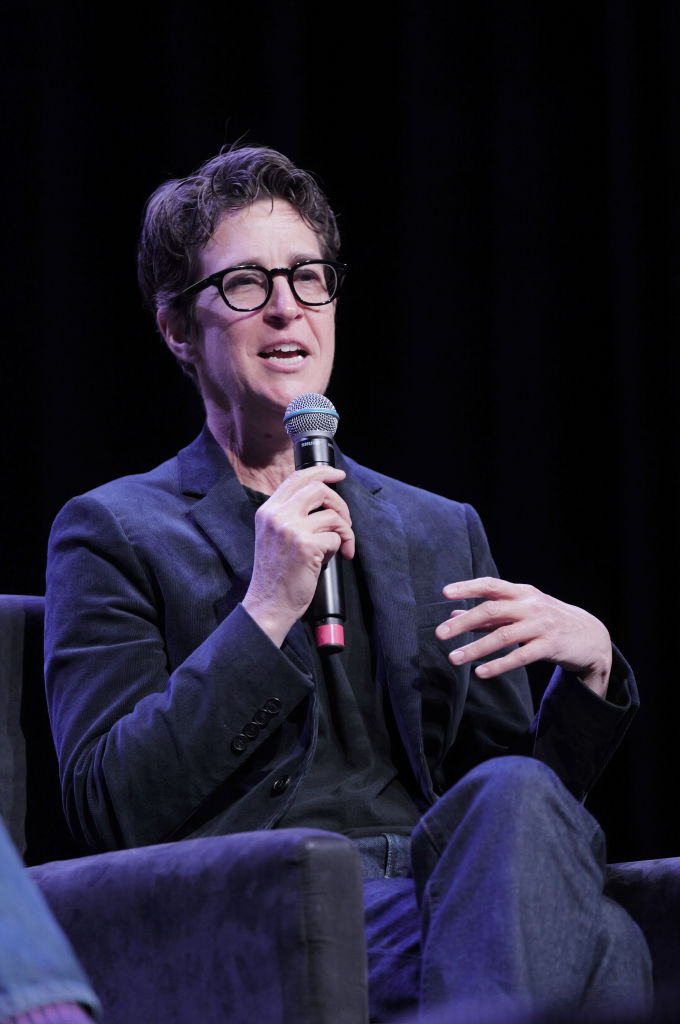
It’s a jarring moment of optimism during a conversation that is centered on a dark period in U.S. history that is not all that far in the past. As Rachel Maddow, arguably the most influential voice in progressive media and the biggest talent on the rebranded bench of MSNBC now known as MS NOW, summarized to me her latest project—out today—that focuses on the U.S. internment of Japanese Americans during World War II, she defies the predictable gloom with the same independence that had her last month sitting in the pews at former Vice President Dick Cheney’s funeral.
[time-brightcove not-tgx=”true”]
“Doing the right thing doesn’t always pay off in the short run, but your country will ultimately get this right,” she tells TIME. “The good guys will be rewarded and the bad guys will be punished or forgotten. Having faith in those kinds of moral outcomes is really a nice guiding light to have in dark times like these.”
And these times, for students of the race-driven persecution of the 1940s, feel all too familiar, especially with Maddow’s podcast-as-history-lesson, Burn Order. A government besieged by paranoia. A creeping suspicion that one group in particular is to blame for the domestic angst bleeding through the broader society. Temporary detention facilities in remote places meant to evade scrutiny. A Rasputin-like figure working in the background without accountability. And a public that seems determined to look the other way.
It’s impossible not to draw parallels to what the government is doing today with migrants suspected of crimes. Maddow’s reporting includes details from a startling government memo, a copy of which was discovered in 1982 despite orders to have every last copy of it destroyed by fire. As Burn Order conveys, it provides a blueprint that explains how things went very, very wrong.
“When you recognize that this isn’t the first time something has happened, you want to learn about the other time it’s happened to see if it can inform the way that you ought to respond,” Maddow says.
TIME spoke by phone last week with Maddow from her home in Western Massachusetts about her latest project, the MSNBC reboot, and how history can inform—but not save—the Resistance.
This interview has been edited for length and clarity.
TIME: When did you know you wanted to tackle Japanese internment as a project for a podcast? Is this a product of Trump 2.0
Maddow: I had this story burning a hole in my pocket for a couple of years. When we saw what was going on in terms of people being snatched off the streets and hastily built prison camps going up all around the country in deliberately remote areas. The resonance of it pushed this to the top of the line for us. It just felt like the time to do it.
This history sure feels predictive. John DeWitt, the four-star general who oversaw the internment program, in particular, seems to be a forerunner to some of America’s worst errors, paranoia, sins. What parallels did you see in this?
Sometimes when the country does terrible things, when the government does really awful stuff, it feels like we could have never done this before. That’s definitely not true. These things don’t just automatically happen. They’re not on autopilot. There isn’t anything inevitable about them. It’s individual people—the wrong man in the wrong place at the wrong time—to give terrible policy outcomes like this. And so it’s worth being really specific about who is actually making this happen, who’s driving it, who can potentially be targeted, or focused on in terms of trying to stop it or change it.
The heroes are less well known than the villains. In this case, I actually think the villains are not known at all. I mean, I’m not sure anybody knows who Karl Bendetsen is. You may have heard of Fred Korematsu. You may have even heard of Mitsuye Endo. I’m not sure that the actual historical truth about how this went down will be familiar to 99% of the people.
Ken Ringle seems like a familiar profile when you situate him along John Dean, Daniel Ellsworth, Eugene Vindman. But Ringle’s fate also seems tragically familiar. His report stating that Japanese Americans did not pose a security risk got to the White House two days too late. Fasting forward to the present, why shouldn’t folks like him just give up today?
The thing that I think we’ve learned from the worst things our government has done, the worst things our country has been through, is that there isn’t one silver bullet that solves these problems. Ultimately, it is unpredictable what’s going to be the straw that breaks the camel’s back. It is not necessarily something that gets rewarded in the lifetimes of these heroes. It happens later. One of the heroes in this story is Ken Ringle. His Navy career does not benefit from his heroic efforts in this regard, but history and his own family will tell you that he is the heroism of what he did, and the truth of what he did is something that is his lasting multi-generational legacy.
Another hero is Ralph Carr, who was the Governor of Colorado, who was a huge presence and then actually had his political career destroyed by the principled stake that he took. But right now, all over Colorado, there are statues of Ralph Carr and plaques and highways named after him and buildings named after him. Maybe that’s cold comfort for Ralph Carr in the moment when he lost his election in 1942. But in the long run, he’s in the pantheon in terms of what we think of as American heroism among elected officials.
The same goes with the young Japanese Americans who challenged this thing. Hirabayashi, Korematsu, and Yasui, they all lost their cases and went to prison. Then they all also got the Presidential Medal of Freedom. Doing the right thing doesn’t always pay off in the short run, but your country will ultimately get this right. The good guys will be rewarded and the bad guys will be punished or forgotten. Having faith in those kinds of moral outcomes is really a nice guiding light to have in dark times like these.
Sticking with the dark for a minute, it does seem that time and time again, we will do what is against our self-interest. Ringle was a cultural anthropologist without the title, and he was sounding the alarm that Japanese-Americans were not a threat but rather an asset for U.S. interests. We chose expediency to label an entire population as The Other. Is that a uniquely American trait?
I don’t think it’s uniquely American. James Rowe, [an assistant to FDR’s attorney general,] at one point says in this oral history interview that this is something that we do over and over again. It’s in our blood and every time we do it, we get damned ashamed of ourselves for it. That observation from him decades ago is something that sticks with me. I don’t think it’s peculiarly American, but I also think it’s worth being really specific about how this decision got made. In this case, there was a Stephen Miller-type figure who was not the guy in charge, who was a staffer to the guy in charge.
He was supposed to be a safeguard.
John [DeWitt] was really, really smart and had his own ideas about what should happen. Bendetsen was supposed to clean things up in this messy, important office that he was being assigned to, but he got in there and he laid out the basis for what he did. And it was purely racially based and—against all the evidence to the contrary—that this was military necessity. Sometimes you can get one person—one able, clever, and I think twisted person—in a place with their hands on the levers of government who can make the whole country do something that they are ashamed of for decades.
The country doesn’t go mad all at once. One guy drives us in an evil direction, and then we’ve all got to pay for it. And we should know how the people who fixed it, exposed it, and stopped this policy and ultimately made the country apologize for it, how they did their work because Americans need to do that work around what we’re doing now.
Your previous projects have offered warnings about how bad actors can do bad things, or at least give us really bad outcomes. Why have Democrats not cracked the history books to explain this to voters?
They have a little bit. Gov. [J.B.] Pritzker in Illinois has given some speeches this year in which he’s pretty blunt about what he sees are the historical parallels to the way President Trump is ruling the country. People like Congressman Jamie Raskin have articulated some of these historical parallels. It’s helpful, but I don’t know how effective history is as a political tool. You hear some Democrats speaking along these lines. In some cases it’s just unavoidable. We really are building mass prison camps for essentially black box, extra-constitutional detention centers. We’ve done that in this country before and we should make those connections.
Where does a progressive voice like yours fit into this moment? I mean, we certainly have a freer media environment to tell these stories than 1930s Europe or 1940s America or even at the height of the Cold War in Western capitals. How does your platform right now fit historically in moments like this?
I’m very happy that MS NOW exists. I’m very glad to be working there, especially when we’re seeing a lot of the real hallmarks of state capture of the media that we’ve seen in other authoritarian takeovers in other countries. [Hungarian Prime Minister Viktor] Orbán would blush at what some media companies in this country have been doing to try to please Trump and ultimately to turn over media ownership to oligarchs who are happy to serve the regime. It’s like Hungary on meth.
But at the same time, our First Amendment lives. Our Freedom of the Press in particular lives. And we plan to use it. It’s an honor and it is exciting to be at a place where we really can cover what we want the way that we want it, without fear or favor.
There’s almost consensus among real working journalists in this country that we cannot become a country that only has state TV. What it takes to do that is to stand up and be a successful, resonant, scrappy, aggressive, non-state TV competitor. And MS NOW is that in spades.
How has your thinking about your specific role in the media environment changed since Trump 1.0? Has it changed?
I was waving a lot of warning flags in Trump 1.0 about what could be going on and how we should see the risk of the kind of government Trump was trying to impose.
Now, we’re there. There’s no use in warning anymore. We’ve got masked, totally unaccountable secret police grabbing women out of daycares and building prison camps everywhere. In less than a year, the President has stuffed multiple billions of dollars into his own pockets, into those of his family. He has literally torn down the White House. We’re no longer at the point where we need to be warned about what’s coming. We’re now at a point where what we need is understanding what’s going on, knowing what our options are in terms of how to preserve our democracy, to make sure that we’re not going to be the generation that lost the republic.
Where does the help come from?
It comes from context, from understanding historical international allegories to what we’re doing. When you recognize that this isn’t the first time something has happened, you want to learn about the other time it’s happened to see if it can inform the way that you ought to respond. We’re kids in terms of learning about new stuff. You learn by comparison, you learn by analogy, you learn by example.
Make sense of what matters in Washington. Sign up for the D.C. Brief newsletter.