

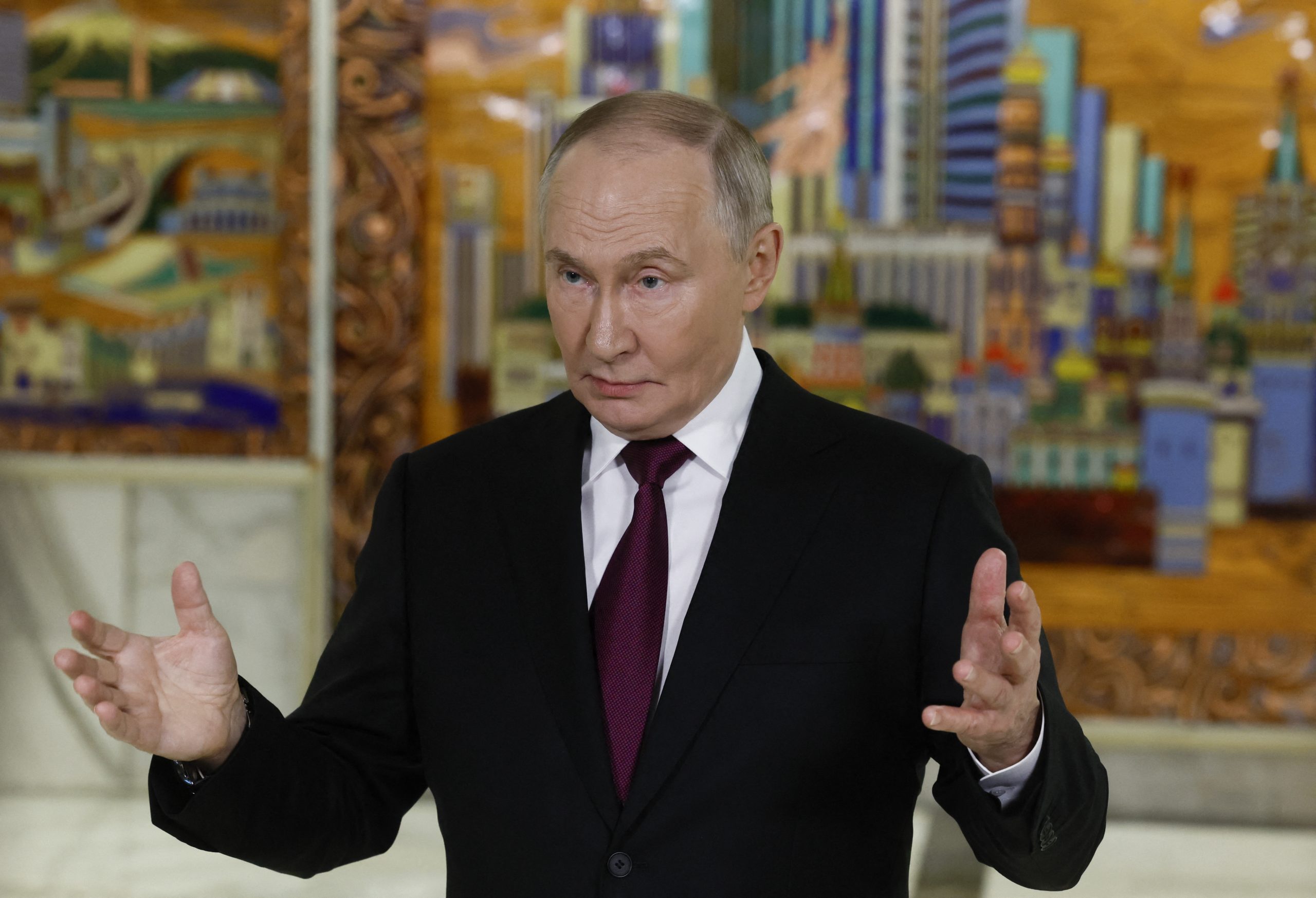
Russian President Vladimir Putin delivered a warning to Europe on Tuesday, saying his country is “ready” for war, should a new conflict erupt. Speaking to reporters at an investment forum in Moscow, Putin said he has no intentions of going to “war” with Europe, but “if Europe suddenly wants to wage a war with us and starts it, we are ready right away.”
[time-brightcove not-tgx=”true”]
He went on to say that if Europe were to start a conflict with Russia, it could well result in “a situation in which there won’t be anyone to negotiate with.”
The Russian leader also took aim at Ukrainian President Volodymyr Zelensky’s European allies, who have voiced their support in helping Kyiv achieve a dignified peace deal. Accusing Europe of hindering the U.S.-led peace proposal talks, Putin claimed Zelensky’s allies have pushed for demands that are “absolutely unacceptable” to Russia and have blocked the “entire peace process.” He doubled down on his assessment, arguing that Europeans have “no peaceful agenda.”
Putin made the comments as a U.S. delegation led by President Donald Trump’s Special Envoy Steve Witkoff waited for him in another part of Moscow to hold talks regarding the details surrounding a Russia-Ukraine peace plan. Putin, who is famed for being tardy to meetings with world leaders and representatives, arrived late in the evening for the sit-down, which also included Trump’s son-in-law, Jared Kushner. After exchanging pleasantries and formalities, the group instructed cameras to leave so that the closed-door meeting could begin. As of 1.45 p.m. ET—9.45 p.m. in Russia—the discussions were still underway.
The high-stakes meeting comes after the Trump Administration’s 28-point peace plan leaked widely on Nov. 20. Zelensky and his European allies expressed disapproval of the initial draft proposal, which sought to have Kyiv reduce its army and included a number of significant land concessions.
Read More: Putin and Trump Envoy Witkoff Meet for High-Stakes Peace Talks
Ukrainian and U.S. officials spent last week in Geneva going over a refined peace plan—the details of which have yet to be revealed. These talks were bolstered by a meeting in Florida over the weekend, which saw U.S. Secretary of State Marco Rubio lead talks opposite Ukraine’s new negotiator Rustem Umerov, who serves as the country’s National Security and Defense Council secretary. (Umerov took over the helm from Andriy Yermak, who resigned as Zelensky’s chief-of-staff last week after a raid on his home by two national anti-corruption agencies amid a widespread corruption scandal.)
Rubio told reporters after the meeting that while the sit-down was “productive,” there was still “more work to be done.” He referred to the ongoing deliberations as “delicate and complicated,” citing a “lot of moving parts” to contend with. “Obviously, there’s another party involved [Russia] that will have to be a part of the equation,” he added, having previously said that both Russia and Ukraine “must agree to difficult but necessary concessions.”
But European allies are vehemently opposed to the idea of Ukraine making land concessions—something Zelensky has also ruled out on a number of occasions. Many officials have warned that it sends the wrong message, citing Putin as the aggressor as Russia invaded Ukraine in 2022.
“We shouldn’t lose focus that it’s actually Russia who has started this war, and Russia that is continuing this war,” Kaja Kallas, the E.U. high representative for foreign affairs and security policy, told reporters on Monday. Kallas shared her fear that Ukraine could be pressured to stop the war by surrendering, something she warns would have major repercussions and is “not in anybody’s interest.”
Putin’s comments on Tuesday mirror what he has previously said when approached about a possible cease-fire or peace agreement with Ukraine.
During a trip to the Central Asian republic of Kyrgyzstan last week, Putin said pursuing any kind of peace deal is “pointless,” so long as Zelensky is in power. Celebrating Russia’s recent advancement on the battlefield, Putin asserted that “if Ukrainian forces leave the territories they hold then we will stop combat operations” but “if they don’t, then we will achieve it by military means.”
Putin’s willingness to keep fighting and his hardline that Ukraine should withdraw from territory claimed by Moscow is at direct odds with Zelensky’s vow to not concede that land. This seemingly leaves the two warring countries at a bitter impasse.
Furthermore, Putin has shown no indication that he plans to compromise. Trump previously said the Russian leader has “let [him] down” when it comes to his refusal to budge from his position. Putin and Trump met in Alaska in August for a summit that was intended to foster discussions about a path toward a potential cease-fire. But the meeting ended earlier than planned, with no deal being reached. Critics argued that Moscow left the meeting with more wins than the U.S. President.
In October, Trump and the E.U. imposed new sanctions on Russia, demanding that “now is the time to stop killing.” But the sanctions did little to stop Putin’s military campaign. In fact, the Kremlin all but dismissed the new levies, with Russia’s Foreign Ministry Spokesperson Maria Zakharova arguing that Russia has a “strong immunity” to Western sanctions.
Zelensky remains supported by his allied European counterparts, but the problem of proposed land concessions and concerns over security guarantees for the future of both Ukraine and Europe remain unresolved.
For now, the Ukrainian President has said he is “waiting for signals from the American delegation after its meetings in Russia.”
In an update shared via social media, as the talks in Moscow took place, Zelensky said the U.S. delegation is set to brief him “immediately” after the meetings end and the “next steps will depend on those signals.”
“If the signals work out in a certain way—if it is fair play with our partners—then we may meet with the American delegation very quickly. At what level, we will see,” he said, adding he is ready for a meeting with Trump, when the time comes.