

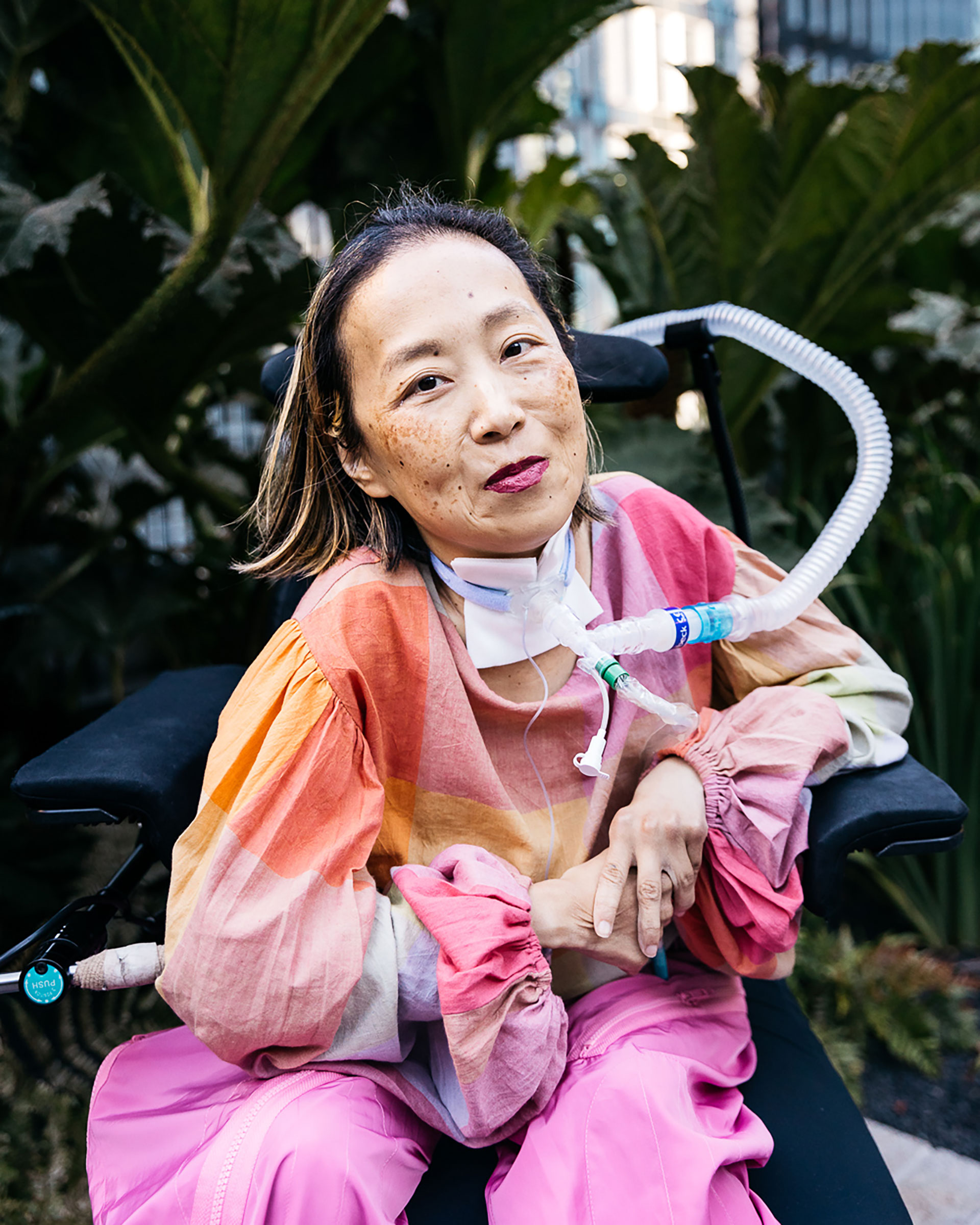
On Nov. 14, the disability justice activist, writer, and self-proclaimed cyborg Alice Wong died in San Francisco. She was 51 years old.
Down to her last words, there was always a fungibility of anger and love in the life of Alice Wong: “I’m honored to be your ancestor and believe disabled oracles like us will light the way to the future. Don’t let the bastards grind you down. I love you all.”
[time-brightcove not-tgx=”true”]
I first dove into Wong’s writings in the midst of my burgeoning disabled political identity and heavy chronic pain. Upon returning to college in 2022, I caught COVID-19 immediately for the first and second time. I felt ashamed for being angry—about the lifting of COVID-19 protocols, reactions from select students and faculty, and developing long COVID from two individuals walking around unmasked (knowingly) on the third day of their infection.
When I read Wong write “I feel very alone w/ so much rage,” I understood.
One of my last good memories from college lies in a photo of me facilitating my first-ever book club: I wore a KN95 mask, prepared to lead a discussion on the intersections of Asian American identity and disability, and excitedly held a copy of Wong’s memoir, Year of the Tiger: An Activist’s Life.
On anger
In 1974, Wong was born in Indianapolis, Ind. to Hong Kong immigrants Henry and Bobby Wong. As a young child, she was diagnosed with a form of muscular dystrophy, a neuromuscular disease that impacts one’s mobility, breathing, and muscular strength.
Her family and friends supported her dearly. Yet, when reminiscing on old photos, Wong remembers “moments of anger and frustration.” Her memoir details stories of blatant discrimination, pressure to be appreciative, encouragement to “get better,” and an Evangelical revival that ends in churchgoers fawning over her seemingly-newfound ability to take a few steps—something Wong had sans the power and spirit of the Almighty.
Non-disabled people do not expect anger. Loneliness, gratitude, and a quiet resilience are the emotions we are allowed to express. However, as Wong shared, in many tweets, blog posts, essays, and talks, “f— that s—!”
Read more: Living With Muscular Dystrophy at 50 Makes Death My Shadow Partner
Wong stayed angry, harnessing her anger and intersplicing it with, and often transmuting it into, a deep love for her communities. She writes in her memoir, “I channeled the anger and frustration that I could not articulate and understand as a child into writing and research about the disability experience as an adult. It was the beginning of my odyssey in disability research and activism.”
I refused to be alone; Wong’s discontent drove me to churn my own anger into a drive to find and take part in supporting disabled communities locally, online, and abroad.
On rights
From 2013 to 2015, Wong served on the National Council on Disability, an independent federal agency advising the U.S. government on legislation and policies that impact people with disabilities. Wong propelled disability rights and political participation by co-founding #CripTheVote with activists Andrew Pulrang and Gregg Beratan.
She recognized the material benefits of disability rights, but embedded in her work was the palpable desire to connect, reaching those who fell to the wayside of federal policies or were subject to its structural violence. Wong fiercely fought against “ableist & fascist” mask bans that limited our rights to health and privacy. She was an avid proponent for Medicaid and a proud “welfare queen.” She coordinated cross-coalitional efforts with Crips for eSims for Gaza with Jane Shi and Leah Lakshmi Piepzna-Samarasinha, and Wong saw Palestinian liberation as a disability justice issue, mobilizing her community in garnering over $3 million to help connect people living in Gaza to the Internet.
Wong insisted on an intersectional, actionable advocacy that draws from the unified anger of the disabled community, funneling rage into justice.
On connection
In the introduction of Disability Intimacy: Essays on Love, Care, and Desire, an anthology edited by Wong, she recalled seeing the question, “Can people with disabilities find love?” Wong said, “Ewwwwww,” and called it “basic AF.”
She refutes a reality where disabled people cannot experience the full breadth of love. Love can be love, can be the intimacy found in unflinchingly advocating for accessibility, can be the tendrils of care and connection made across continents, like in Wong’s most notable work: the Disability Visibility Project. Collaborating with StoryCorps, Wong created the project to record approximately 140 oral histories of disabled oracles and archive them at the Library of Congress.
Since its founding in 2014, the Disability Visibility Project has hosted essays, blog posts, interviews, and collectives on disability justice. In true Wong-ian fashion, the Disability Visibility Project has carved a home into the technical space where many disabled folks have found solace, alongside her famous X posts and Teen Vogue column, and the literature lives on in anthologies like Disability Intimacy and Disability Visibility: First-Person Stories from the Twenty-First Century. Wong’s 2024 MacArthur “genius grant” will continue her efforts to platform disabled stories well into the afterlife.
On Alice
An activist’s life is never a singularity, and Alice Wong’s legacy is everlasting. The GoFundMe page that was originally created to help with Wong’s medical expenses is now raising funds to continue her work.
In the worlds she has helped forge, there might be some cyborg-esque contraption for the disabled oracles of past, present, and future to see the care webs and ruckuses, the love and anger we nurture in their wake. I have learned from Wong that to be angry is to be unapologetically angry. Let it move us forward, metamorphose into or lay beside limitless love. In her words, “Just hang in there, keep reading, and stay angry.”