

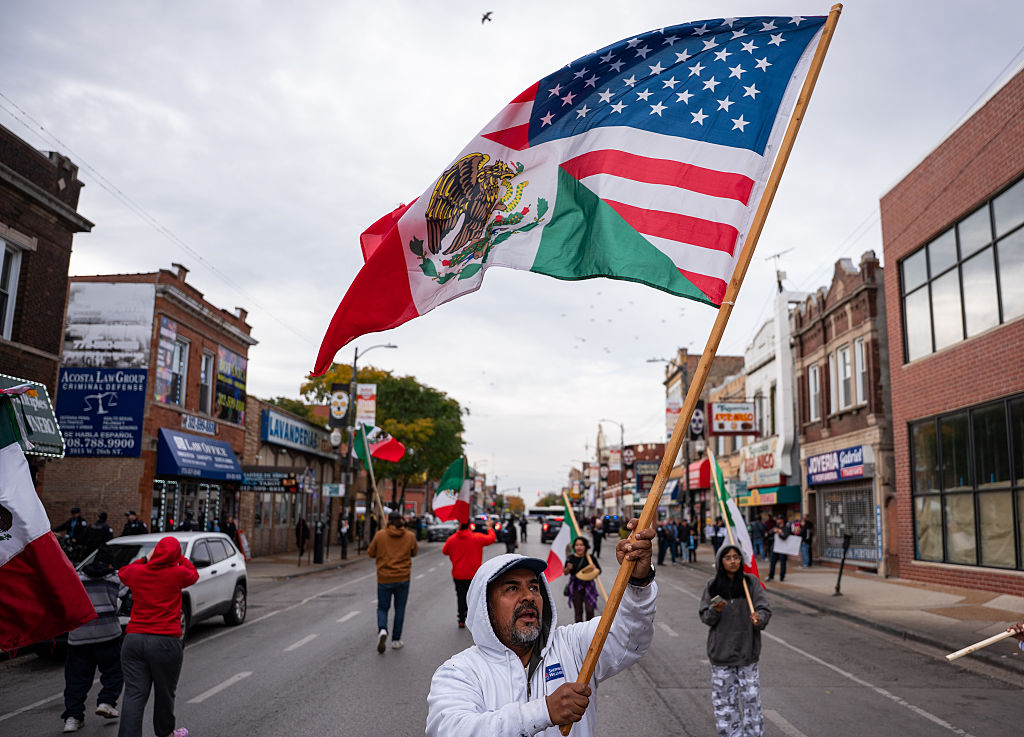
A harrowing new normal has emerged in U.S. immigration enforcement. The chase-down of immigrants, traditionally a tactic employed by the Border Patrol in remote borderlands areas, is now a blunt national strategy deployed by the federal government in America’s most populous cities. ICE agents conducting surprise raids and brutal arrests have rapidly become the symbol of an immigrant purge.
[time-brightcove not-tgx=”true”]
Critics have called for ICE agents and other federal officers to drop their masks so they might be known and accountable to the public. But Trump’s hot pursuit of immigrants in American cities requires an unmasking not only of ICE operatives, but of the flimsiness of his narrative. Contrary to Trump Administration messages, there is no “invasion” necessitating the widespread suspension of basic civil liberties.
During Trump’s clampdown, Mexican communities in Chicago and Los Angeles have emerged as notable targets. But Mexican migration, far from being an invasion, proceeds from an invitation eagerly extended by the United States to Mexican migrants to address its farm labor shortage during and after World War II.
The U.S. federal government insisted on access to Mexican migrants, even when Mexico began to seriously question whether the exodus was desirable and piloted measures to impede it. Long before ICE persecuted migrants on the streets of America’s most iconic cities, the United States openly pursued them as its laborers of choice.
For more than two decades after WWII, the United States beckoned Mexicans to move north to work in American agriculture. To facilitate this migration, the United States formally enlisted the cooperation of the Mexican government, which was to recruit Mexican men and transport them north, proceeding from the understanding that migrants were to be guaranteed certain baseline wages, housing, and food provisions. The treaties outlining this cooperation between the U.S. and Mexico came to be known as the Bracero Program. All told, it brought over four million Mexicans to the United States between 1942 and 1964.
Read More: America’s Border Wall Is Bipartisan
Farmers argued such a program was necessary—at first because World War II shrank the domestic labor pool, as 16 million American men were deployed to fight Nazi Germany and Japan. But once the war ended, farmers emphasized a different rationale to keep the program going: farm labor jobs were so demanding—the hours, the climate, the constant stooping—that white Americans would never fill them. Their economic destiny, amid the U.S. post-war boom, was to join the expanding middle class, ensconced in proliferating suburban developments. Mexicans, on the other hand, were framed as being especially suited to arduous toil.
In reality, growers were attracted to the cost structure of institutionalized Mexican migration. Mexico took care of conveying migrants to the border, sparing growers expenditures on labor recruitment and transportation. Growers were also seduced by the disciplining power they gained. Migrants who engaged in labor organizing could be summarily deported back to Mexico, meaning growers could exploit migrants with less fear it might lead to labor unionism. Millions of migrants subjected themselves to this system to experience life in the United States and earn their livelihood in dollars.
Just as the United States has toggled back and forth between accepting immigrants and rejecting them, the Mexican government has also flip-flopped between enabling out-migration and restricting it. Mexico was initially on board with conveying migrants to the United States, expecting certain payoffs, including the prestige of contributing to the Allied war effort in WWII.
But by the mid-1950s, Mexican leaders could see the experiment had backfired. Far from elevating Mexico’s image, migrant workers evoked lamentable headlines in both the United States and Mexico. They were routinely mistreated by employers who flouted wage, food, and housing guarantees. “Like Animals,” announced one Mexican newspaper, describing how Mexican migrants were treated. In Mexico, the misery of migration was crystallized in popular movies such as Espaldas Mojadas and songs such as “El Canto del Bracero,” which underscored the social marginalization and labor exploitation faced by Mexicans abroad.
Bothered by such press, Mexico refused to renew the Bracero Program in 1954. It demanded significant concessions from the United States to resume diplomatic conversations—chiefly, the authority to block abusive farmers from receiving workers without waiting for lengthy investigations and U.S. approval. Under President Adolfo Ruiz Cortines, Mexico began to experiment with policies to employ Mexicans internally instead. Mexican officials circulated policy proposals, penned editorials, and delivered remarks extolling possible paths to prosperity without emigration, including the formation of state-supported agrarian settlements for migrants and their families within Mexico. President Ruiz Cortines, in a moment of chest-thumping nationalism, proclaimed his government’s newfound rallying cry: “the braceros of Mexico for the fields of Mexico.”
The United States and growers, especially those in Southern California, grew concerned. Mexico not only refused to renew the Bracero Program and sanction out-migration—it actively policed the exit of Mexicans at border checkpoints, barring Mexicans from leaving and guarding them with military personnel. While Mexico completed its about-face on migration, California’s lettuce crop rotted due to a lack of farmhands.
In desperation, the U.S. Department of Labor decided to jettison Mexico’s involvement in migration altogether. It initiated a program of “unilateral hiring” to bring Mexicans to the United States. and save the lettuce crop. The DOL called on Mexican migrants to make their way to the border and into the United States, promising that jobs awaited them. Mexican officials decried this as an “open border” policy that invited migrants to trample over Mexico’s dictates.
Thousands arrived at border crossings, especially the Mexicali–Calexico crossing leading to Southern California. They overwhelmed Mexican forces stationed there. Mexican federal envoys pleaded with migrants to return home, promising eventual resettlement within Mexico, but failed to convince them. Instead, for days, migrants tussled with Mexican soldiers and auxiliary police officers, demanding to be let go, to enter the United States. Reports surfaced of soldiers beating migrants and even shooting at them. Mexico’s willingness to explore counter-migratory politics soon dissipated.
For Mexico, the embarrassment of mass out-migration was worsened by the humiliation of Mexican citizens openly rejecting its protectionism. The government adopted the position that if Mexicans wanted to leave, it was their prerogative. It assented to the U.S. proposal to move past the incident and simply renew the Bracero Program.
Read More: Rural America’s Revival Depends on Immigrants
By strategically manipulating its border policy, the United States managed to keep unfettered access to the highly desirable Mexican labor pool. More importantly, it disciplined Mexico against seeking to foment fixity. The Mexican government would never again explore counter-migratory policies with similar verve, understanding that U.S. access to Mexican labor was off limits.
Ever since, the United States has exerted great latitude in its manipulation of Mexican movement. Again in 1954, just months after it opened its borders to Mexican workers, it launched a campaign dubbed “Operation Wetback” to round up undocumented migrants. It was a farce, defined by overinflated numbers and sensationalized images of captured immigrants crammed into buses and trains. Its aim was to reassure Americans that the U.S. Border Patrol remained serious about controlling arriving immigrants. However, the United States’ truest nature—its reliance on foreign labor—was revealed in its earlier siren call to Mexican migrants who answered it despite the opposition of the Mexican government.
Trump often speaks admiringly of Operation Wetback. This selective remembering of 1954—the emphasis on the U.S. as protector of its borders, rather than on its involvement in securing Mexican labor to begin with—sidesteps a deeper truth. Migration control is illusory so long as employers who seek a foreign workforce—whether as guest workers or undocumented laborers—escape the scrutiny that migrants face daily.
From the 1950s to today, U.S. immigration restriction has contented itself with sporadically intimidating migrants; all the while, employers, thanks to their lobbying power, have remained relatively untouchable.
In Trump’s view, poorer nations manipulatively dump their people into the United States. But, while the United States was able to bend Mexico to its will in the mid-20th century, the truth is more resilient. Mexican immigration flourished with the encouragement—indeed, the insistence—of the United States. To pretend otherwise is to feign shock at a harvest it intentionally planted and from which it has continually reaped rewards.
Irvin Ibarguen is an assistant professor of history at New York University and the author of Caught in the Current: Mexico’s Struggle to Regulate Emigration, 1940-1980.
Made by History takes readers beyond the headlines with articles written and edited by professional historians. Learn more about Made by History at TIME here. Opinions expressed do not necessarily reflect the views of TIME editors.