

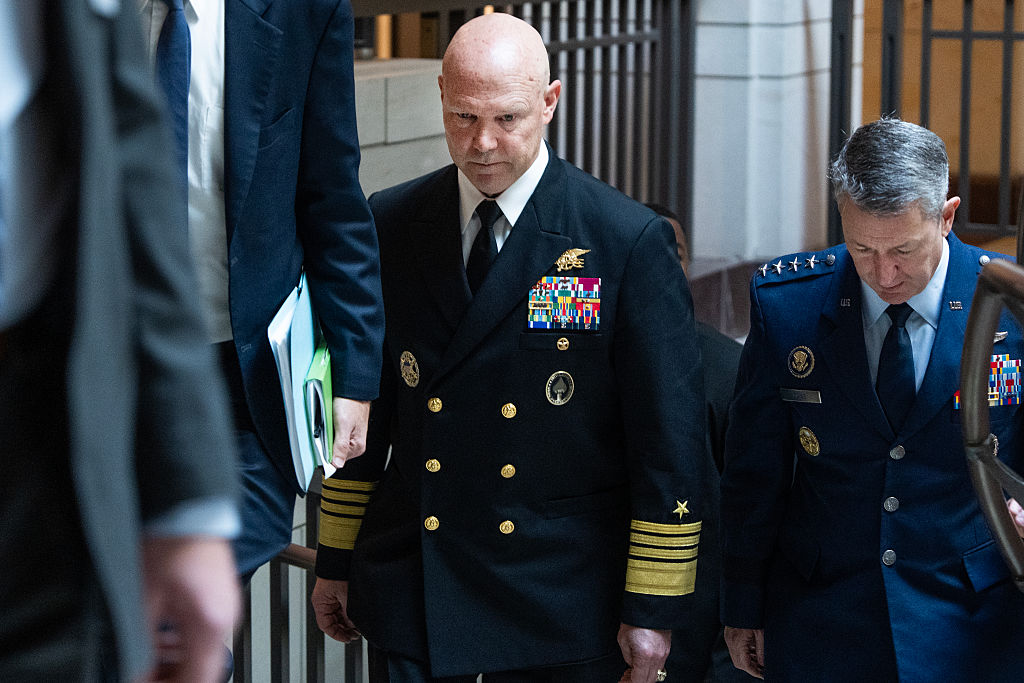
Lawmakers struck starkly different tones in their initial remarks after emerging from a classified Thursday briefing by the U.S. Navy Admiral who reportedly ordered a follow-up air strike targeting the survivors of an attack against an alleged drug boat in the Caribbean.
[time-brightcove not-tgx=”true”]
Senate Armed Services Committee Ranking Member Jack Reed, a Democrat of Rhode Island, said in a statement to TIME that he was “deeply disturbed” by what he saw at the briefing. “The Department of Defense has no choice but to release the complete, unedited footage of the September 2nd strike, as the President has agreed to do,” he added. “This must and will be the only beginning of our investigation into this incident.”
“What I saw in that room was one of the most troubling things I’ve seen in my time in public service,” Democratic Rep. Jim Himes of Connecticut, the ranking member on the House Intelligence Committee, told reporters.
Republican lawmakers who attended the briefing, however, expressed very different sentiments. Committee Chairman Rick Crawford, Republican of Arkansas said that he was “confident” in Defense Secretary Pete Hegseth and “satisfied” after the briefing. Republican Sen. Tom Cotton of Arkansas, chairman of the Senate Intelligence Committee, called the military actions “righteous strikes.”
“I didn’t see anything disturbing about it,” Cotton added.
A select group of lawmakers, including the leaders of the Armed Services and Intelligence committees in the House and Senate, were briefed about the controversial Sept. 2 attack, in which Adm. Frank M. “Mitch” Bradley, a Navy SEAL officer with decades of experience who now leads U.S. Special Operations Command, reportedly approved a second strike against a Venezuelan vessel that allegedly carried drugs and cartel members after a pair of survivors from the first strike were seen.
Read More: White House Confirms Second Strike on Alleged Drug Boat and Defends Move as Legal
After reviewing footage of the attack, Himes said that any American who sees the video without having “the broader context” will see “the United States military attacking shipwrecked sailors.”
“You have two individuals in clear distress, without any means of locomotion, with a destroyed vessel, [who] were killed by the United States,” the Connecticut congressman said, though he acknowledged that “there’s a whole set of contextual items” that Bradley explained. “Yes, they were carrying drugs. They were not in the position to continue their mission in any way,” Himes added.
The Trump Administration has not publicly provided evidence for its claims that the vessels targeted in the U.S. military’s attacks in the Caribbean in recent months were carrying drugs or operated by cartels the country has designated as terrorist organizations. But lawmakers who were at the Thursday briefing said officials confirmed that the boats had narcotics aboard.
The White House on Monday admitted that Hegseth authorized Bradley to launch the strikes on the boat after The Washington Post reported that the Defense Secretary ordered armed forces to kill everyone aboard the alleged drug vessel in early September, leading the commander to order the second attack that killed survivors of the first.
But Himes said that Bradley had informed legislators that there was no order to kill all of the people aboard the ship or to give them no quarter.
Cotton said that Hegseth gave “no such order”—either in writing or vocally—to “kill them all” as described in the Post story.
White House Press Secretary Karoline Leavitt and Hegseth have both defended Bradley’s decision to carry out the follow-up strike amid criticism. “Admiral Bradley made the correct decision to ultimately sink the boat and eliminate the threat,” Hegseth said on Tuesday. “He sunk the boat, sunk the boat, and eliminated the threat. And it was the right call. We have his back.” Leavitt said on Monday that Bradley was working “well within his authority and the law,” when he ordered the second strike.
Those comments appeared to contradict remarks made on Sunday by President Donald Trump, however, who told reporters on board Air Force One that he would not have wanted a second strike. “The first strike was very lethal, it was fine, and if there were two people around—but Pete said that didn’t happen. I have great confidence in him,” the President added.
Read more: How Pete Hegseth’s Account of a Deadly Strike in the Caribbean Keeps Changing
Congressional lawmakers from both sides of the aisle have condemned the decision and called for a bipartisan investigation of the early September strikes. Democratic Sen. Richard Blumenthal of Connecticut called the attack a “criminal offense.”
“War crimes or murder are criminal offenses,” Blumenthal told TIME earlier this week. Referring to the Defense Secretary’s role in the strikes, he said, “Hegseth doesn’t have the immunity that the President of the United States does.”
Experts previously told TIME that if the Post’s reporting on the Sept. 2 strikes is accurate, Hegseth could be found legally culpable of “murder” and a “war crime.”
“It is absolutely unlawful to order that there will be no survivors,” said Cardozo Law School professor and expert in international law Rebecca Ingber. “There is no actual armed conflict here, so this is murder.”
More than 80 people have been killed in the series of U.S. strikes on alleged drug vessels since they began in early September in what the Trump Administration has characterized as an effort to stop the flow of illegal drugs into the country.
Amid the strikes, the U.S. has also amassed a significant military presence in the region, exerting pressure against Venezuelan President Nicolás Maduro, who the Administration has called “illegitimate” and accused of leading a criminal network involved in drug trafficking along with other high-ranking Venezuelan officials. Maduro has denied any ties to the illegal drug trade.
Tensions between the two countries are continuing to mount as Trump this week said he could launch land strikes against Venezuela “very soon.”
“You know, the land is much easier,” Trump told the press during a Cabinet meeting when asked about a potential attack on Venezuela. “We know the routes they take. We know everything about them. We know where they live. We know where the bad ones live. And we’re going to start that very soon, too.” The President added that any country where drugs are trafficked or produced could similarly be subject to strikes.
Last month, the U.S. sent its most advanced aircraft carrier, the USS Gerald R. Ford, to the Caribbean. Other military warships, a nuclear submarine, and F-35 jets were already in the region. The Venezuelan government, which has alleged that the U.S. is seeking regime change in the smaller Latin American country, is preparing for a potential attack from the military superpower.
Nik Popli contributed reporting.