

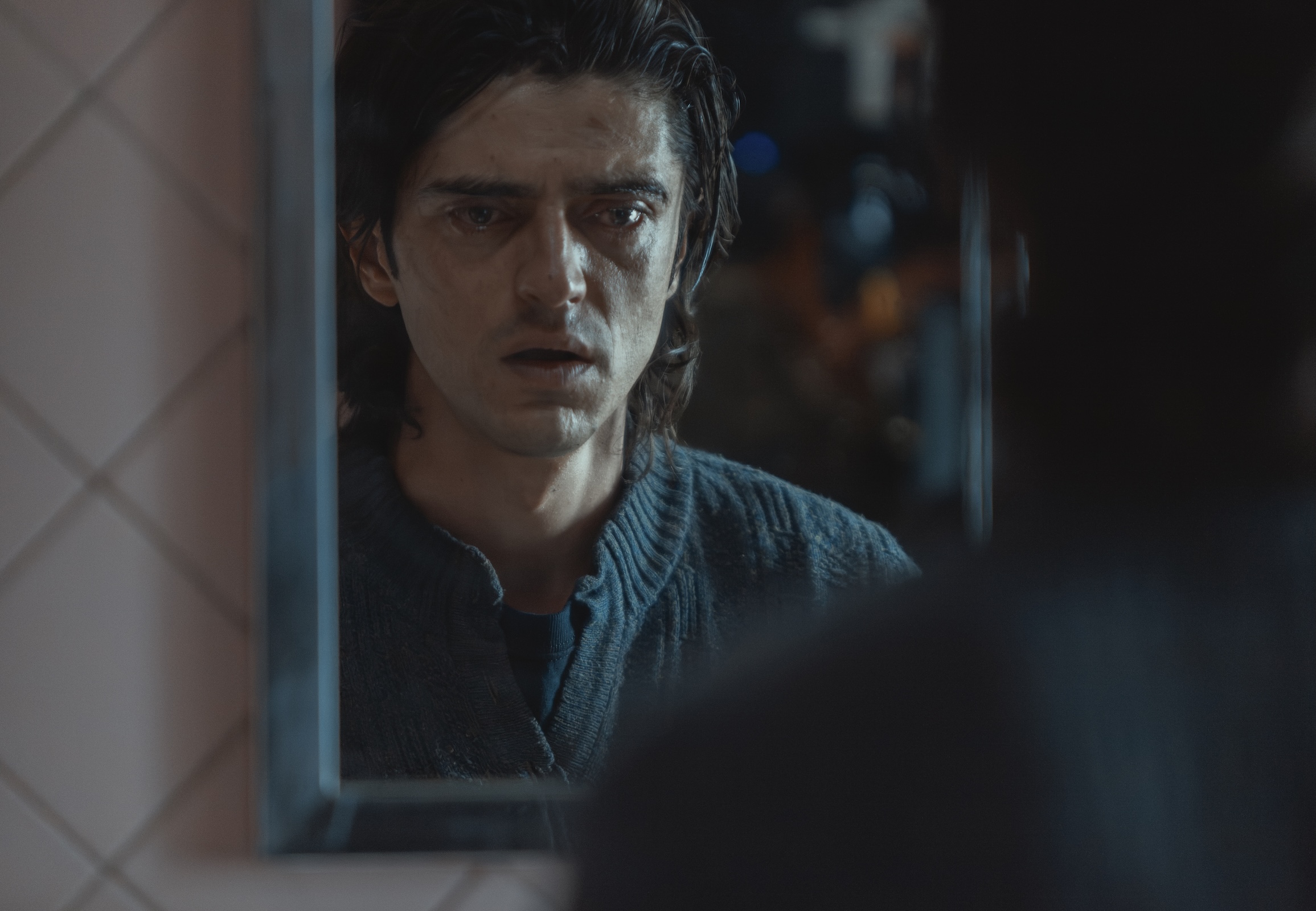
On Dec. 4, 1986, Colombia was shaken by one of the deadliest mass killings in the country’s history. In just a few hours, former Vietnam War veteran Campo Elías Delgado murdered his mother, several neighbors, and multiple people inside the Italian restaurant Pozzetto, turning an ordinary evening Bogotá’s Chapinero district into a scene of horror.
[time-brightcove not-tgx=”true”]
Netflix’s limited series Fugue State 1986 (Estado de fuga 1986), premiering 39 years after the massacre on Dec. 4, revisits the tragedy through fact and fiction. Rather than reconstructing the murders’ timeline, the series focuses on the fraught friendship between Jeremías Salgado (Andrés Parra)—a character inspired by Delgado—and literature student Camilo León (José Restrepo), who becomes a key witness to what occurs in the days leading up to the killings. Carolina Gómez stars as Indira Quinchía, an investigator determined to uncover the crime’s motives.
Written by Ana María Parra under the supervision of Colombian author Mario Mendoza, who knew Delgado personally, and directed by Carlos Moreno and Claudia Pedraza, the series is anchored in two truths: the massacre itself, and the fact that Delgado was studying at a Bogotá university in the months leading up to it. From there, everything else is fiction. “We knew we didn’t want to narrate it from the perspective of the perpetrator of the massacre, but rather through someone who had known him: León,” says Parra. “And from that closeness between the two, León begins to ask the same question we all had: why does someone commit a crime of this nature?”
Here’s to know about the real events behind Fugue State 1986.
What happened on Dec. 4, 1986
The killing spree began early on Dec. 4, 1986. That morning, Campo Elías Delgado visited a 15-year-old student to whom he gave English lessons. Without warning, he shot the girl and her mother. He then went to the apartment he shared with his own mother, murdered her, and set her body on fire using alcohol and newspapers.
As smoke filled the hallway, Delgado knocked on neighbors’ doors, warning them about “a fire.” The six people who opened their doors—simply trying to respond to the emergency—were shot dead.
Hours later, he entered Pozzetto, a well-known Italian restaurant in the Chapinero district, carrying a briefcase filled with ammunition. He sat at table number 20, ordered spaghetti and some drinks, and ate calmly. When he finished his drink, he stood up, drew his revolver, and opened fire on diners. Panicked customers threw themselves to the ground; many hid under tables. Delgado died at the scene, but the circumstances of his death remain uncertain. It is unclear whether he was killed in a shootout with police or if he took his own life.
The final death toll: 29 people. In the Netflix series inspired by these events, the ending note reads: “On December 4, 1986, Campo Elías Delgado, a Vietnam War veteran studying languages, killed 29 people, including his mother, in Bogotá, Colombia, within 24 hours. To this day, the killer’s body is still missing, and key documents relating to the case are either lost or inaccessible.”
The man behind the massacre
Delgado was born in Durania in 1934, the son of Rita Elisa Morales. As a child, he was traumatized by his father’s suicide and reportedly blamed his mother for the tragedy. Delgado later joined the United States Army and served in the Vietnam War.
At the time of the massacre, Delgado was 52-years-old. His life was marked by trauma, isolation, and a relentless search for belonging. For a time, Delgado also pursued studies at the Pontificia Universidad Javeriana—where he crossed paths with Mario Mendoza, the executive producer and script supervisor of Fugue State 1986.
“It was very important for us to keep one aspect of the real-life person and transfer it to the fictional character: his loneliness, his isolation, his spiritual exile,” says Mendoza. “As a soldier, he took part in one of the cruellest wars in history, the Vietnam War. Most of those soldiers returned with post-traumatic stress disorder and reintegrating into social life was not easy, even impossible in many cases.”
Delgado also carried a profound desire to belong, a trait that the series carefully translated into Jeremías Salgado’s character, according to the Colombian author. “This is noticeable in many moments of our character’s intimate life, in his work at the newspaper and at the university where he studies,” says Medoza. “He is a lone wolf not because he is being true to his nature, but because he has to be. That small detail gives a particular complexity to the character that was very important for the entire team.”
What’s real—and what’s fiction
While the series is inspired by the real-life massacre and the killer’s final 24 hours, much of the story explores the imagined months leading up to it. “It fictionalizes the four months prior to the fact, in which Jeremías’ life and his relationship with León is uncovered,” says Parra. “In real life, Campo Elías was a student at the same university where I went to and where Mario Mendoza was my literature professor.”
Based on that small and little-known connection, they built the friendship between Jeremías and a young man who is just beginning to make his way as a writer, a world that was familiar to both Parra and Mendoza. “That is why the starting point of this entire fictional narrative is the fact that the killer and the witness to his life share a passion for literature,” she says.
The massacre also inspired Mendoza’s 2002 novel Satanás. “I sought to portray the bleak, apocalyptic atmosphere of Bogotá,” he says. “The mere fact that I studied at the same university as the killer and even shared bibliography with him for our respective thesis projects inevitably placed me in a close point of view to the murderer.”
The social and historical context behind the series
Fugue State 1986 goes beyond the massacre, showing the historical environment that shaped its characters. For Mendoza, understanding Bogotá in the 1980s was essential: “The writing team spent a lot of time studying the ‘80s. That entire unhealthy atmosphere, this pervasive and toxic environment, permeates the series.”
In 1985, a year before the massacre, the M-19 guerrilla group seized the Palace of Justice in Bogotá. The military response was violent, resulting in the deaths of judges, hostages, and combatants, and marked a period of intense political tension in Colombia.
The widespread violence and political instability directly influence Jeremías and León’s psychology. “In our story, the 1980s are not just a backdrop or a historical set piece, they are embedded in the characters’ psychology: in the everyday violence they live with, in the sense of hopelessness, in the way they relate to a city and a country where violence repeats itself in a vicious cycle,” says Parra. “The atmosphere of the ’80s doesn’t just surround the characters: it defines their state of mind.”
According to Mendoza, the context also invites social reflection: “There is a concept known as Amok Syndrome, which means that the individual has been pushed to the brink by an entire society that mistreats, insults, segregates, and repeatedly demeans him. This does not excuse him nor lessen his responsibility for the crimes committed, but it does prompt a re-examination of the behavior of those around them, that is, all of us,” he says. “Colombia is a country still at war, and we have inherited this violence from one generation to the next. We hope the series helps spark reflection on these traumas that have cascaded down onto each of us.”