

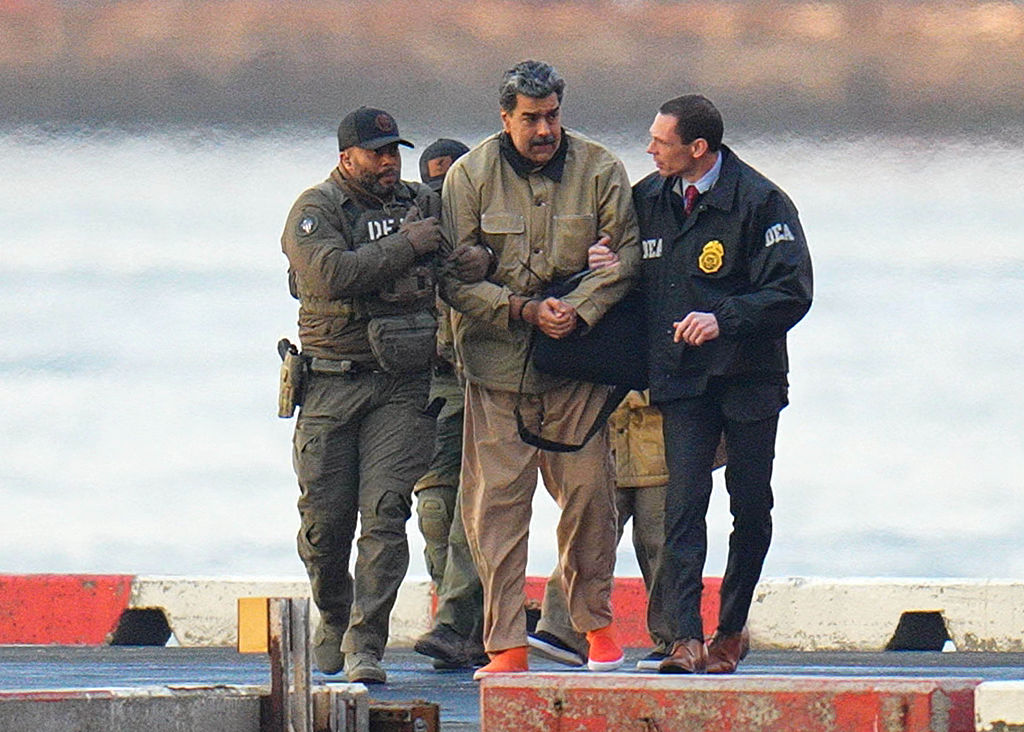
Americans are torn over the aggressive U.S. military operation that resulted in the capture of Venezuelan President Nicolás Maduro, early polling suggests.
Only about a third supported the operation, according to a Reuters/Ipsos poll conducted Sunday and Monday. The poll also found that 72% of respondents feared that the U.S. would become overly involved in Venezuela as a result of the attack.
[time-brightcove not-tgx=”true”]
But poll respondents were split along party lines. About 65% of Republicans approved of the military intervention, whereas only 11% of Democrats and 23% of independents did.
Other polls showed a similar partisan divide. About 66% of Republican respondents in YouGov surveys completed in the 48 hours after Maduro was captured said they strongly or somewhat supported the U.S. using military force to capture Maduro, compared to just 14% of Democrats and 27% of independents. Overall, about 36% of adults approved of the operation and 39% opposed it, the surveys found. About 25% said they were unsure how they felt about the strike.
And Americans were split over whether the operation would improve the situation in the South American country: 34% said yes, while 35% said it would worsen the political climate there.
The Saturday attack came after months of pressure by the Trump Administration against Maduro’s government over allegations of drug trafficking. The U.S. operation—the largest of its kind in Latin America since the 1989 invasion of Panama—stunned lawmakers and the public. The Trump Administration has heralded the military action as a victory, but it has drawn outcry from global leaders. A spokesperson for the United Nations Human Rights office said on Tuesday that the operation has made “all States less safe around the world.” Several Democratic lawmakers have called for President Donald Trump’s impeachment in the aftermath of the attack.
Trump’s assertion following the operation that the U.S. would “run the country” until a “proper and judicious transition” of power takes place also sparked controversy, as did his decision to name Delcy Rodríguez, who served as Venezuela’s vice president under Maduro beginning in 2018, as the most likely candidate to take over governing the country, while distancing himself from Venezuelan opposition leader María Corina Machado. Rodríguez was formally sworn in as the nation’s interim president on Monday.
Read More: How the World Is Reacting to the U.S. Capture of Nicolas Maduro
A poll conducted by journalists at The Washington Post who texted more than 1,000 Americans to ask them for their thoughts on the attack yielded results similar to the Reuters/Ipsos and YouGov surveys: About 40% approved of the U.S. using military force, while 42% opposed it and 18% said they were unsure how they felt about it. Results again differed based on political affiliation: 74% of Republicans approved, compared to 13% of Democrats and 34% of independents.
But the majority of Americans—63%—said that the attack should have required congressional approval, according to the Post’s poll. Those reactions were again split along party lines, with only 24% of Republicans saying that the Trump Administration should have gotten congressional approval to embark on the operation, compared to 94% of Democrats and 70% of independents.
Democratic lawmakers have condemned Trump for not getting authorization from Congress to launch the attack.
“I cannot stand by as my Republican colleagues allow President Trump to defy the rule of law, repeatedly overstep the authority of Congress and undermine our national security and the well-being of my fellow Americans,” Rep. April McClain Delaney of Maryland said in a statement on Monday. “Over the weekend, we saw the President—without authorization or approval from Congress, as required by our Constitution—launch an attack on Venezuela and voice his intention to ‘run’ the country.”
The Post also found that about half of Americans felt that the U.S. should try Maduro for drug trafficking charges. Maduro pleaded not guilty to charges including narco-terrorism and conspiracy to import cocaine on Monday. Appearing before the New York court, he called himself a “decent man” and “a prisoner of war.” His next court appearance is scheduled for March 17.