

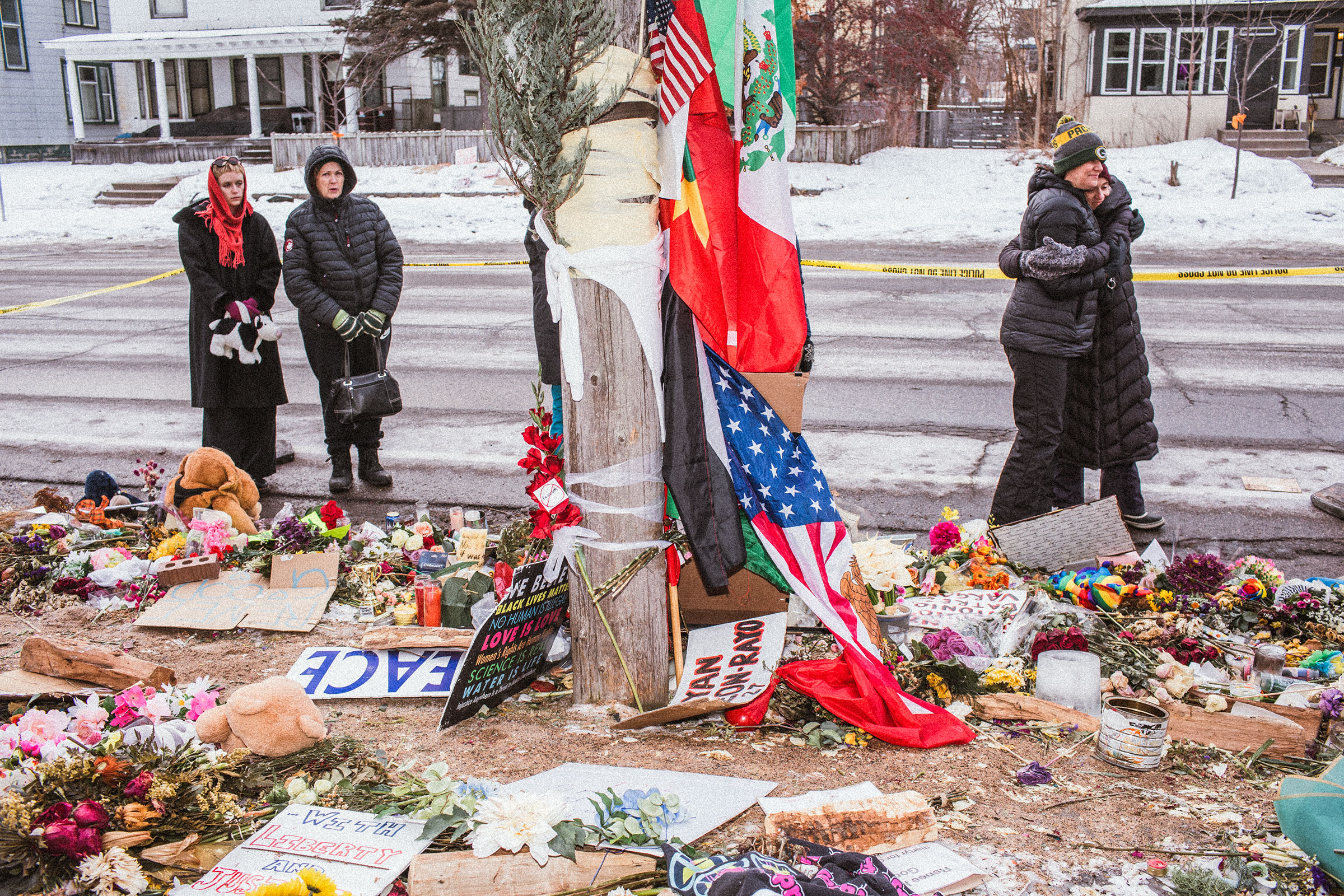
The memorial for Alex Pretti, who was shot and killed by federal agents on Jan. 24, has grown to span several parking spots on Nicollet Avenue in the Whittier neighborhood of Minneapolis. It’s now a mountain of carnations, prayer candles, poems, and notes. One message pleads: “America, do not let their deaths be in vain – We the People.”
[time-brightcove not-tgx=”true”]
Alex Hand, a 40-year-old caregiver, knelt down to place a bundle of lilac and maroon satin flowers at the site on a recent morning. “Alex Pretti stood up for what is right,” she says as a tear begins to freeze on her cheek. “He stood for all of us.”
Hand’s husband, John Holman, a gallery guard at the Minneapolis Institute of Art, draped an arm around her. Holman had run over the day of Pretti’s killing, joining hundreds in the street. The crowd swelled enough that agents used tear gas and a percussion grenade to try to clear the area. Holman briefly lost his hearing. “What’s happening here is the antithesis of what Minneapolis is about,” he says. “But the response? I couldn’t be prouder of my city.”
Over the past eight weeks, as Operation Metro Surge brought 3,000 federal agents to Minneapolis, residents have marched in the cold, monitored school drop-offs and pick ups, and held fundraisers for families who aren’t showing up for work and the immigrant-owned businesses without foot traffic. Signal groups set up to monitor suspected ICE movement ding every few minutes. “Two cars with no plates idling,” someone says. “I’ve got eyes on the white Chevy,” another reports.
“I’m 64-years-old and I just bought my first gas mask,” Lori Gesch tells me outside of the Whipple Federal Building, where the retired grandmother has been protesting several days a week.
The number of federal agents in Minneapolis will soon decrease, border czar Tom Homan announced Thursday. But the operation, which he called “effective,” but not “perfect,” remains in place. “We are not surrendering the president’s mission on a mass deportation operation,” Homan said.
Minneapolis has been through more in the last six years than a city should have to bear. This is the same community that demonstrated after George Floyd’s murder, shared heartache after a political assassination in the nearby suburbs, and mourned after a school shooting at Annunciation Catholic School last summer.
“This is a group of people who know they have to rely on each other to get through winter alive,” former Minneapolis mayor Betsy Hodges says of the city’s resilience. “I think that does a little something for a community’s resolve.”
At Javier Perez’ taco shop in the southeastern part of the city, the door stays locked as a precaution to protect customers. ICE has shown up twice in the last two months. They left after Perez, a U.S. citizen, showed his passport. His small business has taken a major hit, putting financial strain on his family. “Last week, one day I made $82,” he says as he prepares a pork-shoulder pozole.
Luis Carlos, who runs the adjoining Ecuadorian grocery, has a work permit but worries that’s not enough given the seemingly indiscriminate stops and arrests he says he’s seen ICE make. He inherited the store from his mom, who died in 2023 of cancer. Her smiling photo hangs over the register. “I feel like I’m in jail, because I’m in the store all day and then I drive home a few blocks down the street,” says Luis Carlos, whose last name TIME is withholding because he fears being targeted. In what feels like a past life, Luis Carlos organized children’s talent shows in the community.
Amanda Otero’s school pick-up and drop-off routine has gotten more complicated in the last two months. She’s using her gray Subaru to shuttle her kids and several others in the neighborhood whose parents are trying to avoid federal agents. Otero, a co-executive director of TakeAction Minnesota, a grassroots social-justice advocacy group, works with more than 1,000 volunteers on “sanctuary school teams.” At her daughter’s elementary school, the group is helping about 50 families with rides, groceries, and money to pay rent.
“I’m a community organizer. My work is helping people find ways to take action. But I am overwhelmed,” Otero says. “That’s more people taking action and organizing than I’ve ever seen in my lifetime.”
Daniel Hernandez and Viviana Salazar, community organizers in North Minneapolis, are trying to help prepare families for those scenarios. They assist parents in signing DOPAs, or Delegations of Parental Authority documents, which create a custody plan should a family be separated.
On a recent Tuesday, Hernandez and Salazar pull up to a ranch in the suburb of Columbia Heights to help a family execute a DOPA. Rosalia and her son Sammy—TIME is using their first names to protect their identities—have been living here since raids in their southern Minneapolis neighborhood became too frequent. (Renee Good was shot just a few blocks away.)
The White House estimates ICE has detained more than 3,000 people in Minneapolis since the start of Operation Metro Surge in early December. Many of them have children, who are now left without a guardian.
Rosalia is undocumented, though she’s lived in the U.S. for 28 years. Her son, who goes by Sammy, was born here. The family patriarch died six years ago, so now it’s just the two of them. Sammy’s an upbeat 23-year-old who loves football and playing drums at church. He has physical disabilities which have required more than 30 surgeries, most recently in December. Rosalia fears taking him to appointments and has relied on church friends and neighbors to do so.
At the kitchen table, Hernandez explains the DOPA paperwork, and Rosalia designates her pastor as the person to care for Sammy if she’s taken away. Afterward, the weight of what she and her son have prepared for settles in. “I would just like for this to end,” Rosalia says in Spanish, tears in her eyes. “There’s so many people suffering, there’s so many families separated.”
Sammy sits in an armchair by the window quietly listening to his mom. There’s a powerlessness he feels even after being proactive and making a plan. “It’s good, but at the same time it’s scary because she’s been with me all my life,” Sammy says.
Back in the car, Hernandez collects himself. The stop marked one of more than 100 DOPAs he’s helped families sign in the last week. “The trauma is unbelievable,” he says. “I do it to protect the kids, but also to take away the burden and anxiety from the parents.” Hernandez is a citizen, a business owner, and a father of two. His daughter asked him recently why she had to bring her passport to elementary school with her.
“A 9-year-old asked me that,” Hernandez says. “In the United States of America.”